In short
- Letterbox fishing means taking something through a letterbox opening with wire, a hook, a coat hanger or a bent tube.
- The Dutch Police Quality Mark for Secure Housing (Politiekeurmerk Veilig Wonen) describes it as pulling the door handle down through the letterbox.
- Variant two is fishing post back out: in Amsterdam in November 2024 it involved credit cards and PIN codes.
- There are no Dutch figures: the police, CBS (Statistics Netherlands) and insurers publish no numbers.
- Dutch law requires a slot of at least 265 by 32 mm, with no maximum: Postregeling 2009, article 6, paragraph 3.
- According to manufacturers, EN 13724 requires protection against unauthorised removal up to 680 mm from the base.
- What works: keys out of the hallway, a thumb turn instead of a lever handle, parcels behind a locked door.
Letterbox fishing means reaching through the letterbox opening with a wire, a hook, a coat hanger or a bent metal tube and taking something: the door handle, the inner cylinder, a key lying on the cabinet in the hallway, or the post that has just dropped behind the flap. What stops it is not a miracle cure but a chain of four things: keys out of reach, a thumb turn instead of a lever handle on the inside, an opening that does not point towards the lock, and parcels that sit behind a locked door rather than on the doorstep.
Below you will find what the police actually write about it, what the European letterbox standard EN 13724 does and does not require, which constructions manufacturers really build in and what they call them, and why not a single figure on letterbox fishing exists in the Netherlands. We make parcel letterboxes in our own factory, so we read standards, guidelines and manufacturer specifications anyway. A webshop that resells boxes has never had those documents in its hands, and so it simply repeats what the previous webshop wrote on this subject. Where a source is missing, we say so plainly below, along with the name of the place where we looked. The rest of this knowledge base is on the BunnyBox knowledge base.
- 32 mmLegal minimum height of the clear posting opening in the Netherlands, Postregeling 2009 article 6 paragraph 3. No maximum is given.
- 680 mmDistance from the base within which, according to Max Knobloch and frabox, EN 13724 requires protection against unauthorised removal.
- 8 NMaximum force that may be needed to fully open the self-closing drop flap, according to summaries of EN 13724.
- 0Dutch figures on letterbox fishing from the police, CBS, municipalities and insurers. We did not find a single number.

What is letterbox fishing?
Letterbox fishing (in Dutch: hengelen) is a burglar's term. It describes an action: pulling towards you, through the letterbox opening, something that lies within reach on the other side. The Dutch Police Quality Mark for Secure Housing lists fishing on its page of burglary methods and writes, word for word: "The burglar pushes a piece of wire or a coat hanger through the letterbox. He then tries to use it to pull the door handle down." That is the sharpest Dutch description there is, and it is also a useful narrowing: in this definition it is not about keys and not about post, but about operating the handle.
The British supplier Global Door described it more broadly on 19 September 2014 as pushing "a rod and hook or arm and stick through the letter plate in order to steal something in reach". Putting those two descriptions side by side is exactly what this subject needs. One is about operating a lock, the other about taking something. In everyday Dutch the two get mixed up, and that is why discussions about anti-fishing protection so often go nowhere.
The tools are the same in every source, and they are mundane: wire, a coat hanger, a long hook, a thin rod, a strip of sheet steel. The community police officer who warned about it in Voorburg in 2016 spoke of a specially bent metal tube. The 2012 leaflet from the Metropolitan Police and the London Borough of Richmond upon Thames describes the same principle: look first, then hook. None of it calls for skill or electronics.
That letterbox fishing really does happen in the Netherlands is documented on politie.nl, the Dutch police website. A news item of 2 September 2020 about a burglary on the Spoorlaan in Tilburg, during the night of Saturday 14 to Sunday 15 December 2019 at around 6.30am, says literally: "The perpetrators probably entered the building by fishing the door open through the letterbox." That is the only datable politie.nl quote containing the word hengelen that we have found and can retrieve. The police also had a separate explanatory page on letterbox fishing in the Burgernet section of politie.nl. It still appears in the search index, but returns a 404 every time we try. So we cannot quote what was on it, and we do not.
What is the difference between fishing inwards and fishing post out of the box?
This is the insight the whole page rests on. There are three variants, with different perpetrators, different loot and very different burdens of proof.
Variant 1 is a burglary method and is described as such by the Dutch Police Quality Mark for Secure Housing, alongside seven other methods: forcing, cylinder pulling, drilling holes, slipping the latch with a card, snapping the cylinder and sneaking in. The loot is not the post, the loot is the home. That is why the countermeasure belongs at the door and not at the letterbox.
Variant 2 is theft of post and has its own, surprisingly businesslike profile. The Dutch magazine Quote wrote on 20 November 2024 about two reports in two months in the Oostelijke Handelskade neighbourhood of Amsterdam. The method: find out company details, presumably via the Dutch Chamber of Commerce (KvK), then apply for a credit card in that name and fish it out of the letterbox. One attempt succeeded and cost the victim thousands of euros. The second failed because the intercepted credit card was in the wrong name. So this is not street crime but fraud with a letterbox as one link in the chain.
Variant 3 is the variant most of the marketing is about and the one with the fewest facts. Not one manufacturer we checked uses the word hengelen, or a German or English equivalent, on its parcel box pages. What they do describe is the mechanism that prevents retrieval. If you want to know how often parcels actually go missing in the Netherlands and what is recorded about it, you will find that in Parcel theft in the Netherlands: the figures. Letterbox fishing is not a separate category there, and that is no coincidence.
How does a thief go about letterbox fishing?
The "Car keys" leaflet from the Metropolitan Police and the Richmond upon Thames Community Safety Partnership, published in 2012, describes the process in two sentences. First: "One method is to peer through the letterbox and see if the keys have been left within easy reach." Then: "implements have been used in the same manner to hook onto internal door handles." Look, then hook. That is the whole method.
The figure that circulates for how long this takes is under thirty seconds. It comes from the British webshop Home Secure, which writes on its own explainer page that it is often done in "under 30 seconds", without citing a source. So we report that figure for what it is: a claim by a seller, not by the police. The same page lists what a thief fishes out: car keys and key fobs, house keys, post and financial documents, wallets and identity documents.
Whether the method succeeds depends entirely on what lies within reach on the inside. That makes the problem solvable in most homes without a single screw in the door.
- Bunch of keys on the cabinet next to the door
- Car key on a hook in the hallway
- A lever handle on the inside of the door
- A thumb-turn cylinder on the front door
- Post that stays just behind the flap
- Keys in a drawer in another room
- A smooth knob without a lever
- Post behind a cage on the inside of the door
- Post more than 680 mm from the opening, the limit in EN 13724
- A parcel behind a locked door
How often does letterbox fishing happen in the Netherlands?
There is no figure for it. That is not vagueness on our part, it is the result of our research. We looked at politie.nl, the Police Quality Mark for Secure Housing, CBS (Statistics Netherlands), the Dutch Centre for Crime Prevention and Safety (CCV), municipalities and the Dutch Association of Insurers (Verbond van Verzekeraars). On the Association's website the words hengelen and brievenbus do not appear on the homepage, and its statistics page has no publication about letterboxes or fishing. We found no body that records letterbox fishing as a separate modus operandi. The police record domestic burglary, and fishing is a method within it, not a category.
The closest thing to a figure is a local spot check. Het Krantje in Leidschendam and Voorburg wrote on 1 March 2016 about community police officer Joke Smit, who tested homes on the Elzendreef, Populierendreef, Appelgaarde and Kersengaarde in the Essesteijn district. According to the article, almost all the homes tested could be opened this way. That is a striking finding, and it is not a statistic: it is one neighbourhood, one moment, no published method and no number. That is how it should be read. The same article calls cylinder pulling the most common burglary method in that region over the preceding six months, so even there fishing is not the biggest item.
The assumption that the British police do publish figures on this is not correct either. We found no police force, no Home Office table and no figure from the Office for National Statistics on letterbox fishing. What does exist is the 2012 police and council leaflet with the method and advice, without numbers. A sponsored article in The Edinburgh Reporter of 21 April 2026 claims that letterbox-related burglary has been "climbing steadily for over a decade" and that forces in England and Wales warn about it, but gives no figure, no force name and no year. That is exactly the kind of claim that gets copied onto hundreds of sales pages.
There is one figure that is often pulled into this subject, and it deserves an explicit caveat. The Dutch Association of Insurers reported on 13 November 2025 that a total of 6,350 cars were stolen in the first ten months of 2025, against 5,493 in 2024. For motorcycles the figures are 1,582 against 1,706, for scooters 8,323 against 8,861, and the report refers to Stichting VbV, which had earlier reported that around twenty per cent more cars were stolen that year. The report itself makes no link at all with letterbox fishing, nor with key theft from a home. We use it here purely as context on car theft, to show what the consequential damage from a stolen key can be. Anyone presenting a fishing percentage based on these figures is making it up. A breakdown of thefts using the original key is not public: those figures sit behind a dashboard at Stichting VbV and cannot be checked as text.
If something has gone missing from your box or your doorstep, the route you need to follow is well documented. It is set out step by step in Your parcel has been stolen: step-by-step plan and template letter, and the background figures on how often it happens are in Parcel theft in the Netherlands: the figures.

Why does the legal letterbox size make letterbox fishing possible?
Because Dutch law sets a minimum and no maximum. The dimensions of a private letterbox in the Netherlands are laid down in the Postregeling 2009, reference BWBR0025578, article 6. Paragraph 3 says of the clear posting opening: "The dimensions of the clear posting opening shall be at least 265 mm te in length and 32 mm in width." The slip "mm te" appears like that in the published Dutch text on wetten.overheid.nl. What is clear: 265 by 32 mm is a floor, not a ceiling.
An opening 32 mm high easily lets through wire, a coat hanger, a bent tube and thin sheet steel. There is nothing you can do about that without making the letterbox breach the requirement it has to meet for post delivery. Paragraph 4 of the same article only adds that the opening must be made "so that the letterbox can be operated without risk of injury". That is interesting, because a sharp serrated strip in the slot touches on exactly that paragraph. We should say straight away that this link is our own reasoning: the Postregeling 2009 says not a word about risk of injury in connection with anti-theft strips, and nowhere does it contain a requirement, a recommendation or even a mention of protection against removing post.
Paragraph 2 covers height: the letter slot sits "at 1.1 metres or in any case not lower than 0.6 metres or higher than 1.8 metres above the level from which the letterbox is operated". Paragraph 5 covers the storage space: the usable internal width is at least 270 mm and the two other internal dimensions at least 150 and 380 mm. PostNL summarises the same requirements in centimetres in its 2017 leaflet "Waaraan moet uw brievenbus voldoen?" (What must your letterbox comply with?): a posting opening of at least 26.5 cm long and 3.2 cm high, a storage space of at least 15 cm deep, 27 cm wide and 38 cm high, and the note that a height of 110 cm is ideal. The leaflet is available as a PDF on postnl.nl.
One thing goes wrong across the market time and again, and this is the moment to write it down. A great many pages still cite the Besluit brievenbussen (Letterbox Decree), reference BWBR0004448. That decree lapsed on 1 April 2009, revoked via Stb. 2009, 155, signed on 25 March 2009 and published via Stb. 2009, 156. On wetten.overheid.nl it is marked as a revocation regulation. Anyone citing it as current law is quoting a regulation that has not existed for more than seventeen years. Since that date the dimensions have been in Postregeling 2009 article 6. The full set of requirements and all dimensions are in Letterbox requirements in the Netherlands: all dimensions and rules.
THE DIMENSIONS THAT SHAPE THE STORY
Sources: Postregeling 2009 article 6 paragraph 3 for 265 and 32 mm, BunnyBox product data for 210 mm, summaries of EN 13724 by Max Knobloch and frabox for 680 mm.
What does EN 13724 require against unauthorised removal of post?
EN 13724:2013, with a corrigendum from January 2016, is titled in full "Postal services, Apertures of private letter boxes and letter plates, Requirements and test methods". It is the only standard that tackles the subject mechanically, and it is a postal standard, not a burglary resistance standard. The text of the standard itself is paid for and not freely available. So below we rely on what four parties quote from it independently of one another: the German manufacturers Max Knobloch, frabox and Briefkasten-Manufaktur, and a 2018 summary by the British trade union CWU. That is a limitation and it should be stated.
| Requirement in EN 13724 | What the summaries say verbatim | Mentioned by | Not mentioned by |
|---|---|---|---|
| Protection against unauthorised removal, up to 680 mm from the base | "Defined removal safeguards against unauthorized removal, up to a distance between the box floor and the opening of 680 mm, must be provided" | Max Knobloch; frabox, 3 May 2023 | Briefkasten-Manufaktur, 28 July 2026; CWU, 2018 |
| Self-closing drop flap | "Die Klappe muss nach dem Posteinwurf selbstständig schließen" and "The insertion flap must close automatically" | frabox, 3 May 2023; Briefkasten-Manufaktur, 28 July 2026 | CWU mentions the flap only indirectly via the retrieval protection |
| Flap opening force no more than 8 N | "the force required for full opening must not exceed 8 N" | Briefkasten-Manufaktur, 28 July 2026 | Max Knobloch; CWU, 2018 |
| Retrieval protection with minimum size and fixed angle | Depending on the letterbox type, "a minimum dimension and fixed angle of inclination in the direction of insertion of the post" | CWU, 2018 | The three German manufacturer summaries |
| Security levels with load test | Level 0, 1 and 2; house letterboxes loaded with 150 N at level 1 and 220 N at level 2; locks with 200 and 500 key differs respectively | Max Knobloch; Briefkasten-Manufaktur; frabox speaks of three levels, CWU of two | None of the sources gives the test method itself |
The core is in the first row, and for this subject it is decisive. So the standard does not demand a vague "secure design" but a defined safeguard against unauthorised removal, and it ties that requirement to a distance. If the distance between the floor of the box and the opening is greater than 680 mm, the post is deemed to be out of reach. If it is smaller, there has to be a mechanical safeguard. In the language of the standard, that is exactly what is called anti-fishing protection in plain English.
Two things need sharpening here. First: the 680 mm requirement is mentioned by Max Knobloch and frabox, and not by Briefkasten-Manufaktur or the CWU. We have not seen the standard, so we present this as two manufacturer summaries that confirm each other, not as an established quote from the standard. Second, three different height measurements run through this subject and you must not mix them up. The Postregeling 2009 is about the slot itself, 0.6 to 1.8 m with 1.1 m as ideal. According to the CWU, EN 13724 is about the centre line of the opening, 700 to 1700 mm, in exceptional cases 400 to 1800 mm. And according to Max Knobloch and Briefkasten-Manufaktur, the lock axis must sit between 900 and 1300 mm. Three quantities, three ranges: one source that confuses them and the whole piece falls apart.
One more detail that explains why this standard says nothing about parcels: the test object is a C4 envelope of 229 by 324 by 24 mm, which must pass through the opening without folding or damage. The posting dimensions in the standard are tuned to that: transverse posting 325 to 400 mm wide by 30 to 35 mm high, or 35 to 45 mm high, and longitudinal posting 230 to 280 mm by 30 to 35 mm. That is the world of post, not of boxes. Which parcels will never fit through, whatever you do, is covered in Which parcels will not fit through a standard letterbox.
What does the Police Quality Mark for Secure Housing require of a letterbox?
Exactly one thing, and it is useful to read what it says and what it does not. In the Security Guideline of the Dutch Police Quality Mark for Secure Housing (Politiekeurmerk Veilig Wonen) of January 2024, page 10, under the heading of escape-friendly doors, sits the only letterbox requirement in the entire document.
If there is a letterbox in or next to the door, a safeguard against manipulation must be fitted, so that manipulation of the thumb-turn cylinder or door handle through the letterbox opening is not possible.
Security Guideline, Politiekeurmerk Veilig Wonen, January 2024, page 10
This is the best primary Dutch quote on the subject there is. It is about manipulating the cylinder and the handle, so about variant 1. There is no requirement on removing post, nothing about parcel letterboxes, and no standard, test method, performance level or product category attached. Only "a safeguard against manipulation". Anyone who claims that the Police Quality Mark requires a particular type of letterbox or a particular construction goes further than the guideline.
The rest of the guideline does put that one point in perspective. Page 5 states that the main principle of structural security is achieving 3 minutes of burglary resistance with certified locks and hardware, that products with two SKG stars must achieve three minutes of burglary resistance on their own and products with three stars five minutes. Page 7 states that when doors are replaced, preference goes to doors suitable for resistance class 2 of NEN 5096. That is the world letterbox fishing belongs to: locks and hardware, not a letterbox catalogue. Which lock does what, and when a combination lock or a smart lock makes sense, is covered in Combination lock, key lock or smart lock: which to choose.
Is there a quality mark for anti-fishing protection on a parcel letterbox?
No. As far as this research goes, there is no standard, no quality mark and no test method for the parcel flap. That is an observation about the market and it is the most important one in this article, because it explains why you see so many promises on sales pages and so few figures.
The list is as follows. The Postregeling 2009 covers dimensions, positioning and risk of injury and is silent on protection against removal. The Dutch Police Quality Mark for Secure Housing only requires a safeguard against manipulation of the cylinder and handle. VdS in Germany certifies in the categories of mechanical security systems, electronic security technology and secure storage units, and does not list letterboxes or parcel boxes as a category. NEN 5096 concerns facade elements, so doors and windows; from it we only cite the reference in the PKVW guideline to resistance class 2, because the product page on nen.nl could not be retrieved and the standard is paid for. The SKG and SKG-IS domains could not be reached and the SKG-IKOB burglary resistance register could not be viewed, so whether a scheme for letterboxes or parcel boxes exists there has neither been confirmed nor ruled out by us.
In the United Kingdom there does seem to be something, and that is exactly where the sources contradict each other. Secured by Design, the British police accreditation scheme, published the GAI Specifiers Guide for locks and hardware in 2019. On the letter plate it says exactly four words: "Letterplate should be to TS008." No test criteria, no description of an anti-fishing test, no dimensions. The supplier Global Door, on 19 September 2014, recommended TS 009 for letterboxes instead, referring to the Secured by Design New Homes Guide of 2014. The publications page of the Door and Hardware Federation, which lists the official titles and years of TS 007, TS 008 and TS 009, returned 403 and 404. So we have not verified the frequently heard claim that TS008 tests for fishing, and there is not even agreement on the number. We could not retrieve the Secured by Design Residential Guide 2025 or the British Approved Document Q, so we make no statement here at all about British maximum dimensions for a letterbox opening.
Sold Secure appears in this subject only as a claim for one product, the FlapGUARD, labelled Sold Secure Domestic Bronze. We have not checked that certification with Sold Secure itself. And then the point many people search for: there is no test of parcel letterboxes by the Dutch Consumentenbond (Consumers' Association) and none by Stiftung Warentest. It does not exist, and we found no indication to the contrary. Comparison sites that trade on a well-known name in their own domain are not an independent test. We also searched for a Belgian police or government source on letterbox fishing: there is none.
Which constructions stop letterbox fishing, and who uses them?
Before we go through the constructions, one linguistic observation you will not read anywhere else. Dutch has the burglar's word hengelen, but there is no established product term for the construction that stops it. A few Dutch words for these mechanisms do circulate in web copy, but we did not find them at a single manufacturer or supplier, and they are not in any standard either. So we do not use those words and describe the constructions by function, using the name the source itself gives them. That the market has no fixed words for this is striking for a product category that does advertise with it.
| What the construction does | Name used by the source | Who uses it | What is promised |
|---|---|---|---|
| Serrated strip or serrated plate in the slot that lets post go one way only | Entnahmesicherung, Rückholsperre, gezackter Entnahmeschutz, Zackenleiste | Expert-Security, Safepost series, also available as a retrofit | Prevents post being pulled back out through the slot |
| Serrated plate plus steel pins in the storage space | Zahnblech and steel pins | frabox, blog of 3 May 2023 | Against unbefugtes Herausnehmen, unauthorised removal |
| Flap that closes by itself after posting, with limited opening force | Self-closing flap, maximum 8 N | frabox and Briefkasten-Manufaktur, both as a summary of EN 13724 | No open gap where a tool can stay in place |
| Depth, so the item drops out of reach of the opening | Ausreichende Größe mit genügend Tiefe | frabox, 3 May 2023; also a requirement in EN 13724 via the 680 mm | Post rutscht weit nach unten and can no longer be reached from outside |
| False floor that drops the item one level lower after posting | Deckelmechanik with Zwischenboden | Resorti, for the MEISTERBOX and Pakko brands | Ein Zwischenboden, der das Paket oder Päckchen eine Etage tiefer fallen lässt |
| Lock that engages automatically straight after posting | Automatic locking | Bravios | The delivery driver places the parcel through the parcel flap, after which the lock engages automatically |
| Two posting principles, a flap or a separate door for the delivery driver | Parcel drop flap and parcel door | Max Knobloch | Named only as a posting principle, with no security claim |
| Cage or bag on the inside of the door, over the draught excluder | Post catcher bag, product Postkeeper | Mijnijzerwaren | Makes it impossible for a burglar to fish for the door handle or rim lock with a piece of wire |
| Lockable steel cover over the letter plate on the outside | Lockable letterbox security cover, product FlapGUARD | Home Secure, United Kingdom | Thumb-turn lock, four screws, labelled Sold Secure Domestic Bronze |
| Restrictor on the inside of the letter plate | Internal letterbox restrictor | Metropolitan Police and Richmond upon Thames, 2012 leaflet | Consider fitting an internal letterbox restrictor |
| Spring-loaded inner plate, retrofittable in an existing letterbox | Spring-loaded inner plates | Global Door, 19 September 2014 | Closes off the passage behind the letter plate |
| A knob instead of a lever handle on the inside | Knob | Community police officer Joke Smit via Het Krantje, 1 March 2016 | Removes the point the hook can catch on |
Two things stand out in that table. First: the best described construction for parcels comes from a German supplier and has a name that says nothing about the threat. Resorti calls it Deckelmechanik and describes it as a false floor that drops the parcel or small packet one level lower. Functionally, that is the strongest principle we found with a source: after posting, the item is no longer at the height of the opening. Second: the manufacturer that publishes the most extensive explanation of EN 13724, Max Knobloch, does not name a single protection against retrieval in its own parcel box category. Bravios also limits itself to the automatically locking lock. And the German parcel box that literally calls itself XL Anti-Diebstahl Paketkasten (anti-theft parcel box) consists, security-wise, solely of a lock according to its own description: "Sobald die Sendungen eingeworfen wurden, verbleiben alle Pakete und Briefe im Postkasten und können nur über die vordere Zugangstür mit einem der zwei mitgelieferten Schlüssel entnommen werden." That box is 103 cm high, 48.5 cm long and 45 cm wide, takes parcels up to 44 by 33 by 30 cm and costs €169.99 including VAT.
What it costs, and what you get for it
All prices below were checked on 26 August 2026 and come from the party selling the product. They give a picture of the range in this market, from a ten-euro plate to a box costing almost a thousand.
| Product | What it is | Price on 26 August 2026 | Who sells it |
|---|---|---|---|
| Postkeeper post catcher bag | Plastic cage over the draught excluder, inside of the door, explicitly against letterbox fishing | €51.21 including VAT | Mijnijzerwaren |
| Mailblocker letterbox blocker | Blocks the letter plate. The page itself presents it primarily against fireworks and against post delivery, not as an anti-fishing measure | €9.83 | Mijnijzerwaren |
| FlapGUARD Lockable Letterbox Security Cover | Steel cover with thumb-turn lock, four screws, labelled Sold Secure Domestic Bronze | £44.99 | Home Secure, United Kingdom |
| Fire-Proof Letterbox Bag | Fire-retardant catcher on the inside | £99.99 | Home Secure, United Kingdom |
| Monster XL Anti-Diebstahl Paketkasten | Parcel box of 103 by 48.5 by 45 cm, parcels up to 44 by 33 by 30 cm, the security is the lock | €169.99 including VAT | Monster Shop DE |
| Bravios parcel box, wall-mounted up to Smart | Parcel box whose lock engages automatically after posting | €179.90 to €1,519.91 | Bravios |
| Paketbriefkasten Kompakt Pakko | Parcel letterbox from the range with Deckelmechanik and false floor | €195.00 | Resorti |
| MEISTERBOX Paketbriefkasten Kombert | Parcel letterbox from the same range | from €539.10 | Resorti |
| MEISTERBOX Paketkasten Kaster and Kaster Forst | Large parcel boxes, the highest price points in this range | from €827.10 and from €935.10 | Resorti |
The words that do and do not exist
| What we looked for | Found at a manufacturer or in a standard | What does exist with a source |
|---|---|---|
| A Dutch product term for the construction against retrieval | No, not at any manufacturer or supplier | The German terms Entnahmesicherung, Rückholsperre and Zackenleiste |
| Anti-fishing as a product feature on a sales page | No. Expert-Security sells the construction without naming the problem | Briefkasten mit Entnahmesicherung as a category name |
| A Dutch word for the threat | Yes, but as a burglar's term: hengelen, at the Police Quality Mark for Secure Housing | The description with wire or a coat hanger and the door handle |
| English product terms around the threat | Yes, plenty: letterbox fishing, letterbox restrictor, letterbox security cover | 2012 police leaflet, Global Door 2014, Home Secure |
| A brush or flap in the slot as protection | No. Brushes are sold in the market as draught excluders | The self-closing flap from EN 13724 and the serrated strip |
| A letterbox cage with a source and a price | No, not found | The cage on the inside, Postkeeper, and the cover on the outside, FlapGUARD |
What can you do yourself against letterbox fishing?
Six steps, in the order in which they have the most effect and cost the least. The first two are free and come straight from the police.
- Keep your keys somewhere else. The 2012 leaflet from the Metropolitan Police and Richmond upon Thames says it in two lines: "Keep your house and car keys in separate places" and "Leave your car keys in less obvious areas, out of sight". No key bowl in the hallway, no hook next to the door, no car key on the coat rack.
- Lock the door, even if you only step away for a moment. In a post about sneak-in thieves on 21 July 2025, politie.nl wrote literally that "when you are out, even if you are only walking to the letterbox, you should always lock your front door". A latch that has merely clicked shut is something to grab, a locked door is not.
- Replace the lever handle on the inside with a knob. This advice comes from community police officer Joke Smit, as reported in Het Krantje of 1 March 2016. A lever is exactly what a hook wraps around. From the same article: use the deadlock even when you are at home, and fit anti-pull hardware on the front door.
- Put something between the opening and the lock. The 2012 police leaflet calls this an internal letterbox restrictor. In the Netherlands the best-known version is the Postkeeper, a plastic cage over the draught excluder on the inside, €51.21 including VAT at Mijnijzerwaren. With products like this, always check what the seller itself claims: the €9.83 Mailblocker is presented on the same page primarily as protection against fireworks.
- Take the post out of the thief's path. The Amsterdam cases of November 2024 involved credit cards and PIN codes lying in the letterbox. If you know a card or PIN is on its way, take the post out the same day, or have that kind of item delivered to a lockable box rather than through a slot in the front door.
- Move the letterbox away from the front door, in view of the street. A letterbox or box that is not in the front door has no passage to your hallway and therefore nothing to grab on your lock. A spot that can be seen from the pavement or from the window also robs a thief of the calm he needs. How to approach that in practice is covered in Freestanding installation: foundation, height and the ten-metre rule and in Anchoring a parcel letterbox so it cannot be carried off. Fixing the box to paving slabs or in concrete is a sensible idea in any case.
Please note. If you place a freestanding letterbox in your front garden, check briefly in advance whether your municipality has a view on it. The Dutch Besluit bouwwerken leefomgeving (Buildings Decree) has, in article 2.29, a permit-free category for another structure in the yard area up to 1 metre high and 2 square metres. No primary source and no municipality literally mentions a letterbox or parcel letterbox in that context, and in practice there are letterboxes in front gardens all over the Netherlands. If in doubt, ring the municipality; it takes five minutes. What is certain: with a freestanding model, the posting opening sits within the band of 0.6 to 1.8 metres prescribed by the Postregeling 2009 in article 6 paragraph 2, with 1.1 metres as the ideal height.


Which parcel letterbox suits someone worried about letterbox fishing?
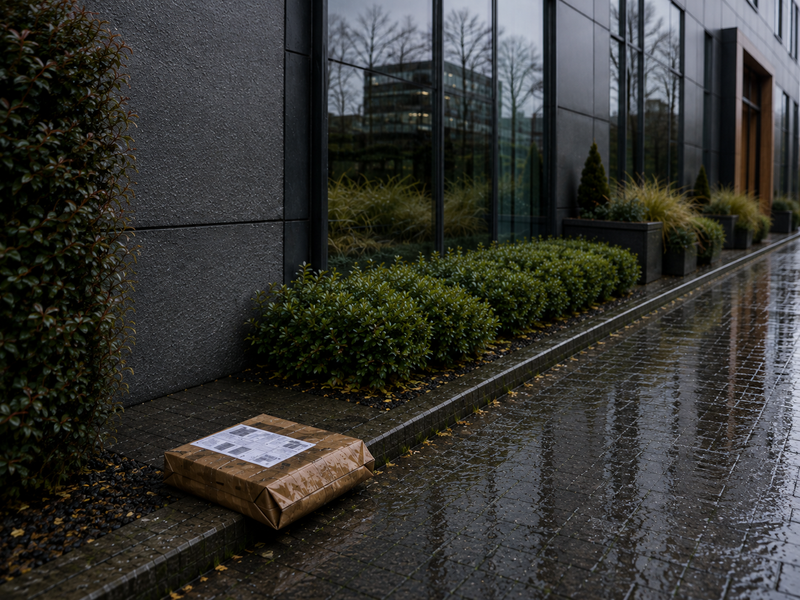
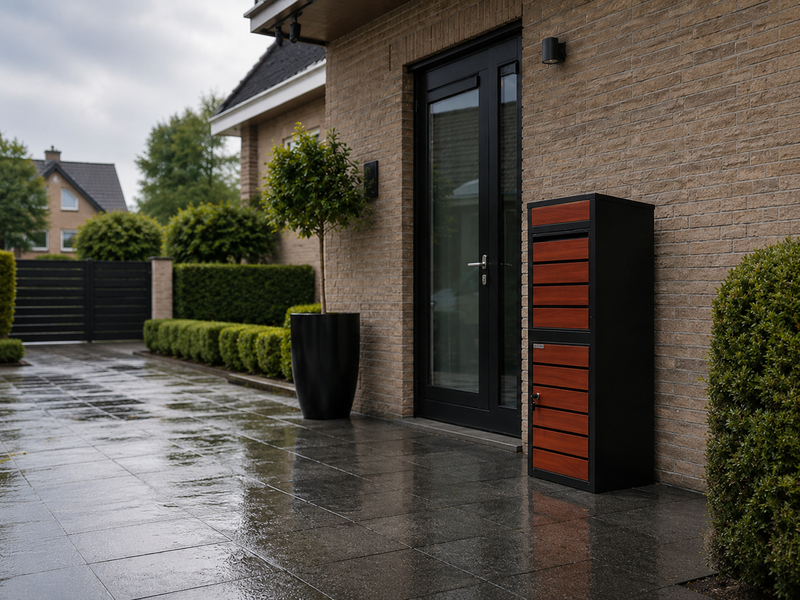
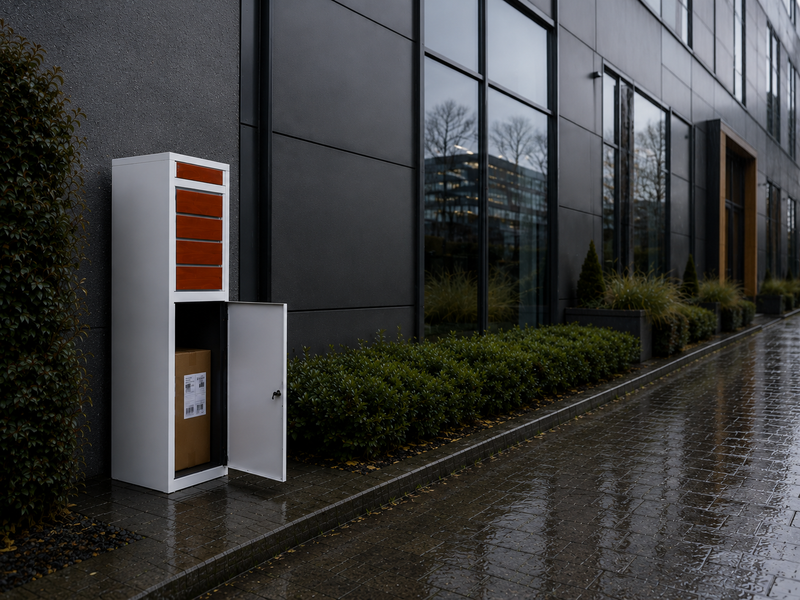
The real answer to this whole subject is not a plate in a slot, it is where your delivery ends up. If it lies on the doorstep, behind the planter or with the neighbours, anyone passing can reach it. If it lies in a box whose door is closed with a key lock, they cannot. All four of our series have a door with a key lock and two keys, and a flap on top where the delivery driver puts the delivery in. The housing is 0.7 mm galvanised sheet steel with Qualicoat Class 2 powder coating with zinc phosphate pretreatment, in RAL 9005 black, RAL 9010 white, RAL 7036 platinum grey and RAL 7016 anthracite, plus combinations with dark teak or light oak.
The point almost always skipped in comparisons: the parcel compartment of a freestanding model is almost half a metre high. That holds a week of orders, not one box. Concretely, that is fourteen book packages in the Home and the Style and eighteen in the Plus, tilted the way a delivery driver would. Four shoeboxes fit in every freestanding model. Phone boxes: nine in the Compact, forty in the Home and the Style, forty-two in the Plus. So if you are away for a week, you do not come home to a full flap and three parcels in the rain.
| Model | Parcels up to | External dimensions | Post and parcels | Installation |
|---|---|---|---|---|
| BunnyBox Compact, wall-mounted model | 300 x 200 x 200 mm | 365 x 250 x 450 mm | Separate slot, 1 compartment | Supplied pre-assembled |
| BunnyBox Style, freestanding column with wood-effect front | 350 x 320 x 200 mm | 380 x 365 x 1000 mm | Separate slot, 1 compartment | Self-assembly kit |
| BunnyBox Home, freestanding | 370 x 320 x 210 mm | 410 x 380 x 1020 mm | 1 compartment | Self-assembly kit |
| BunnyBox Plus, tall freestanding column | 450 x 320 x 210 mm | 500 x 370 x 1120 mm | Separate compartments for post and parcels | Self-assembly kit |
The choice runs from small to large. If you live in a flat or on a street without a front garden, the BunnyBox Compact is the wall-mounted model you hang on the facade: 365 x 250 x 450 mm external dimensions, parcels up to 300 x 200 x 200 mm, and the only series that arrives pre-assembled. Unpack, hang, done. If you want the box to match your front door while keeping a separate letter slot, the Style is the freestanding column with a wood-effect front. If you simply want the most popular freestanding size, the BunnyBox Home, with parcels up to 370 x 320 x 210 mm, is the model that is most often the answer.
If you regularly receive longer boxes, or you do not want your post and parcels piled on top of each other in the same compartment, the BunnyBox Plus is the model to look at. It takes parcels up to 450 x 320 x 210 mm and has separate compartments for post and parcels. That last point is more relevant to this subject than it seems: your post does not then lie on top of a box just behind a flap, but in its own compartment. Which size suits your ordering habits, you can work out in Which size parcel letterbox do I need, and the four series are compared side by side in Which BunnyBox suits me. Whether PostNL, DHL and the rest really deliver into it is covered in Can PostNL put a parcel in your parcel letterbox. Always someone home with a BunnyBox, even when you are at work.

View the models
Frequently asked questions about letterbox fishing and letterboxes
What is letterbox fishing?
Taking something through the letterbox opening with a wire, hook, coat hanger or bent tube. The Dutch Police Quality Mark for Secure Housing describes it as pulling the door handle down with a piece of wire or a coat hanger. In practice the word is also used for fishing post out of the letterbox and for grabbing keys lying in the hallway.
How many burglaries in the Netherlands involve letterbox fishing?
That figure does not exist. We searched politie.nl, CBS (Statistics Netherlands), the Dutch Centre for Crime Prevention and Safety, municipalities and the Dutch Association of Insurers and found no number or percentage at all. Letterbox fishing is a method within domestic burglary and is not recorded as a separate category. The only quasi-figure is the local test by community police officer Joke Smit in the Essesteijn district of Voorburg in March 2016, in which almost all the homes tested could be opened.
Can a thief fish a parcel out of a parcel letterbox?
There are no figures on how often that happens in the Netherlands, Belgium or Germany. We also found no manufacturer that uses the word for letterbox fishing on its parcel box pages. What manufacturers do describe are the constructions that prevent retrieval: a serrated strip in the slot, a self-closing flap, depth, a false floor that drops the delivery one level lower, and a lock that engages after posting. In our models, deliveries sit behind a door with a key lock and two keys.
Is there a quality mark for anti-fishing protection?
As far as our research goes, there is no standard, no quality mark and no test method for the parcel flap of a parcel letterbox. For letter openings there is EN 13724, a postal standard which, according to manufacturer summaries, requires protection against unauthorised removal up to 680 mm from the base. The Dutch Police Quality Mark for Secure Housing only requires a safeguard against manipulation of the thumb-turn cylinder or door handle through the letterbox opening.
Can I make my letterbox slot smaller than 265 by 32 mm?
Then your letterbox no longer meets the requirements for post delivery in the Netherlands. Postregeling 2009 article 6 paragraph 3 sets 265 by 32 mm as the minimum for the clear posting opening. PostNL gives the same size in centimetres in its 2017 leaflet: at least 26.5 cm long and 3.2 cm high. The regulation sets no maximum, so larger is allowed.
Does a brush in the letterbox help against fishing?
We found no source at all that presents a brush or flap in the slot as protection. Brushes are sold in the market as draught excluders. What is offered as a measure is a cage or bag on the inside of the door, such as the €51.21 Postkeeper, and the internal letterbox restrictor mentioned by the Metropolitan Police in 2012.
What is a letterbox restrictor?
A restrictor on the inside of the letter plate that closes off the passage to the hallway. The 2012 leaflet from the Metropolitan Police and the London Borough of Richmond upon Thames recommends it literally: "Consider fitting an internal letterbox restrictor". In 2014 the British supplier Global Door described the same principle with spring-loaded inner plates that you fit into an existing letterbox.
Where is the best place to keep my car keys?
Not by the front door. The 2012 police leaflet advises keeping house and car keys in different places and putting car keys out of sight. For context: the Dutch Association of Insurers reported on 13 November 2025 that 6,350 cars were stolen in the Netherlands in the first ten months of 2025, against 5,493 in 2024. That report itself makes no link with letterbox fishing or with key theft from a home.
Does my insurer set requirements for my letterbox?
We found no policy or terms and conditions that do, and no position from the Dutch Association of Insurers on letterbox fishing. The only party with an explicit requirement is the Dutch Police Quality Mark for Secure Housing, in its Security Guideline of January 2024 on page 10, and that requirement concerns a safeguard against manipulation of the cylinder and door handle.
Is a combination lock safer than a key lock against letterbox fishing?
We have found no test of the fishing resistance of locks on parcel letterboxes. What EN 13724 does say about locks concerns key differs: 200 at level 1 and 500 at level 2, according to the summary by Max Knobloch. The trade-off between lock types is covered in detail in our article Combination lock, key lock or smart lock.
Please note. This article rests on primary sources where they exist, and says so out loud where they are missing. Sources used: Postregeling 2009, BWBR0025578, article 6 paragraphs 1 to 5, text valid from 1 April 2009, wetten.overheid.nl. Besluit brievenbussen, BWBR0004448, lapsed on 1 April 2009 via Stb. 2009, 155 and 156. PostNL, leaflet "Waaraan moet uw brievenbus voldoen?", 2017. Politiekeurmerk Veilig Wonen, Security Guideline January 2024, pages 5, 7 and 10, and the Burglary methods page. Politie.nl, news item of 2 September 2020 about a burglary on the Spoorlaan in Tilburg, and news item of 21 July 2025 about sneak-in thieves. The page on letterbox fishing in the Burgernet section of politie.nl appears in the search index but returned a 404 every time we tried, so its content has not been used here. Het Krantje, 1 March 2016, with community police officer Joke Smit. Quote, 20 November 2024, on two reports in Amsterdam. Metropolitan Police and Richmond upon Thames Community Safety Partnership, "Car keys" leaflet, 2012. Summaries of EN 13724:2013 with corrigendum January 2016 by Max Knobloch, by frabox on 3 May 2023, by Briefkasten-Manufaktur on 28 July 2026 and by the CWU in 2018; the text of the standard itself is paid for and was not consulted. Secured by Design, GAI Specifiers Guide 2019. Global Door, 19 September 2014. Home Secure, undated. The Edinburgh Reporter, 21 April 2026, sponsored publication without figures. Resorti, Bravios, Max Knobloch, Monster Shop DE, Expert-Security, Mijnijzerwaren and BBK Ede, all prices checked on 26 August 2026. Dutch Association of Insurers, 13 November 2025, solely as context on car theft. We update this page twice a year and immediately after any change to the Postregeling 2009, EN 13724 or the Security Guideline of the Police Quality Mark for Secure Housing. Last checked on 26 August 2026. More research from our factory is in the BunnyBox knowledge base.