In short
- The requirements are set out in the Postregeling 2009 (the Dutch Postal Regulations), articles 5 and 6. The older Besluit brievenbussen (Letterbox Decree) was withdrawn on 1 April 2009.
- The slot is at least 265 x 32 mm, horizontal, and between 0.6 and 1.8 metres high.
- Behind the slot there must be at least 270 mm of width and 150 by 380 mm.
- The letterbox must be reachable within ten metres of the edge of a road, with a visible house number.
- PostNL's 25 cm depth is a recommendation, not a requirement. The legal minimum is 15 cm.
- The Postregeling says nothing about receiving parcels, so there are no legal dimensions for a parcel compartment.
The requirements for a letterbox in the Netherlands are set out in articles 5 and 6 of the Postregeling 2009, and they come down to a slot of at least 265 x 32 mm, a receiving space of at least 270 x 150 x 380 mm, a mounting height between 0.6 and 1.8 metres and access within ten metres of the edge of a road. If your letterbox does not meet them, nobody is obliged to deliver your post, but you will not be fined for it either.
Below you will find every requirement with its article and paragraph number, what it means in practice, where the official legal text differs from how PostNL and the ACM (the Dutch consumer and market authority) present it, and which of those figures are requirements and which are recommendations. We also cover what is explicitly not regulated: the Postregeling contains no provision at all on receiving parcels. You are hearing this from us rather than from just any webshop because we make these boxes ourselves in our own factory, so we deal with the legal slot size, with delivery drivers and with real box dimensions every day. Where sources contradict each other, we name both.
- 265 x 32 mmminimum clear slot opening, Postregeling 2009 article 6 paragraph 3
- 270 x 150 x 380 mmminimum storage space behind the slot, article 6 paragraph 5
- 10 metresmaximum distance from the edge of a road, article 5 paragraph 4
- 0provisions on receiving parcels in the entire Postregeling 2009

Which law sets the requirements for your letterbox?
The requirements are in the Postregeling 2009, listed in the Dutch legal register wetten.overheid.nl as BWBR0025578, and based on article 20 paragraph 1 of the Postwet 2009 (the Dutch Postal Act). The version currently in force dates from 1 July 2026. Article 5 covers where the letterbox is placed, article 6 covers the letterbox itself: the opening, the storage space, the height, safety and appearance. No other articles are needed, because that is the complete set.
Almost every Dutch page on this subject still quotes the Besluit brievenbussen, BWBR0004448. That decree was withdrawn on 1 April 2009. Anyone relying on it today is relying on law that has not existed for more than seventeen years. In practice the figures are largely the same, so people quoting the decree often end up with the same dimensions, but the reference itself is wrong, and so are the article and paragraph numbers. If you are in a dispute about your letterbox with a landlord, a homeowners' association or a delivery company, you want to be able to point to the provision that actually applies. That is article 6 of the Postregeling 2009, not article 2 of the withdrawn Besluit brievenbussen.
Two organisations translate the regulations into plain language, and that is where most of the confusion comes from. The ACM states on its ConsuWijzer consumer site, last updated on 29 July 2025, that the receiving space must be at least 27 x 15 x 38 cm. Those are exactly the millimetres from article 6 paragraph 5, converted to centimetres. PostNL gives the same dimensions in centimetres in its own leaflet "Waar moet jouw brievenbus aan voldoen?" (What does your letterbox need to meet?), but adds recommendations that are not in the law. Online, those two layers, law and advice, are constantly mixed up. On this page we keep them apart: for every figure we state whether it is a requirement or a recommendation, and whose.
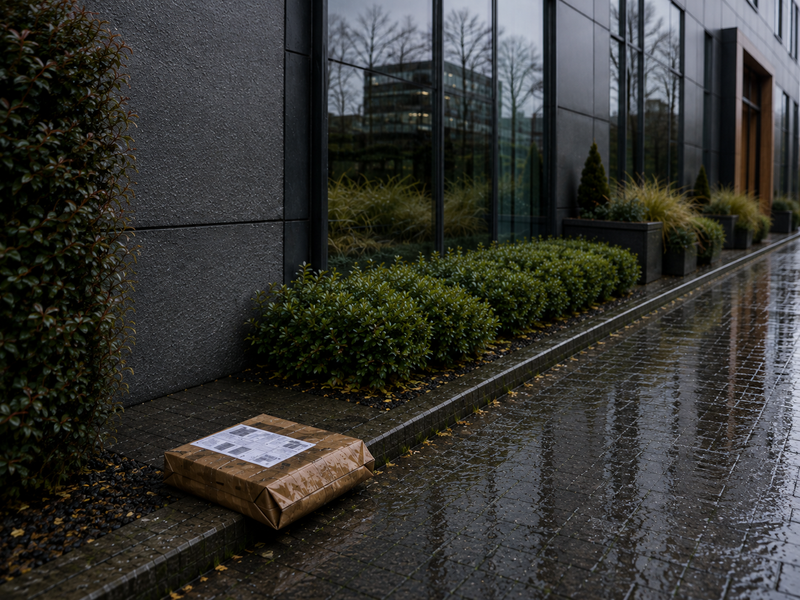
And there is something that is structurally missing from the legal text. The Postregeling regulates the letterbox function. It does not say a single word about parcels, parcel compartments, parcel letterboxes or receiving parcels. That is not an omission on this page but a feature of the regulations, and it has big consequences as soon as you buy a parcel letterbox. There is a separate section on that further down.
All letterbox requirements at a glance: article, paragraph, requirement and what it means in practice
This is the heart of this page. On the left the provision with its article and paragraph number, in the middle what it literally says, on the right what it means for you at home.
| Article | Paragraph | What the requirement says | What it means in practice |
|---|---|---|---|
| Article 5 | Paragraph 1 | The letterbox is as close as possible to the carriageway of a public road accessible to motor vehicles | On the street side, not at the back of the garden and not on the rear of the house. With a long driveway, the letterbox belongs at the entrance, not at the door |
| Article 5 | Paragraph 3 | The house number is clearly shown on or next to the letterbox | Numbers on the letterbox or right next to it, large enough to read from the pavement. Where there are several letterboxes at one address, this is the most important requirement of all |
| Article 5 | Paragraph 4 | The letterbox is reachable within ten metres of the edge of a road | Measure from the edge of the road, not from your registered property boundary. Verge, pavement and footpath count as part of the road |
| Article 5 | Paragraph 7 | The operating level is no more than 2.5 metres above or below the road surface | A letterbox at the top of a steep flight of front steps or at the bottom of basement stairs fails as soon as the difference in height exceeds 2.5 metres |
| Article 6 | Paragraph 1 | Shape and colour do not cause confusion with public post boxes | No orange letterbox styled like a PostNL street post box. Any other colour is fine, including orange on an ordinary letterbox design |
| Article 6 | Paragraph 2 | The letter slot is horizontal, preferably 1.1 metres above the operating level, and in any case no lower than 0.6 and no higher than 1.8 metres | Measure from where the delivery driver stands, not from your own garden level. A vertical slot does not comply |
| Article 6 | Paragraph 3 | The clear slot opening is at least 265 mm long and at least 32 mm wide | This is a minimum for the slot, not a maximum for your post. Larger is always allowed |
| Article 6 | Paragraph 4 | The letterbox can be operated without risk of injury | Damped flap, folded sheet edges, no sharp corners in the slot |
| Article 6 | Paragraph 5 | The usable internal width is at least 270 mm, the other two usable internal dimensions are at least 150 and 380 mm | Internal dimensions, not external. Double walls, locks and angled flaps do not count as usable space |
Two things stand out as soon as you put the legal text next to the public explanations. First, article 6 paragraph 5 only names the width explicitly: 270 mm. The 150 and 380 mm are given as "the other two usable internal dimensions", without the regulations saying which of them is the depth and which the height. PostNL fills this in on its leaflet as an internal depth of at least 15 cm, and the ACM lists the series as 27 x 15 x 38 cm. That is a reasonable reading, but it is a reading and not the legal text. Second, every figure in article 6 is a lower limit. Not a single provision sets a maximum on how large your slot or your storage space may be. That is exactly the space in which a parcel letterbox exists.
The slot: 265 by 32 millimetres, and why exactly that size
Article 6 paragraph 3 states that the clear slot opening is "at least 265 mm in length and 32 mm in width". In plain English: the slot is at least 26.5 centimetres wide and 3.2 centimetres high. PostNL gives the same two figures on its leaflet, in centimetres.
The words that disappear from almost every explanation are at least. The law regulates the letterbox, not the post. Article 6 paragraph 3 says how small a slot may be at most before it no longer meets the requirements. A larger opening complies just as well: a slot of 300 by 50 mm is larger than the minimum in both directions and is therefore perfectly fine. There is no legal maximum for a slot opening. If you read somewhere that your post or your small parcel "may not be larger than 265 x 32 mm", you are reading a minimum requirement for the letterbox as a maximum rule for the item being sent. That is the most common mistake on this subject, and it crops up in product descriptions, in blogs and in customer service chats.
The direction of the slot is also set out in paragraph 2 and is often overlooked: the opening is horizontal, in a vertical surface or in the top of the letterbox. So a vertical slot in a sleek facade panel does not comply, however good it looks. The practical consequence: the delivery driver has to fold post to get it through, and that is one of the reasons a letterbox gets skipped.
The size of the slot then determines everything that does and does not go inside. Anything thicker than 32 mm stays outside by definition, however hard it is pushed. Which box sizes that means in practice, from a 330 x 200 x 110 mm trainer box to a crate of groceries, is covered in our article on which parcels do not fit through the letterbox.
LEGAL MINIMUM, RECOMMENDATION AND WHAT A PARCEL NEEDS
Source: Postregeling 2009 article 6 paragraphs 3 and 5, PostNL leaflet "Waar moet jouw brievenbus aan voldoen?" and our own model overview.
Why a letterbox parcel measures exactly 380 x 265 x 32 mm
This is the question nobody answers, and it explains the whole market. The letterbox parcel from PostNL, DHL and DPD measures at most 380 x 265 x 32 mm. Those three figures were not dreamt up by a marketing department. They come straight from the Postregeling 2009.
The 265 mm and the 32 mm appear word for word in article 6 paragraph 3, as the minimum clear slot opening. The 380 mm comes from article 6 paragraph 5, as one of the other two usable internal dimensions of the storage space. In other words: the carriers made their smallest parcel product exactly as large as the smallest letterbox that still meets the requirements under Dutch law. As a result, every letterbox parcel fits by definition into every letterbox that complies with the Postregeling. That is the whole logic behind it, and it is also the reason that size has not changed since 2009.
That order of events also corrects something that was previously stated the other way round on this page. The law was not designed around the letterbox parcel. The letterbox parcel was designed around the law. The regulations date from 2009, and the letterbox parcels of the three big carriers came afterwards.
And that leads to the second correction, which matters more. Because 265 x 32 mm is a minimum for the opening, it is not a maximum for what may go through it. If you have a letterbox with a 300 x 60 mm slot, an item 55 mm thick goes straight through. The carrier simply will not ship it as a letterbox parcel, because that 32 mm is a product requirement set by the carrier, chosen so the parcel fits everywhere. The law prohibits none of this. The legal minimum and the commercial product limit are two different things that happen to share the same number.
| Carrier and product | Upper limit of the class | Maximum weight | Where the size comes from |
|---|---|---|---|
| PostNL letterbox parcel, private customers NL | 38 x 26.5 x 3.2 cm | 2 kg | Article 6 paragraphs 3 and 5, Postregeling 2009 |
| PostNL letterbox parcel, business customers NL | 38 x 26 x 3.2 cm | 2 kg | Rate guide, 5 mm narrower than the private customer size |
| DHL eCommerce letterbox parcel, consumers | 38 x 26.5 x 3.2 cm | 2 kg according to the consumer page, 1 kg according to the business page | Same legal basis, contradictory weight stated |
| DHL Envelop | 38 x 26.5 x 3.2 cm, minimum 15 x 11 x 1 cm | 500 g | Same external size, different weight limit |
| DPD NL ParcelLetter | 38 x 26 x 3 cm, minimum 15 x 10 x 1 cm | 1 kg | 2 mm below the legal slot height, as a margin |
| PostNL small parcel | 38 x 28 x 15 cm according to the customer service page, 34 x 28 x 15 cm according to the shipping page | 3 kg | Rate class, not a letterbox product. By definition it does not fit through the slot |
Note the last row. "Klein pakket" (small parcel) is a rate class at PostNL and not a letterbox product: the height goes up to 15 cm, almost five times the legal slot. The name suggests something other than the size. And note the two contradictions we are not smoothing over here: DHL states 2 kg on its consumer page and 1 kg on its business page and in the MyParcel carrier specification 2026, and PostNL publishes two different length dimensions for small parcels on two of its own pages. We name both and do not choose between them.
Storage space: 270 by 150 by 380 millimetres
There has to be space behind the slot, otherwise the post gets stuck in the flap and the first passer-by pulls it out. Article 6 paragraph 5 puts it like this: the usable internal width is at least 270 mm, and the other two usable internal dimensions are at least 150 and 380 mm. The ACM translates that on ConsuWijzer into a receiving space of at least 27 x 15 x 38 cm. With a built-in letterbox, you also choose between rear retrieval and front retrieval of your post.
The two words doing the work here are usable internal. That is not the external size, and it is not the internal size of the sheet metal housing either. It is the space where post can actually lie. Cheap letterboxes often have a double wall, a sloping flap or a lock mechanism in the way, so the usable space turns out ten centimetres smaller than the box suggests. So always measure inside, or ask the seller explicitly for the usable internal dimensions. Our size guide by format shows what really fits.
The regulations do not say which of the other two dimensions is the depth and which is the height. That means a letterbox 270 wide, 380 deep and 150 high complies with the letter of article 6 paragraph 5 just as well as one 270 wide, 150 deep and 380 high. PostNL opts for the second reading on its leaflet and gives 15 cm as the internal depth. The ACM keeps the order 27 x 15 x 38, which amounts to the same thing. We follow that reading too, and point out that the legal text itself does not make that assignment.
What 270 x 150 x 380 mm can handle in practice: a week of ordinary post, a few magazines and a pile of envelopes. That is exactly what this minimum is meant for, because it regulates the letterbox function. For a week of online orders you choose a parcel compartment, and the one in a freestanding BunnyBox is almost half a metre high.
Is a depth of 25 centimetres a requirement or a recommendation?
Short answer: a recommendation. This is one of the most persistent misunderstandings on the subject, and it comes from a single line in the PostNL leaflet.
The legal minimum depth follows from article 6 paragraph 5 and is 150 mm. In its leaflet "Waar moet jouw brievenbus aan voldoen?", PostNL gives that same 15 cm as the minimum, and then adds a recommendation of at least 25 cm. The word recommendation is not carelessness: PostNL itself asks for more space than the legal minimum, precisely because 15 cm is tight for an average day's post with a few magazines in it.
The difference matters in practice. If your letterbox is 15 cm deep, you comply with the law and nobody can tell you otherwise. If you choose 25 cm, you are following the advice of the party that puts the most into your letterbox. If you build a letterbox into a wall or gate, you notice the difference straight away, because those extra 10 cm partly decide whether a pass-through in the wall is possible at all. How that works and what wall thickness you need is explained in building a parcel letterbox into a wall, gate or fence.
Height: between 60 and 180 centimetres, ideally 110
Article 6 paragraph 2 says the letter slot is preferably 1.1 metres above the operating level, and in any case no lower than 0.6 metres and no higher than 1.8 metres. So around 110 centimetres is not a rule of thumb from a DIY blog but the preference set out in the regulations themselves, and the reason is hip height: a delivery driver with a full bag can reach it without bending or stretching.
The word that matters is operating level. That is where the delivery driver stands, not the ground level of your garden and not the top of your driveway. With a raised terrace or a sunken front garden, that can easily make a difference of 30 centimetres. Measure from the floor where someone stands with both feet when they put the post in.
This is the requirement most often broken in self-builds and renovations. A letterbox bricked in nice and low in a garden wall looks sleek, sits below 60 centimetres, and then no longer complies with article 6 paragraph 2. The reverse also happens: a letterbox set high in a gate panel, above 1.8 metres, falls outside the rules just the same. With a freestanding post this takes care of itself, because the height of the post determines where the slot ends up.
Article 5 paragraph 7 adds another limit on top of that, separate from the slot height: the operating level is no more than 2.5 metres above or below the road surface. That is the provision behind the familiar "no high steps". If you live in a basement flat or at the top of a steep flight of front steps with more than 2.5 metres of height difference, the letterbox belongs lower or higher, on the street side. PostNL translates this in its leaflet as "no steps higher than 2.5 metres".


No more than ten metres from the edge of a road
Article 5 paragraph 4 requires the letterbox to be reachable within ten metres of the edge of a road. Article 5 paragraph 1 adds that the letterbox should be as close as possible to the carriageway of a public road accessible to motor vehicles. Together, these are the two provisions that decide whether your letterbox belongs by the street or may be on the front of the house.
There is a ruling on those ten metres, and it is stricter than people expect. The Geschillencommissie Post (the Dutch postal disputes committee) ruled in case POS05-0168 on 16 February 2006 that even a small excess over the ten metres is not permitted. It is not a guideline with a margin but a limit. In the same ruling, the committee explained what "edge of a road" means, and that is the part most people get wrong: it is the boundary between lawn and verge, not the registered property boundary. The concept of a road also includes pavements, paths, verges and embankments. If you measure from your own registered boundary, you are measuring from the wrong point and usually come out too favourably.
The edge of a road lies where the lawn meets the verge, because pavements, paths, verges and embankments also form part of the road. Even a small excess over the ten metres is not permitted.
Geschillencommissie Post, case POS05-0168, ruling of 16 February 2006
There is a nuance to that ruling which we state explicitly, and which you will not read anywhere else. POS05-0168 dates from February 2006 and is therefore based on the Besluit brievenbussen, which was withdrawn three years later. Formally, the legal basis for that ruling has lapsed. In substance, the standard now appears in almost identical wording in article 5 paragraph 4 of the Postregeling 2009: the same ten metres, the same term "edge of a road". The committee's reasoning on those two points, no margin and a concept of the road that includes verges, is therefore still the best available interpretation of what article 5 paragraph 4 says today. We present it as a strong interpretation, not as a ruling under current law.
In practice this means: no letterbox behind a locked gate whose code the delivery driver does not have, no letterbox behind a fence with a dog behind it, and no letterbox at the back of a house that cannot be seen from the road. If you live more than ten metres from the roadside, the letterbox belongs at the front, towards the drive entrance or the property boundary on the street side. That is also the practical argument for a freestanding post over a wall-mounted model: you place a freestanding box where the delivery driver stops anyway, whereas a wall-mounted model follows the facade, and that is sometimes simply too far back. What a delivery driver under time pressure does when the letterbox is hard to reach is covered in why your delivery driver skips your parcel letterbox.
Findability, safety and appearance
Three requirements that get less attention and still go wrong every day. All three are set out in black and white in the regulations.
- House number visible, article 5 paragraph 3. The house number must be clearly shown on or next to the letterbox. Where there are two or more letterboxes at one address, for example in a divided building or a homeowners' association, this is the difference between delivered and delivered to the wrong place. In new builds and after a renovation, this is the requirement most often forgotten.
- No risk of injury, article 6 paragraph 4. It must be possible to use the letterbox without anyone getting hurt. A flap that snaps back onto a hand, or a cut sheet edge in the slot, falls under this. On a well-made letterbox the flap is damped and all edges are folded over, so there is no exposed cutting edge anywhere.
- No confusion with public post boxes, article 6 paragraph 1. Shape and colour must be such that confusion with a public post box is not possible. The ban lies in the combination of shape and colour, not in the colour alone. An orange home letterbox in a normal letterbox shape is no problem, a large round pillar in PostNL orange is.

What requirements apply to the parcel compartment of a parcel letterbox?
None at all. That is not a sloppy summary but the literal result of the legal text: the entire Postregeling 2009 contains no provision on receiving parcels, parcel compartments or parcel letterboxes. Articles 5 and 6 regulate only the letterbox function. So there is no legal minimum size for a parcel compartment, no prescribed flap size, no prescribed lock and no prescribed depth.
That explains in one go why you find so much contradictory information about this online. People search for "legal dimensions parcel letterbox" and get answers that repeat the letterbox dimensions from article 6, as if they also applied to the parcel compartment. They do not. The 265 x 32 mm is about your letter slot. The compartment a 330 x 200 x 110 mm box drops into is not covered by any regulation.
What does apply are requirements of a different kind. They are practical or contractual, and you need to keep the two apart:
- Practical. The parcel has to physically fit, and the delivery driver has to be able to operate the flap with a parcel in hand. If the box does not fit, the delivery does not happen, regardless of what any regulation says. This is a question of size, not a legal question.
- Contractual. The carrier decides in its own terms and conditions and delivery conditions whether it may deliver into a locked box, what happens to liability afterwards, and which delivery preference you need to set for it. That is an agreement between you, the sender and the carrier, not something from the Postregeling. It differs per carrier, and so does the terminology: DHL calls it Afgesproken Plek (agreed place), DPD works with Neerzettoestemming (permission to leave), GLS with FlexDeliveryService. What each carrier does exactly is covered in parcel letterbox carriers: DHL, DPD, GLS, Budbee and Vinted Go.
- Not statutory. There is no rule obliging a delivery driver from PostNL, DHL, DPD or GLS to put a parcel in your box, and there is no rule prohibiting it either. How that works out in practice with PostNL is covered in can PostNL put a parcel in your parcel letterbox.
- Size of the slot, article 6 paragraph 3
- Storage space behind the slot, article 6 paragraph 5
- Height of the slot, article 6 paragraph 2
- Distance from the road, article 5 paragraph 4
- Height difference with the road surface, article 5 paragraph 7
- House number, article 5 paragraph 3
- Safety and appearance, article 6 paragraphs 1 and 4
- Size of the parcel compartment
- Size and operation of the parcel flap
- Type of lock and number of keys
- Steel thickness and coating
- Anchoring to the ground
- Whether a delivery driver has to use your box
- Who is liable once the parcel is inside
A parcel letterbox therefore does two things at once, and those two are governed by completely different rules. For your post, it has to comply with articles 5 and 6, with a proper letter slot at the right height. For your parcels, all that counts is what physically fits and what you have agreed with your carriers. A box that only does the second is legally not a letterbox, and then nobody is obliged to deliver post into it either.
A parcel requiring a signature on receipt or an age check is a category of its own: by definition it needs a person to sign or show ID. That is a feature of that type of shipment, just as with registered post, and it has nothing to do with the letterbox. For everything else, and that is the vast majority of what gets delivered, the delivery preference you set with the carrier is the dial you control yourself. What to do best in that case is covered in receiving a parcel when you are not at home.

Please note. Post and parcels in the same compartment or separately is a choice, not a requirement. The law only sets requirements for the letterbox function. If you want to keep post and parcels strictly separate, the BunnyBox Plus is the model with two separate compartments.
Who needs to give permission for your letterbox: landlord, homeowners' association or municipality?
The Postregeling says what a letterbox must be able to do. It says nothing about who has to say yes before you can mount it or build it in. That is found in three other corners of the law, and which of the three applies to you depends on your living situation.
Renting? Article 7:215 of the Dutch Civil Code
Article 7:215 paragraph 1 of the Burgerlijk Wetboek (the Dutch Civil Code) says that a tenant may not change the layout or appearance of the rented property without the landlord's written permission, unless the changes can be undone at the end of the tenancy without significant cost. A freestanding post that you simply take with you when you move out falls under that exception. A recess in the facade or a hole in the front door does not.
Paragraph 2 helps you with residential property: the landlord grants permission within eight weeks in any case if the change does not harm the property's rentability and does not reduce its value. But read paragraph 6 straight away, because that is where the catch is. The preceding paragraphs cannot be deviated from to the tenant's disadvantage, unless it concerns the exterior of the rented residential property. A letterbox in the facade or in the front door is exterior. That is exactly where your landlord may make stricter arrangements than the law allows as a general rule. Ask in writing, and keep the reply.
Living in an apartment with a homeowners' association? The facade is shared
In an apartment, the facade is a shared part of the building, even where it borders your home. Article 9 paragraph 2 of the Modelreglement 1992 (the standard Dutch rules for homeowners' associations) prohibits changes to shared parts without the permission of the meeting of owners. Note that word: the meeting, not the board. Verbal approval from the chair is not a decision.
That applies to small changes too. On 16 February 2026, a court ruled in a case about a 50 mm hole through the load-bearing facade for an air conditioning unit that the permission requirement applies to all changes to shared parts, regardless of their nature or scale. So the size of the hole is no argument. If the meeting refuses without reasonable grounds, you can ask the subdistrict court for substitute authorisation under article 5:121 of the Dutch Civil Code. Always check the deed of division and the house rules as well, because they may contain stricter or more lenient rules than the standard regulations.
Building it into a boundary fence or wall? Then the local environmental plan counts
If you build the letterbox into a fence, low wall or gate, the rules for boundary structures from the Besluit bouwwerken leefomgeving (the Dutch Buildings Decree) apply. According to the IPLO update of 6 July 2026, the position is as follows. In planning terms, a boundary structure up to 1 metre is exempt from a permit nationwide under article 2.29 under j of the Bbl, and that national rule takes precedence over local rules. Between 1 and 2 metres it is exempt from a permit provided you comply with the rules of the municipal environmental plan, the structure stands on a plot with an existing main building and stays behind the front of that main building. Technically, up to 2 metres is permit-free, and above 2 metres a building notification is required. For a listed building, a boundary structure is never exempt from a permit.
| Situation | Who decides | Legal basis | What you actually do |
|---|---|---|---|
| Rented home, freestanding post in the garden | Usually nobody | Article 7:215 paragraph 1 of the Dutch Civil Code, exception for changes that can be undone | Put it in place, and if in doubt, let the landlord know in writing |
| Rented home, letterbox in the facade or the front door | The landlord | Article 7:215 paragraphs 1 and 2 of the Dutch Civil Code, with paragraph 6 excepting the exterior | Ask for permission in writing. Allow eight weeks and expect stricter conditions than for interior work |
| Apartment with a homeowners' association | The meeting of owners | Article 9 paragraph 2 Modelreglement 1992, ruling of 16 February 2026 | Put it on the agenda for the meeting. If that fails, substitute authorisation via article 5:121 of the Dutch Civil Code |
| Boundary structure up to 1 metre | Nobody | Article 2.29 under j Bbl, national and above local rules | Install without a permit |
| Boundary structure up to 2 metres | The municipality, via the environmental plan | Besluit bouwwerken leefomgeving, IPLO update 6 July 2026 | Check the environmental plan. Behind the front of the main building and on a plot with an existing main building |
| Listed building or protected townscape or village view | The municipality | Article 2.30 Bbl, article 5.1 paragraph 1 under b Omgevingswet (the Dutch Environment and Planning Act) | Always check in advance with the Omgevingsloket (the Dutch planning permission portal). A new recess is by definition a change |
A nuance we state explicitly, because no source makes it definitive: strictly speaking, a recess for a letterbox is not a window frame, facade panel or insulation board, and those are the categories that article 2.29 Bbl declares permit-free. The closest framework is therefore not the same as a settled classification. The safe course is to ask the municipal Omgevingsloket case by case, especially for a front facade or a side facade facing a public area. The full details, including wall thickness, lintel and costs, are in building a parcel letterbox into a wall, gate or fence.
What does this mean for where you place a BunnyBox?
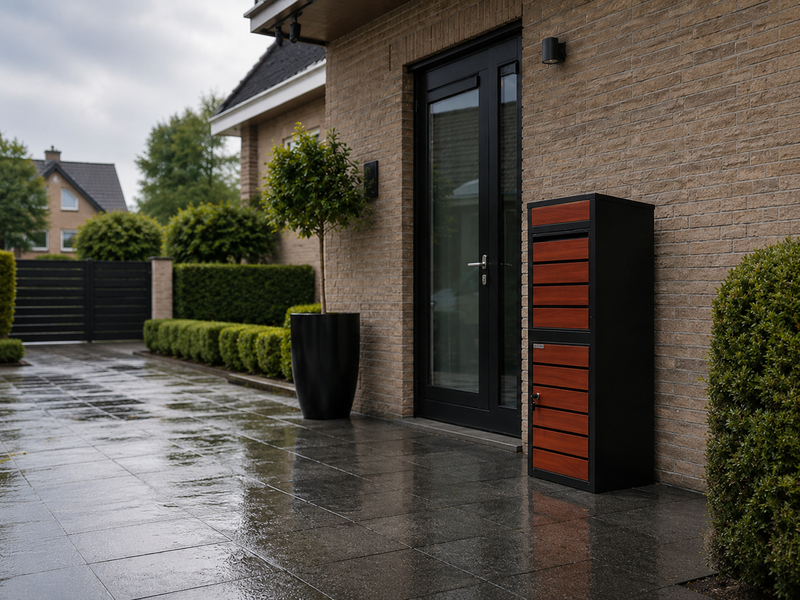
We make the boxes ourselves in our own factory, so we can say exactly how they relate to these requirements. All four series are made of 0.7 mm galvanised steel sheet with Qualicoat Class 2 powder coating with zinc phosphate pretreatment, all four have a door with a key lock and two keys, and all four have a flap on top for the delivery driver. The Compact is the only series supplied pre-assembled, so all you do is choose a spot and mount it. Which wall plug suits which type of wall and how to prevent leaks is explained in mounting a wall-mounted parcel letterbox.

| Model | External height | Parcels up to | What that means for articles 5 and 6 |
|---|---|---|---|
| BunnyBox Compact | 450 mm, wall-mounted model | 300 x 200 x 200 mm | You decide the height when mounting it. Measure on the box where the slot is, add that to the height of the bottom edge and keep the slot between 0.6 and 1.8 metres |
| BunnyBox Style | 1000 mm, freestanding | 350 x 320 x 200 mm | A one-metre post, so the slot automatically ends up well within the range of article 6 paragraph 2. Separate letter slot in the front |
| BunnyBox Home | 1020 mm, freestanding | 370 x 320 x 210 mm | Just over a metre high and freely positioned, so you decide yourself whether you stay within the ten metres of article 5 paragraph 4 |
| BunnyBox Plus | 1120 mm, freestanding | 450 x 320 x 210 mm | The tallest post of the four and the only model with post and parcels in separate compartments, so the letterbox function is completely separate from the parcel compartment |
You stand the three freestanding models wherever you like, and that is exactly the feature that makes article 5 paragraphs 1 and 4 easy: you place the post at the drive entrance or on the property boundary, where the delivery driver stops anyway. With the wall-mounted model you follow the facade. If your facade is more than ten metres from the roadside, choose a freestanding model.
For the height of the slot per model, there is a practical rule we would rather give than a figure we have not measured ourselves: measure on the box itself where the centre of the slot is, add that to the height of the bottom edge, and keep the result between 0.6 and 1.8 metres with 1.1 metres as the target. With the three freestanding models this works out automatically, because the posts are between 1000 and 1120 mm high.
From small to large: which model suits which order?
The letterbox requirements are the same for all four, because they concern the letter slot. The difference is in the parcel compartment, and that goes up in four steps.
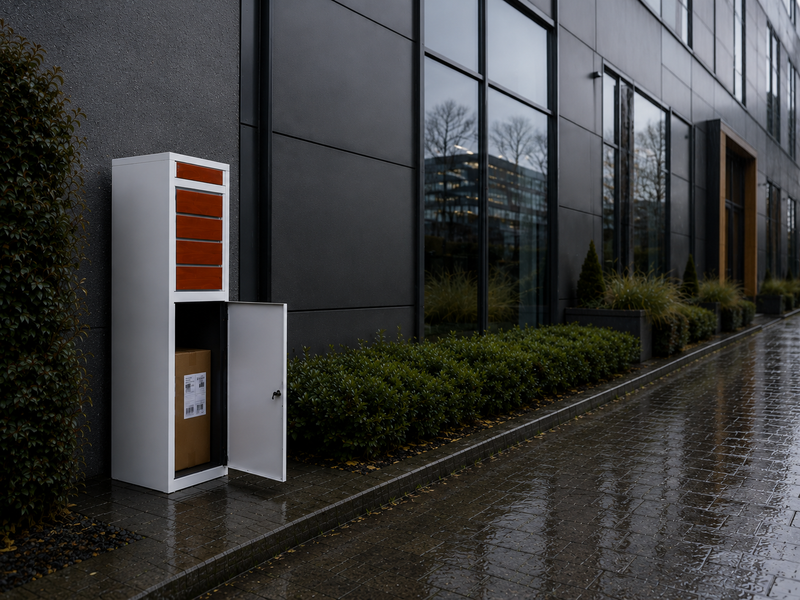
The parcel compartment of a freestanding model is almost half a metre high. A week of orders fits in there, and that is exactly the difference from the 270 x 150 x 380 mm the law sets as the minimum for the letterbox function. If you are torn between two models, which BunnyBox is right for me gets you there in a few questions. If you first want to know where the money goes in a parcel letterbox, read what does a good parcel letterbox cost.
The five mistakes we see most often
- Bricked in too low. Looks nice in the garden wall, slot below 60 centimetres, and therefore outside article 6 paragraph 2.
- Vertical slot. Looks sleek in a designer facade, but paragraph 2 requires horizontal, and now the delivery driver has to fold the post.
- Measured from the property boundary. The ten metres of article 5 paragraph 4 run from the edge of the road, which according to POS05-0168 lies where the lawn meets the verge. Measuring from your registered boundary gives too favourable a result.
- Internal size confused with external size. Article 6 paragraph 5 is about the usable internal space. Double walls and a sloping flap can easily take a few centimetres off that.
- No house number. Article 5 paragraph 3 in one sentence, and after a renovation or in a new build the most forgotten requirement of all.
A sixth that comes close: a box that is fine in itself but stands somewhere it cannot be seen from the street. Visibility is not a separate requirement in the regulations, but it follows from article 5 paragraph 1 and from practice. What that means for the risk of theft is covered in parcel theft in the Netherlands. You will find all articles together in the BunnyBox Knowledge base.
View the models
Frequently asked questions about letterbox requirements
Is a letterbox a legal requirement in the Netherlands?
No, you are not obliged to have a letterbox. The Postregeling 2009 does not require a letterbox, but it does set requirements for the letterbox if you have one. The consequence of not complying is not a fine but something else: nobody is then obliged to deliver your post.
Which law sets the requirements for a letterbox?
The Postregeling 2009, listed in the Dutch legal register as BWBR0025578, based on article 20 paragraph 1 of the Postwet 2009 (the Dutch Postal Act). Article 5 covers where the letterbox is placed, article 6 the letterbox itself. The Besluit brievenbussen still mentioned on many sites was withdrawn on 1 April 2009.
How big does the slot of a letterbox have to be?
At least 265 mm in length and 32 mm in width, and positioned horizontally. That is set out in article 6 paragraph 3 of the Postregeling 2009. It is a minimum for the opening: larger is always allowed, and there is no legal maximum.
How deep does a letterbox have to be, 15 or 25 cm?
The legal minimum depth is 15 cm, from article 6 paragraph 5. The 25 cm PostNL mentions is a recommendation in its own leaflet and not a requirement. If you meet 15 cm, you comply with the law. If you choose 25 cm, you are following the advice of the party that puts the most into your letterbox.
What is the ideal height for a letterbox?
About 110 centimetres above the operating level, so measured from where the delivery driver stands. Anything from 60 to 180 centimetres is allowed under article 6 paragraph 2. In addition, the height difference with the road surface may not exceed 2.5 metres under article 5 paragraph 7.
How far from the road can my letterbox be?
No more than ten metres from the edge of a road, under article 5 paragraph 4. In case POS05-0168 on 16 February 2006, the Geschillencommissie Post (the Dutch postal disputes committee) ruled that even a small excess is not permitted, and that the edge of a road is where the lawn meets the verge, not your registered property boundary. Pavements, paths, verges and embankments count as part of the road.
What legal dimensions apply to a parcel letterbox?
For the parcel part, none at all. The entire Postregeling 2009 contains no provision on receiving parcels. The requirements in articles 5 and 6 only concern the letterbox function. What applies to the parcel compartment is practical, whether the parcel fits, and contractual, what you have agreed with your carrier.
Is a parcel delivery driver allowed to use my parcel letterbox?
Allowed, yes; obliged, no. There is no legal obligation, and no ban either. Whether it happens depends on the delivery preference you have set with the carrier, on the instructions with the shipment and on the delivery driver's judgement on the spot.
Does a parcel letterbox have to be anchored?
It is not compulsory: anchoring is not mentioned in any regulation. It is sensible, though, because a freestanding post that is not fixed down can be carried off. The general advice is to fix it to a firm base, for example on paving slabs or in concrete. If you are unsure how to go about it in your situation, just drop us an email.
Do I need permission from my landlord or homeowners' association?
For a freestanding post in the garden usually not, because you can remove it at the end of the tenancy without significant cost. For a letterbox in the facade or the front door, yes: article 7:215 paragraph 1 of the Dutch Civil Code requires written permission, and paragraph 6 allows the landlord to make stricter arrangements specifically for the exterior. In a homeowners' association, the meeting of owners decides, not the board.
Please note. Last checked on 25 August 2026. Main sources: Postregeling 2009 (BWBR0025578), articles 5 and 6, version in force from 1 July 2026, based on article 20 paragraph 1 Postwet 2009; the Besluit brievenbussen (BWBR0004448), withdrawn on 1 April 2009 and deliberately not used as current law on this page; ACM ConsuWijzer on the receiving space of 27 x 15 x 38 cm, updated on 29 July 2025; the leaflet "Waar moet jouw brievenbus aan voldoen?" from PostNL for the recommended depth of 25 cm alongside the legal 15 cm; the Geschillencommissie (Dutch disputes committee), case POS05-0168, ruling of 16 February 2006 on the ten metres and the edge of a road, given under the since withdrawn Besluit brievenbussen but materially identical to article 5 paragraph 4 Postregeling 2009; article 7:215 of the Dutch Civil Code, article 5:121 of the Dutch Civil Code and article 9 paragraph 2 of the Modelreglement 1992, with a court ruling of 16 February 2026 on changes to shared parts; the Besluit bouwwerken leefomgeving and IPLO on boundary structures, update of 6 July 2026; the letterbox parcel and rate pages of PostNL, DHL eCommerce, the MyParcel carrier specification 2026 and DPD. Where sources contradict each other, on the DHL weight of 1 or 2 kg and on the two PostNL dimensions for small parcels, we name both and choose neither. No source explicitly states that a letterbox recess falls under article 2.29 Bbl, and we do not present it that way either. We update this page every January, and immediately after any change to the Postregeling 2009.