In short
- You complain to the seller, not the delivery driver. ACM ConsuWijzer (the consumer information service of the Dutch Authority for Consumers and Markets) says literally: "You do not have to complain to the delivery service yourself."
- Under Dutch law, the risk only passes once you, or a third party you have designated, has received the parcel, and that third party is never the carrier (article 7:11 paragraph 1 of the Dutch Civil Code, BW).
- Does the webshop say it was delivered? Then the webshop has to prove it. A delivery scan is not receipt.
- First gather evidence, then report in writing to the webshop, set a reasonable deadline and announce termination (article 7:19a paragraphs 1 and 3 BW).
- If the webshop does not cooperate, the Geschillencommissie (Dutch Disputes Committee) is next. In case 227340/233108 a consumer got €425.72 back.
- You report the theft to the Dutch police online under "Theft of something else", with DigiD.
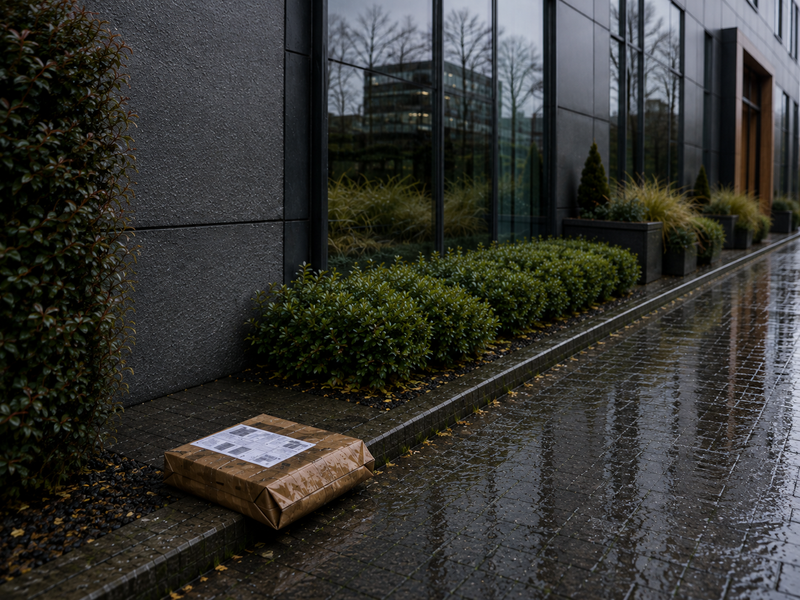
- A parcel in a lockable box is not on the doorstep. That is the only step that prevents the next time.
If your parcel has been stolen, or it says "delivered" when there is nothing there, you do not go to the carrier but to the webshop where you bought it. You have a purchase agreement with that webshop, and as long as it has not been shown that you or someone you designated actually received the parcel, the risk lies with the webshop.
Below is the whole route: the four situations that occur and why the approach differs for each, the articles of law with paragraph and number, eight rulings by the Dutch Disputes Committee with case numbers, a template letter you can copy, what each carrier publishes itself, what the police do, what your home contents insurance does and what your payment method gives you. We manufacture parcel letterboxes and make them in our own factory. That means we see every week what goes wrong at the front door, and we have no interest in a story in which the delivery driver is to blame. The figures on how often this happens are in our article on parcel theft in the Netherlands. This page is about what you do now that it has happened to you.
- 30 daysMaximum delivery time for a consumer purchase if nothing else was agreed, article 7:9 paragraph 4 BW
- €425.72Refund in case 227340/233108 of the Geschillencommissie Thuiswinkel (online shopping disputes committee), 6 December 2023
- 8 rulingsCases about missing parcels that we checked on degeschillencommissie.nl, four of which went against the consumer
- 180 daysDeadline for opening a dispute under PayPal Buyer Protection, counted from the payment to the seller

Who should I complain to if my parcel has been stolen: the webshop or the delivery driver?
The webshop. That is not a tip but the core of your position, and it is exactly where most people lose weeks to carriers' chatbots. You see, you have no agreement with the carrier. You have a purchase agreement with the seller, and the seller has a transport agreement with the courier. Those two contracts are separate. You can only turn to the party you have a contract with yourself.
ACM ConsuWijzer, the consumer information service of the Dutch Authority for Consumers and Markets, says it on the page "Aankoop niet geleverd" (Purchase not delivered) in two sentences you can copy into your letter: "You do not have to complain to the delivery service yourself." And: "Because the seller is responsible for shipping." Both consulted on 26 August 2026.
Note a detail that many older articles on the internet get wrong: consuwijzer.nl has moved to consument.acm.nl. All old addresses redirect. The current page is Aankoop niet geleverd at ACM ConsuWijzer.
Having to go to the webshop does not mean you ignore the carrier. The carrier is your source of evidence. That is where the scan time is recorded, whether the doorbell was rung, whether the parcel was left with the neighbours. You collect that information and then use it with the webshop. What the carriers publish about this themselves, and who may claim according to their own terms, is in the carrier table further down and in more detail in our overview of what each carrier does with a parcel letterbox.
Why the webshop often sends you to the carrier anyway
Because it is cheaper for the webshop if you sort it out. Once you disappear into the carrier's customer service, the clock keeps running and the chance that you come back shrinks. Do not fall for it, and write it literally in your message: you hold the seller liable, you refer to article 7:11 paragraph 1 BW and to the burden of proof, and you ask for a written response within a deadline you name yourself. The letter is written out in full further down.
There is one exception, and it is small. Article 7:11 paragraph 2 BW says: "If the buyer designates a carrier and the choice of this carrier is not offered by the seller, the risk passes to the buyer at the moment the carrier receives the item." So: if you yourself hired a courier that the webshop did not offer, the risk passes as soon as that courier has the parcel. With an ordinary webshop order where you choose from the carriers the shop offers, this does not apply.
Which situation am I in, and does that change my route?
Yes, the route differs. Four situations occur in practice, and they call for different evidence. Find your own situation first, because that determines what you record in the first few days.
Situation 1: track and trace says delivered, but there is nothing there
This is the situation in which you have the strongest position, and almost nobody tells you so. First go through the standard check the carriers themselves prescribe, because some of these parcels have not been stolen but have ended up somewhere that is not in the tracking. PostNL writes: "Check your track & trace and your email. Sometimes your parcel is with the neighbours or has been accepted by a member of your household." And PostNL itself admits that a scan does not mean the parcel is in the right place: "Your parcel may have been scanned together with other parcels. It is often delivered later that day."
DHL eCommerce adds a pointer that is relevant to anyone with a parcel letterbox: "Look in your (external) letterbox. Even if this is not in the track and trace, there is a chance that your parcel has been delivered to your letterbox." In other words: the carrier itself confirms that a parcel can end up in an external box without the tracking saying so. So look in your box before you think of theft. Why a delivery driver sometimes skips that box is explained in our article on why your delivery driver skips your parcel letterbox.
If the parcel really is not there, the core rule is this: a delivery scan is not receipt. The whole next section is about that.
Situation 2: the parcel was left with the neighbours
Ask first, including neighbours you do not normally talk to. DHL writes: "Ask your nearest neighbours whether they have received your parcel. Your parcel may always have been delivered to neighbours, even if this is not visible online." DPD states on its own delivery page: "Not at home? Then we will try to deliver the parcel to the neighbours or the nearest Pickup point."
If that turns up nothing, this is legally a different matter from a parcel accepted by a member of your household. That distinction is the sharpest point of this article and it is set out further down under the rulings of the Disputes Committee.
Situation 3: the parcel never arrived
No delivery scan, just tracking that has stalled. Here your position depends on the delivery period. If a delivery date was agreed and has passed, or the statutory period of thirty days from article 7:9 paragraph 4 BW applied, you first give the seller a reasonable extra period and then you terminate. The ACM: "Do you not receive the product within that delivery period? Then you must first give the seller extra time to deliver the product after all." If there was a fixed, agreed delivery date and it was missed, then according to the ACM you may terminate immediately, without first giving extra time. That is in line with article 7:19a paragraph 2 BW.
PostNL does give figures for this situation: with a scan but no delivery, "Wait another 2 delivery days", and "Have you been waiting longer than 5 delivery days?" means contacting the sender. Those are the carrier's waiting times, not legal deadlines. Do not confuse them with the deadline you set the webshop.
Situation 4: there is a "not home" notice while you were at home
This happens and it can be refuted. Record that you were at home at that time and that there was no moment when the bell was rung, for example with a work schedule, a diary or the absence of a notification on your doorbell. In case 252957/330247 of the Geschillencommissie Post (postal disputes committee), 21 November 2024, a consumer won precisely on this type of evidence: she disputed the signed delivery confirmation because the signature was not hers and she was on the train at the stated time of delivery. Being able to show where you actually were is one of the strongest things you can do. If you want to know what alternatives you have for avoiding this whole scenario, see receiving a parcel when you are not home.
What does the law say about when the risk passes to you?
The law says: on receipt, and not before. The key article is article 7:11 paragraph 1 of Book 7 of the Dutch Civil Code (Burgerlijk Wetboek). The text below comes from wetten.overheid.nl, BWBR0005290, version in force from 12 February 2025, consulted on 26 August 2026.
In a consumer sale in which the item is delivered to the buyer, the item is at the buyer's risk from the moment the buyer, or a third party designated by the buyer who is not the carrier, has received the item.Article 7:11 paragraph 1 BW (Dutch Civil Code), wetten.overheid.nl, BWBR0005290, version of 12 February 2025, our translation
There are four building blocks in that one sentence. One: it is about receipt, not dispatch and not a scan. Two: the recipient may also be "a third party designated by the buyer". Three: that third party is, in so many words, not the carrier, so a courier can never receive on your behalf. Four: paragraph 2 has an exception that does not apply with an ordinary webshop.
Put article 7:10 paragraph 1 BW next to it: "The item is at the buyer's risk from delivery, even if ownership has not yet been transferred." That is the general rule for sales. Article 7:11 BW is the consumer version that departs from it and gives you, as a private individual, a stronger position than a business buyer. That contrast is exactly why a webshop cannot fob you off with carrier terms.
| Article | What it covers | What it gives you |
|---|---|---|
| Article 7:9 paragraph 2 BW | "Delivery means putting the buyer in possession of the item." | Putting it on the doorstep is not putting you in possession. This is the pivotal provision under the whole story. |
| Article 7:9 paragraph 4 BW | Delivery without delay and in any case within thirty days of concluding the agreement. | The statutory delivery clock if you did not agree a date. Also the basis of the 30 days the ACM mentions. |
| Article 7:10 paragraph 1 BW | General rule: risk lies with the buyer from delivery. | The contrast that shows the consumer has a more favourable rule. |
| Article 7:11 paragraph 1 BW | Risk passes on receipt by the buyer or a third party designated by the buyer, who is not the carrier. | The article you quote in every letter. A delivery scan is not receipt. |
| Article 7:11 paragraph 2 BW | Exception if the buyer designates a carrier the seller did not offer. | Knowing that this exception does not apply to you with a normal webshop order. |
| Article 7:11 paragraph 3 BW | You can also rely on paragraphs 1 and 2 against an intermediary who acted on behalf of or for the account of the seller. | Useful with a purchase via a platform or via an intermediary. |
| Article 7:19a paragraph 1 BW | Default occurs after a formal reminder setting a reasonable period for delivery. | The legal form of your letter: in writing plus a deadline. |
| Article 7:19a paragraph 2 BW | No reminder needed if the seller refuses, or if the delivery date was essential. | The fast route for a gift with a date or a refused delivery. |
| Article 7:19a paragraph 3 BW | On termination, the seller refunds "without delay all payments received from the buyer". | The word you insist on for the refund. The law gives no number of days here. |
| Article 6:82 paragraph 1 BW | Default after a written reminder with a reasonable period for performance. | The general basis for your notice of default. In writing is the requirement, not registered post. |
| Article 6:74 BW | Obligation to compensate the damage the creditor suffers because an obligation is not performed, unless it cannot be attributed. | The basis for damage above the purchase price. We give no paragraph number here, because our source gave the paragraphs as one block. |
Two articles that are often mentioned in the same breath are deliberately missing above: articles 6:265 and 6:271 BW on termination and its consequences. On 26 August 2026 we could not retrieve the Dutch text of those from a primary source. wetten.overheid.nl delivers Book 6 as one document that breaks off when retrieved, and the places that did give something gave an English translation. So we mention those articles by number and do not quote them. That is why you will not find a literal quote of 6:265 on this page, while you will on many other pages.
Who has to prove that the parcel was delivered?
The seller. Not you. That is stated in one sentence on the ACM page "Aankoop niet geleverd", and it is the most important sentence in this entire article.
Does the seller say the product was delivered to you? Then the seller has to prove it.ACM ConsuWijzer, "Aankoop niet geleverd", consument.acm.nl, consulted 26 August 2026
This rule turns the discussion around. You do not have to prove that you did not receive something, which is practically impossible anyway. The webshop has to show that the parcel arrived with you or with someone you designated. A screenshot of tracking with the word "delivered" is a statement by the carrier about its own actions, not proof of receipt by you.
The ACM has no separate template letter for your situation. We went through the full list of template letters on consument.acm.nl on 26 August 2026. The only letter that comes close is "Bestelling te laat geleverd" (Order delivered late), and that is about delay, not about a parcel that disappeared after a delivery scan. What is more: the word track and trace does not appear on the ACM page "Aankoop niet geleverd". So the ACM does not name the delivery scan, but it does put the burden of proof on the seller. We fill that gap further down with a letter that follows the ACM structure and builds in the burden of proof.
The three fourteen-day periods that get mixed up
This is where almost every article on this subject goes wrong. There are three different fourteen-day periods in circulation, and only two of them concern your situation.
| Which period | How long | Source |
|---|---|---|
| Cooling-off period for an online purchase | Ends 14 days after delivery | ACM ConsuWijzer, "Aankoop niet geleverd", 26 August 2026 |
| Refund after paying in advance or after withdrawal within the cooling-off period | Within 14 days | ACM ConsuWijzer, "Aankoop niet geleverd", 26 August 2026 |
| Refund after termination because nothing was delivered | "Without delay", with no number of days | Article 7:19a paragraph 3 BW, wetten.overheid.nl, 26 August 2026 |
| Reasonable extra period you give the seller | No statutory figure. The ACM uses two weeks in its own template letter | Article 6:82 paragraph 1 and article 7:19a paragraph 1 BW; ACM template letter "Bestelling te laat geleverd", 26 August 2026 |
The fourteen days you read everywhere belong to the cooling-off period and to the refund after paying in advance or after withdrawal. For termination because nothing was delivered, the law says something else: "without delay all payments received from the buyer" (article 7:19a paragraph 3 BW). So in your letter, use the words without delay and not a period of fourteen days, because in this scenario you cannot take that from the law. Exactly how these two tracks relate to each other is a question we would put to a lawyer before you rely on it in proceedings.
On the length of the reasonable period, the ACM is strikingly cautious: the page gives no number of days and says it depends on the type of product and on the earlier delivery time. The only concrete figure the ACM itself uses is in its own template letter, and that is two weeks. So adopt those two weeks as a defensible choice, not as a statutory deadline.

What did the Disputes Committee decide in similar cases?
We checked eight rulings on missing parcels on degeschillencommissie.nl, all on 26 August 2026. Four went in the consumer's favour, four against. That balance matters: anyone who claims you always get your money back is contradicted by the rulings themselves. So read the table as a map of what works and what does not.
| Case | Date | Core of the case | Outcome |
|---|---|---|---|
| 227340/233108, Thuiswinkel | 6 December 2023 | "Merely leaving a parcel on site does not count as handing it to the consumer in person." A neighbour saw the parcel being put down, but proof of receipt by the consumer was missing. | Consumer wins. Agreement terminated, refund of €425.72. |
| 36537/38572, Thuiswinkel | Published 9 November 2020 | A pickup point is an extension of the carrier, not an independent third party. The trader had "put forward nothing that could indicate that the parcel was actually handed to the consumer at the pickup point". A signature by an unknown person was not enough. | Consumer wins. €412.63 plus statutory interest. |
| 29058/31439, Thuiswinkel | Published 9 November 2020 | Noting three digits of an identity document without checking the document gives "insufficient certainty" that the right person received the parcel. | Consumer wins. €183 back plus €52.50 complaint fee. |
| 252957/330247, Post | 21 November 2024 | The consumer disputed the signature on the delivery confirmation and was on the train at the stated time of delivery. The postal company could not refute this. | Complaint upheld. Pay €335.90 within two weeks plus €27.50 complaint fee. |
| 32074/34023, Webshop | 4 September 2020 | Application of article 13 paragraph 5 of the General Terms and Conditions of Stichting Webshop Keurmerk: "The risk of loss of products lies with the trader until the moment of delivery to the consumer". The ruling does not refer to article 7:11 BW. | Consumer wins. Agreement terminated in full, purchase price of €534 does not have to be paid, credit note and €27.50 complaint fee. |
| 15296/22874, Thuiswinkel | Published 9 November 2020 | Laptop delivered to the business address and accepted by a colleague. The committee regards that colleague as an authorised recipient and draws the comparison with a family member at a home address. | Complaint rejected. Risk had passed to the consumer. |
| 21163/37590, Thuiswinkel | Published 9 November 2020 | Permission given via the video doorbell to leave the parcel. The consumer bears the risk of the absence of personal control. | Complaint rejected. |
| 207766/213656, Post | 11 August 2023 | The consumer raised nothing against the proof of delivery of 11 November at 13:12 and could not show that the parcel had not arrived. | Complaint unfounded. The company did pay €500 as a goodwill gesture, formally recorded. |
| 21551/24761, Thuiswinkel | 3 September 2020 | Parcel allegedly delivered without contents. The committee's starting point is correct contents, unless the consumer makes it plausible that it was otherwise. Delivery at 10:05, report only at 17:54. | Complaint unfounded. The time that had passed weighed against the consumer. |
| 118852, Post | 5 December 2018 | "When a parcel is sent with standard service, the wider options for investigation are left unused, which is at the sender's expense and risk." With standard service no signature is required. | Complaint unfounded. No compensation. Claims go through the sender. |
Two things about this table that you will not read anywhere else. First: four of these cases carry the same date on the site, 9 November 2020. That may be a batch publication, but it makes it uncertain whether that is the date of the ruling or the date of publication. That is why those four say "published 9 November 2020" and not "ruling of". Second: rulings of the Disputes Committee are binding advice, not case law that sets a precedent. We found no court rulings on article 7:11 BW in combination with the delivery scan. So what follows is a picture of how committees decide, not a fixed line a judge is bound by.
Is a parcel left with the neighbours the same as a parcel left with a member of your household?
No, and this is the sharpest distinction on the whole page. In the carriers' texts the two sit side by side as a single step: ask the neighbours or a member of your household. Legally, it is something completely different.
A member of your household shares the address you gave. A neighbour does not. Arnoud Engelfriet wrote on blog.iusmentis.com as long ago as 16 January 2008 that a member of the household may sign on behalf of the addressee, unless it is stated that only the addressee may sign, but that this does not apply to neighbours: legally, a neighbour is not a person authorised by the addressee. For the allocation of risk he refers to article 7:11 BW. If a parcel is delivered to the neighbours despite the instruction "home address only", according to him that is at the sender's expense. That piece predates the introduction of article 7:19a BW, so use it for this distinction and not for deadlines or procedures.
The rulings show two lines that cannot be reconciled without nuance. The restrictive line says: only someone who has genuinely been designated counts, and leaving a parcel is never receiving it. That is the statutory text itself, plus cases 227340/233108, 36537/38572 and 29058/31439. The broad line says: anyone present at the address given can count as a designated third party. That is case 15296/22874, in which a colleague the consumer never designated still counts as an authorised recipient, and case 21163/37590 on the video doorbell.
Where it chafes can be summed up in three points. One: a member of the household or a colleague at the address given is regarded as a designated third party more readily than the statutory text suggests, because the law requires you to designate that third party. Two: the neighbour falls outside that, and case 227340/233108 confirms that even a neighbour who saw the parcel being put down does not cause the risk to pass. Three: you can forfeit it yourself. If you say "just leave it" via a video doorbell, a delivery preference in an app or a delivery instruction at the webshop, you shift the risk to yourself. We cannot establish which line is the prevailing view, and that is a question for a lawyer. What carriers do in practice with a delivery instruction is covered in can PostNL put a parcel in your parcel letterbox.
Please note. A delivery instruction in an app or consent via the video doorbell can weaken your legal position. A parcel behind a locked door at your own address is a different situation from a parcel left on the doorstep after a "just leave it". That is why we would rather see a lockable box on the facade than an instruction in an app.
What is the step-by-step plan, from gathering evidence to the disputes committee?
Do it in this order. Each step adds evidence or pressure, and anyone who skips the first two steps will later lose the argument about what exactly happened.
- Record everything, today. Take screenshots of the full track and trace with time and scan location, and keep the order confirmation, the payment confirmation and every email or app notification about the delivery. Tracking that is updated later is no use to you any more.
- Go through the carriers' standard check. Look in your letterbox and in your parcel letterbox, even if the tracking says nothing about it, because DHL itself says this happens. Ask the immediate neighbours. Ask the members of your household. Note for each person what they say and on which day you asked.
- Record where you were. If, according to the scan, the parcel was delivered at 13:12 and you were at work or on the train, that is evidence. In case 252957/330247 that was exactly why the consumer won.
- Report it to the webshop in writing. Do not phone, or phone but then write anyway. Only what is on paper or in an email can be used later. Use the letter in the next section.
- Invoke the burden of proof. Ask the seller to prove that delivery was made to you or to a third party you designated, relying on article 7:11 paragraph 1 BW and on the ACM rule. State that a delivery scan is not sufficient for this and mention cases 227340/233108 and 36537/38572.
- Set a reasonable deadline. That is the notice of default from article 6:82 paragraph 1 and article 7:19a paragraph 1 BW. Two weeks is the period the ACM chooses in its own template letter. State the date on which the deadline expires in so many words in the letter.
- Report it to the police if theft is involved. Online with the Dutch police under "Diefstal van iets anders" (Theft of something else), with DigiD. The report number makes your file more concrete, even though it is not a legal requirement for your claim against the webshop.
- Announce termination. If the deadline passes without delivery or without substantiation, you terminate and claim a refund. Article 7:19a paragraph 3 BW says the seller must then refund "without delay all payments received from the buyer".
- Use your payment route. If you paid by credit card, with PayPal or by paying later, you have a payment track alongside the legal track. See the table of payment methods further down, and note the 180-day deadline with PayPal.
- Report to the ACM and go to the disputes committee. The ACM letter template itself includes the warning that you can report to the ACM and go to the disputes committee. Do so: of the eight cases we checked, four were decided in the consumer's favour.
- Keep the whole file until the money is back. That includes the complaint fee payment and the correspondence with the committee. In two of the cases that were won, the complaint fee was awarded separately, €52.50 in one case and €27.50 in two others.
How do I write the letter to the webshop about a stolen parcel?
Below is the letter written out in full. It follows the structure of the ACM template letter "Bestelling te laat geleverd" and adds what that letter lacks, namely the appeal to the burden of proof. Replace the parts in square brackets with your own details. Send it by email or by post: article 6:82 paragraph 1 BW calls for a written reminder, not registered post, and the ACM page says nothing about registered post and leaves the choice between email and letter open. Registered post does give you proof of dispatch. We have not been able to establish whether an email counts as proof of receipt in every case; for a large amount, that is a question for a lawyer.
The template letter
[Your first name and surname]
[Street and house number]
[Postcode and town]
[Email address and phone number]
To: [Name of the webshop]
[Address or customer service email address]
[Town], [date]
Re: order [order number] has not been delivered to me, request for performance and notice of default
Dear Sir or Madam,
On [order date] I bought [product name and quantity] from you for [amount] euros. I paid that amount in full on [payment date] by [payment method]. The order number is [order number].
[Choose the version that applies to you.] Version A: we agreed a delivery date, namely [date], and the order was not delivered to me on that date. Version B: we did not agree a delivery date. Under article 7:9 paragraph 4 of the Dutch Civil Code, you should have delivered the order without delay and in any case within thirty days of concluding the agreement. That period expired on [date].
The shipment information from [carrier name] states that the parcel was delivered on [date] at [time]. I have not received the parcel. I have checked the following: my letterbox and my parcel letterbox, the members of my household, and the immediate neighbours at [house numbers]. None of them received or accepted the parcel. [Add what applies to your situation, for example: at the stated time I was not at home and I can show where I was, or: I was at home and nobody rang the bell.]
Under article 7:11 paragraph 1 of the Dutch Civil Code, the risk for the item only passes to me from the moment that I, or a third party designated by me who is not the carrier, have received the item. That moment has not occurred. A record in a shipment system is not receipt. I therefore ask you to prove that the order was delivered to me or to a third party designated by me. That burden of proof lies with you: ACM ConsuWijzer states literally on the page "Aankoop niet geleverd" that if the seller says the product was delivered to you, the seller has to prove it.
For the sake of completeness, I would point out that the Geschillencommissie Thuiswinkel ruled in case 227340/233108 of 6 December 2023 that merely leaving a parcel on site does not count as handing it to the consumer in person, and in case 36537/38572, published on 9 November 2020, that a pickup point is an extension of the carrier and that the trader must prove that the parcel was actually handed to the consumer.
I hereby give you notice of default and grant you a reasonable period of two weeks for performance, that is until and including [date two weeks from today]. I ask you, within that period, either to deliver the order after all, or to prove that the order was delivered to me or to a third party designated by me.
If you do not deliver within that period and do not prove delivery either, I will terminate the purchase agreement and claim a refund of the full amount paid of [amount] euros, including shipping costs. Article 7:19a paragraph 3 of the Dutch Civil Code provides that on termination you must refund without delay all payments received from me. Please transfer the amount to [IBAN] in the name of [account holder].
If no solution is forthcoming, I will report this to the Authority for Consumers and Markets (ACM) and put the dispute to the disputes committee of which you are a member.
Please confirm to me in writing, within the period set, what you are going to do.
Yours faithfully,
[Signature]
[Your first name and surname]
Enclosures: copy of the order confirmation, copy of the proof of payment, screenshot of the shipment information of [date].
What to change in the letter and what to leave in
Change: your details, the webshop's details, the order number, the amounts, the dates, the name of the carrier, version A or B, and the line about where you were. Leave in: the references to articles 7:9 paragraph 4, 7:11 paragraph 1 and 7:19a paragraph 3 BW, the ACM rule on the burden of proof, the two case numbers and the announcement of termination. Those are the parts that give the letter its weight.
If the seller clearly has no intention of delivering, it can be shorter. Article 7:19a paragraph 2 BW names three cases in which default occurs without a reminder: the seller has refused to deliver, delivery within the agreed period was essential in view of all the circumstances, or you stated before concluding the agreement that a particular date was essential. Article 6:82 paragraph 2 BW has a similar shorter route: if the seller's attitude shows that a reminder would be pointless, a written notice stating that he is being held liable is enough, so without a deadline.
If you suspect the webshop itself is fraudulent, in other words you paid, received nothing and got no response at all, that is criminal law and not consumer law. In that case the ACM refers you to politie.nl to report it. The letter remains useful as a document in your file, but your focus shifts to the police report and to your payment route.
How do I report a missing parcel to PostNL, DHL, DPD, GLS or UPS?
Who may claim, and which deadlines and maximums are published, differ per carrier. On 26 August 2026 we read the own pages and terms of the five big parties. The table shows what they literally said. Where we could not find something, the table says so, because an assumption is more dangerous here than a gap.
| Carrier | How to report | Deadline | Who claims | Maximum compensation | Source |
|---|---|---|---|---|---|
| PostNL | Via the sender. PostNL: "They can work out with us where your post has got to." | With a scan but no delivery: "Wait another 2 delivery days". Longer than 5 delivery days: contact the sender. Claim deadline in days not found. | The sender, not the recipient | Not found on postnl.nl | postnl.nl, customer service, nothing received, 26 August 2026 |
| DHL eCommerce | Via the sender or webshop: "They will make sure an investigation into your parcel is started with DHL." | No number of days given, only "stalled for a long time" | The sender claims compensation | Uninsured within the Netherlands €3.40 per kilo; international road transport about €10.00 per kilo | dhlecommerce.nl, parcel not delivered and parcel delayed or lost, 26 August 2026 |
| UPS | Claims dashboard after logging in, or as a guest, including as recipient | Loss: within 60 days of the goods being entrusted to UPS. Damage: within 14 days of delivery. Claims lapse 8 months after delivery. Processing time 8 to 15 working days | The recipient may also claim | Article 9.2: the higher of €85.00 per shipment tendered in Belgium or the Netherlands, or "8.33 SDR per kilogram of lost or damaged weight", about €8.00 per kilo on the publication date | UPS, "Terms and Conditions of Service" (NL), articles 9.1, 9.2, 9.3 and 12, plus the claims page, 26 August 2026 |
| DPD | Not found. What is published: "Not at home? Then we will try to deliver the parcel to the neighbours or the nearest Pickup point." | Not found | Not found | Not found | dpd.com, support, delivery of parcels, 26 August 2026 |
| GLS | Not found | Not found | Not found | Not found | Not a single GLS page was accessible on 26 August 2026 |
Two things stand out. First: at none of these five carriers did we find a policy on delivery photos, even though those photos are taken in practice. Nor did we find a ruling by the Disputes Committee in which a delivery photo is assessed as evidence. The rulings that exist are about scans, signatures and noted ID digits. So we cannot say what a delivery photo is worth legally, and we would rather not write it down than make it up.
The second is more important for your wallet. The DHL and UPS maximums are transport law liability limits between sender and carrier. DHL itself cites Book 8 of the Dutch Civil Code, article 1105, for this, and the CMR Convention for international transport; UPS refers in article 9.1 to the Warsaw Convention and the CMR Convention. Those limits are not your ceiling. You have a purchase agreement with the webshop and can claim back the full purchase price under articles 7:11 and 7:19a BW. If you read €3.40 per kilo and think that is the maximum, you are leaving money on the table. Exactly how Book 8 BW and the CMR Convention interact with Book 7 BW is specialist work, so we make no statement about the webshop's position towards its carrier. On your claim against the webshop, the picture is clear.
Case 118852 of 5 December 2018 shows where the carrier route can run aground: when sending with standard service, "the wider options for investigation are left unused, which is at the sender's expense and risk". No signature required, no compensation, claims to the sender. One more reason to focus your energy on the webshop.
Should I report it to the police, and does my home contents insurance cover a stolen parcel?
You can report it online in the Netherlands, and it takes a quarter of an hour. Politie.nl writes: "If something has been stolen from you, you can report it online or at a police station." You need DigiD: "Don't have DigiD yet? Apply for it online via DigiD." If you would rather go in person, call 0900-8844 for an appointment. In an emergency it is 112.
The category may be the most searched-for and least found piece of information on this subject: there is no separate category for parcel theft. A stolen parcel falls under "Diefstal van iets anders" (Theft of something else), referred to on politie.nl as a report of other theft. The full list of theft categories on politie.nl consists of car, moped or scooter, bicycle, cargo from a lorry, theft from a vehicle, boat or outboard motor, pickpocketing, theft of something else, shoplifting and identity fraud. A parcel only fits in the eighth. You can go directly to the right page via report of other theft on politie.nl.
Is a police report required for your claim against the webshop? We found no source at all that names a report as a condition, and the legal route runs via articles 7:11 and 7:19a BW with the burden of proof on the seller. So a police report is not the key that unlocks your claim. We cannot rule out that an individual webshop will ask for one anyway, so just do it: a report number makes your file more concrete and costs you nothing.
Home contents insurance, and the answer there is clear
The main rule is on the insurance card of the Centraal Beheer home contents insurance, a standardised document issued by the Dutch Association of Insurers, with Achmea Schadeverzekeringen N.V. as risk carrier. Under "What is not insured" it says literally: "Belongings outside the home are not insured under the home contents insurance. Not in the garden either." The exception is garden items such as a garden furniture set or garden tools.
On its own product page, the same insurer writes something that seems to say the opposite: "Belongings in your garden, in your yard, on your balcony or roof terrace are insured with our home contents insurance. For example your garden furniture, sun shading and garden tools." The two can be reconciled by the restriction that follows immediately: "This concerns belongings that are also intended for use in your garden." The card gives the main rule, the product page the exception. A parcel on the doorstep or in the front garden is not a belonging intended for use in the garden.
Two things to add, because this is an inference and not a statement by an insurer about parcels. No insurer, nor the Dutch Association of Insurers, deals with the "stolen parcel" scenario in those words; we are applying a general exclusion here. And this is one product from one insurer. Two other insurers we wanted to check could not be verified on 26 August 2026: the pages returned an error, a redirect or no cover details. Nor could we see the policy conditions with the exact article numbers of the exclusion. So read your own policy, and do not assume that your home contents insurance will solve this.
Can I get my money back via credit card, iDEAL, PayPal or Klarna?
Your payment method is a second track alongside the legal one. ACM ConsuWijzer sets out the framework on the page "Hoe kan ik het beste betalen bij online aankopen?" (What is the best way to pay for online purchases?): "An example of insured payment is payment by credit card." And: "With insured payment you can reclaim or reverse your money afterwards." For other methods the ACM warns: "Do you receive the wrong product? Or nothing at all? Then it can be difficult to get your money back afterwards."
| Payment method | What it gives you | Deadline | Source |
|---|---|---|---|
| Credit card | The ACM calls this insured payment: reclaiming or reversing afterwards is possible | We found no primary source with the chargeback procedure or deadline for the Netherlands. The Dutch Payments Association (Betaalvereniging Nederland) said nothing about chargebacks on the pages we checked | ACM ConsuWijzer, "Hoe kan ik het beste betalen bij online aankopen?", 26 August 2026 |
| iDEAL and Wero | No buyer protection programme. The iDEAL consumer page only covers what iDEAL is, its security and how the payment works | Not applicable; no reversal route is mentioned | ideal.nl, consumer page, 26 August 2026 |
| PayPal | Purchase protection if your order does not arrive or differs significantly from the description, but with exclusions. Contacting the seller yourself first is a condition | "The dispute must be opened within 180 days of the date on which you sent the payment to the seller" | PayPal Legal Hub, Purchase Protection Programme and the security page, 26 August 2026 |
| Pay later | The strongest practical position, because you have not paid yet. The ACM: "Does something go wrong with the delivery? Does the seller deliver the wrong product or nothing at all? Then you can choose not to pay." | No deadline given by the ACM | ACM ConsuWijzer, "Hoe kan ik het beste betalen bij online aankopen?", 26 August 2026 |
| Klarna | Not found. Klarna's customer service and buyer protection pages were not accessible on 26 August 2026. The ACM line on paying later applies generally and is not Klarna policy | Not found | No primary Klarna source available |
And now the contradiction you will not read anywhere else, because it is decisive for exactly this article. PayPal Buyer Protection excludes a claim when "the seller has provided proof of delivery". That is exactly the situation this page is about: there is a delivery scan, so there is proof of delivery, so the PayPal claim falls under the exclusion. Whereas Dutch law does help you in that same situation, because the seller has to prove that delivery was made to you and a scan is not sufficient for that.
So the lesson is counter-intuitive and simple: a rejected PayPal claim says nothing about your rights against the webshop. Do not let it fob you off. A second exclusion PayPal names is that you "collect the item in person or have it collected on your behalf". We did not find the maximum amount PayPal covers under Buyer Protection: the 180-day deadline and the exclusions are there, an amount limit is not.
One more thing about costs, because it belongs with choosing your payment method. According to the ACM, the seller may not charge for internet banking, direct debit or a bank credit card such as Visa or Mastercard, but may charge for iDEAL or Wero, PayPal and a credit card such as American Express or Diners Club.


How do I stop the next parcel disappearing from the doorstep?
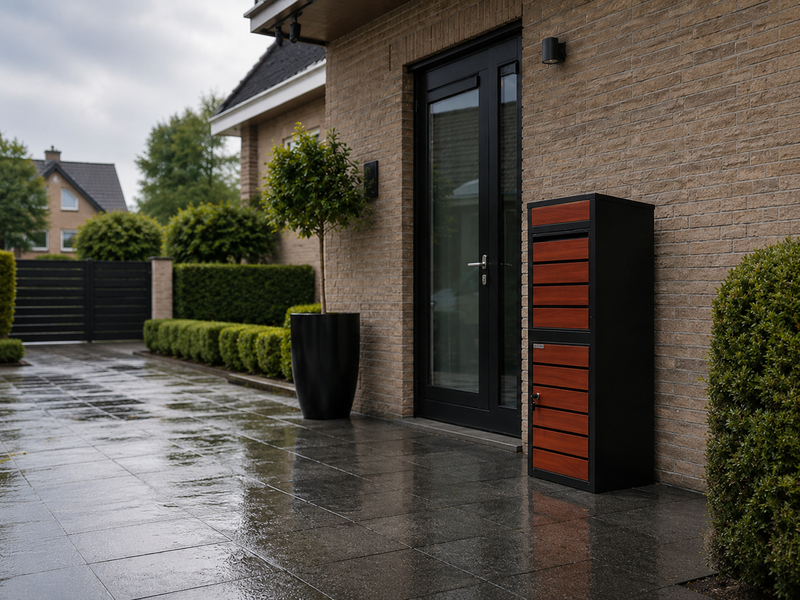
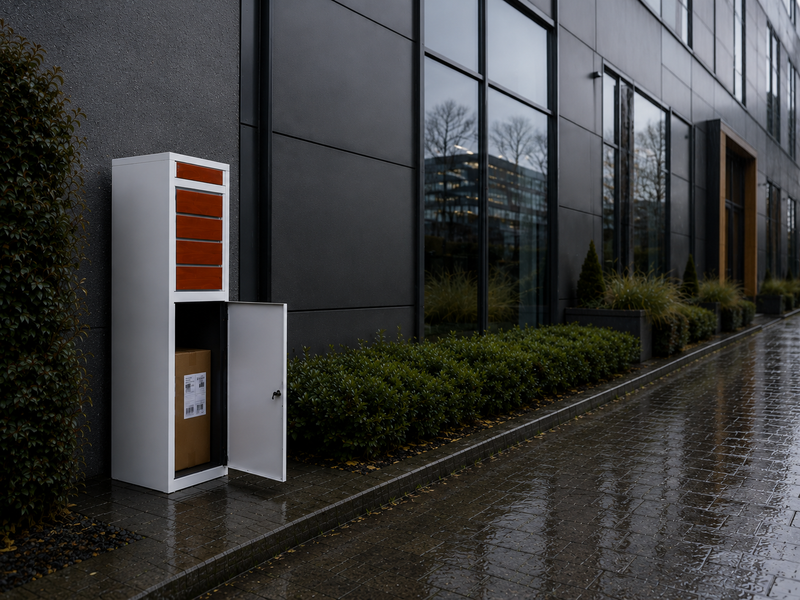
By not letting the parcel end up on the doorstep. That is the whole solution, and it is the only step in this article that works forwards rather than backwards. A parcel in a lockable box with a key lock is not the parcel that disappears from the doorstep. And it immediately makes your legal position simpler, because the discussion about a video doorbell consent or a delivery instruction no longer arises.
We make our boxes ourselves in our own factory, in four series. All series are made of 0.7 mm galvanised sheet steel with Qualicoat Class 2 powder coating with zinc phosphate pretreatment, with a door with a key lock and two keys and a flap on top where the delivery driver puts the parcel in. The parcel compartment of a freestanding model is almost half a metre high, so it holds a week of orders before you need to empty it. For anyone who is out all day and only gets home in the evening, that is the difference between an empty doorstep and a pile of boxes in full view.
LONGEST PARCEL SIDE THAT FITS, PER SERIES
Longest side of the parcel that fits, per BunnyBox series. Source: our own product data, dimensions in mm.
The choice is short. If you have a facade or a wall by the door and mainly order smaller boxes, the BunnyBox Compact is the wall-mounted model: parcels up to 300 x 200 x 200 mm, external dimensions 365 x 250 x 450 mm, and the only series that arrives at your home pre-assembled. If you want it at your boundary with a wood-effect front and separate openings for post and parcels, the Style is the freestanding column of 380 x 365 x 1000 mm for parcels up to 350 x 320 x 200 mm. If you order a mix and mainly want volume, the BunnyBox Home is the freestanding model with parcels up to 370 x 320 x 210 mm in one compartment. And if you regularly run into a long box, the BunnyBox Plus is the answer: parcels up to 450 x 320 x 210 mm, and post and parcels in separate compartments.
| Series | Type | Parcels up to (mm) | External dimensions (mm) | Post and parcels | Installation |
|---|---|---|---|---|---|
| Compact | Wall-mounted model | 300 x 200 x 200 | 365 x 250 x 450 | Separate slot, 1 compartment | Supplied pre-assembled |
| Style | Freestanding column with wood-effect front | 350 x 320 x 200 | 380 x 365 x 1000 | Separate slot, 1 compartment | Self-assembly kit |
| Home | Freestanding | 370 x 320 x 210 | 410 x 380 x 1020 | 1 compartment | Self-assembly kit |
| Plus | Tall freestanding column | 450 x 320 x 210 | 500 x 370 x 1120 | Separate compartments | Self-assembly kit |
To give you an idea of what fits: the Home and the Style take fourteen book packages, the Plus eighteen. Every freestanding model takes four shoeboxes. Phone boxes: nine in the Compact, forty in the Home and the Style, forty-two in the Plus. Colours are RAL 9005 black, RAL 9010 white, RAL 7036 platinum grey and RAL 7016 anthracite, plus combinations with dark teak or light oak. If you are torn between the series, which size parcel letterbox do I need and which BunnyBox suits me will help.
Fix the box to paving slabs or in concrete, because a box you can lift is a box you can carry off. How to go about it is in anchoring a parcel letterbox so it cannot be carried off. Always someone home with a BunnyBox, even when you are not. For the background figures on how often parcels go missing in the Netherlands, see parcel theft in the Netherlands again, and the full overview of our articles is in the knowledge base.
- Showing that you were elsewhere at the time of the scan, as in case 252957/330247
- A written statement from the neighbours that they did not accept anything
- Screenshots of the tracking with the time, taken on the day itself
- A report to the webshop within a few hours of the scan
- A bare delivery scan, on the seller's side
- A signature by an unknown person, case 36537/38572
- Three noted digits of an ID, case 29058/31439
- A report only hours later, case 21551/24761: delivery 10:05, report 17:54

View the models
Frequently asked questions about a stolen parcel
My parcel shows as delivered but I have not received anything. Who is liable?
The seller, as long as it has not been shown that you or a third party you designated received the parcel. That follows from article 7:11 paragraph 1 of the Dutch Civil Code, and ACM ConsuWijzer places the burden of proof on the seller in so many words: "Does the seller say the product was delivered to you? Then the seller has to prove it." Look in your letterbox and with the neighbours first, because DHL itself says a parcel can be in an external letterbox without the tracking saying so.
Should I complain to PostNL or to the webshop?
To the webshop. ACM ConsuWijzer: "You do not have to complain to the delivery service yourself. Because the seller is responsible for shipping." When something goes missing, PostNL itself also sends you to the sender, who can work out with PostNL where the shipment has got to. With DHL the sender claims; with UPS the recipient may also start a claim.
How many days should I wait before reporting a parcel as missing?
With a scan but no delivery, PostNL asks you to wait another two delivery days and says that after more than five delivery days you should contact the sender. DHL gives no number of days. Those are the carriers' waiting times. Legally, it is about the delivery period: if nothing was agreed, the thirty days of article 7:9 paragraph 4 of the Dutch Civil Code apply, and after that you first give the seller a reasonable extra period.
How long is a reasonable period in a formal reminder?
The law gives no figure. Article 6:82 paragraph 1 and article 7:19a paragraph 1 of the Dutch Civil Code speak of a reasonable period. ACM ConsuWijzer says it depends on the type of product and on the earlier delivery time, and does not itself give a number of days on its information page. In its own template letter, the ACM asks for a response within two weeks. So two weeks is a defensible choice, not a statutory deadline.
Will I get my money back within 14 days?
For termination because nothing was delivered, article 7:19a paragraph 3 of the Dutch Civil Code says the seller must refund "without delay all payments received from the buyer". No number of days is given. The fourteen days you often read belong to the cooling-off period: according to the ACM it ends fourteen days after delivery, and after paying in advance or terminating within the cooling-off period your money must be refunded within fourteen days. So with a parcel that has disappeared, use the words without delay.
Should I report a stolen parcel to the police?
In the Netherlands you can do it online with DigiD, under the category "Diefstal van iets anders" (Theft of something else) on politie.nl. There is no separate category for parcel theft. None of the sources we checked names a police report as a condition for your claim against the webshop, so it is not the key that unlocks your claim. Do it anyway: it makes your file more concrete. For an appointment at a police station, call 0900-8844.
Is a parcel left with the neighbours my own risk?
Legally, a neighbour is not a third party you designated. Arnoud Engelfriet wrote on 16 January 2008 that a member of the household may sign on behalf of the addressee but that this does not apply to neighbours, and the Disputes Committee ruled in case 227340/233108 of 6 December 2023 that merely leaving a parcel on site does not count as handing it to the consumer in person, even though a neighbour had seen it being put down. A member of the household or a colleague present at the address given is more readily regarded as a recipient, see case 15296/22874.
Does PayPal Buyer Protection help with a stolen parcel?
In exactly this scenario, often not. PayPal excludes a claim when "the seller has provided proof of delivery", and a delivery scan is such proof of delivery. The dispute must also be opened within 180 days of the payment, and you must first have contacted the seller yourself. A rejection by PayPal says nothing about your rights against the webshop under articles 7:11 and 7:19a of the Dutch Civil Code.
Does my home contents insurance cover a parcel stolen from the doorstep?
In all likelihood, no. The insurance card of the Centraal Beheer home contents insurance, issued by the Dutch Association of Insurers, says under "What is not insured": "Belongings outside the home are not insured under the home contents insurance. Not in the garden either." Garden items are the exception, and a parcel is not a belonging intended for use in the garden. This is one product from one insurer and no insurer mentions the scenario in those words, so check your own policy.
What is the highest compensation a carrier pays for a missing parcel?
For uninsured shipments, DHL eCommerce gives €3.40 per kilo within the Netherlands and about €10.00 per kilo internationally, referring to Book 8 of the Dutch Civil Code, article 1105, and the CMR Convention. In article 9.2 of its terms, UPS gives the higher of €85.00 per shipment or 8.33 SDR per kilogram. At PostNL and DPD we found no maximum. More importantly: those limits apply between sender and carrier and are not your ceiling, because you claim the purchase price from the webshop.
Please note. This article gives general information about your position as a consumer and is not legal advice. If a large amount is involved, or the discussion with the webshop reaches a dead end, it is sensible to consult a lawyer or the Juridisch Loket (the Dutch legal advice centre) before you start proceedings.
Sources and accountability. Last checked on 26 August 2026. Legislation: wetten.overheid.nl, Dutch Civil Code Book 7, BWBR0005290, version in force from 12 February 2025, for article 7:9 paragraphs 1 to 5, article 7:10 paragraph 1, article 7:11 paragraphs 1 to 3 and article 7:19a paragraphs 1 to 4, and Book 6, BWBR0005289, version of 1 January 2024, for article 6:74 and article 6:82 paragraphs 1 and 2. We could not retrieve the Dutch statutory text of articles 6:265 and 6:271 BW from a primary source, so we only mention them by number. For article 6:74 BW we give no paragraph number, because our source gave the paragraphs as one continuous block. Regulator: ACM ConsuWijzer, "Aankoop niet geleverd", "Hoe kan ik het beste betalen bij online aankopen?" and the template letter "Bestelling te laat geleverd", all on consument.acm.nl, consulted 26 August 2026; the news item on the complaint letter assistant dates from 25 October 2023. Note that consuwijzer.nl has moved to consument.acm.nl. Rulings, all from degeschillencommissie.nl and consulted on 26 August 2026: 227340/233108 of 6 December 2023, 252957/330247 of 21 November 2024, 207766/213656 of 11 August 2023, 32074/34023 of 4 September 2020, 21551/24761 of 3 September 2020, 118852 of 5 December 2018, and cases 15296/22874, 29058/31439, 36537/38572 and 21163/37590, all four of which carry the date 9 November 2020, where we could not establish whether that is the date of the ruling or of publication. Rulings of the Disputes Committee are binding advice, not case law that sets a precedent. Carriers: postnl.nl, dhlecommerce.nl, dpd.com and the UPS terms "Bepalingen en voorwaarden van de service" with articles 9.1, 9.2, 9.3 and 12, all 26 August 2026; no GLS page was accessible on that date. Police: politie.nl, report of other theft, 26 August 2026. Insurance: insurance card for the Centraal Beheer home contents insurance, issued by the Dutch Association of Insurers with Achmea Schadeverzekeringen N.V. as risk carrier, and centraalbeheer.nl, both 26 August 2026. Payment: PayPal Legal Hub Purchase Protection Programme and the PayPal security page, ideal.nl consumer page and betaalvereniging.nl, all 26 August 2026. Background: Arnoud Engelfriet, "Bezorging bij de buren van je koop op afstand", blog.iusmentis.com, 16 January 2008. We update this page as soon as any of these sources changes and also check it twice a year. This is general information and not legal advice; for a large amount you can consult a lawyer or the Juridisch Loket.