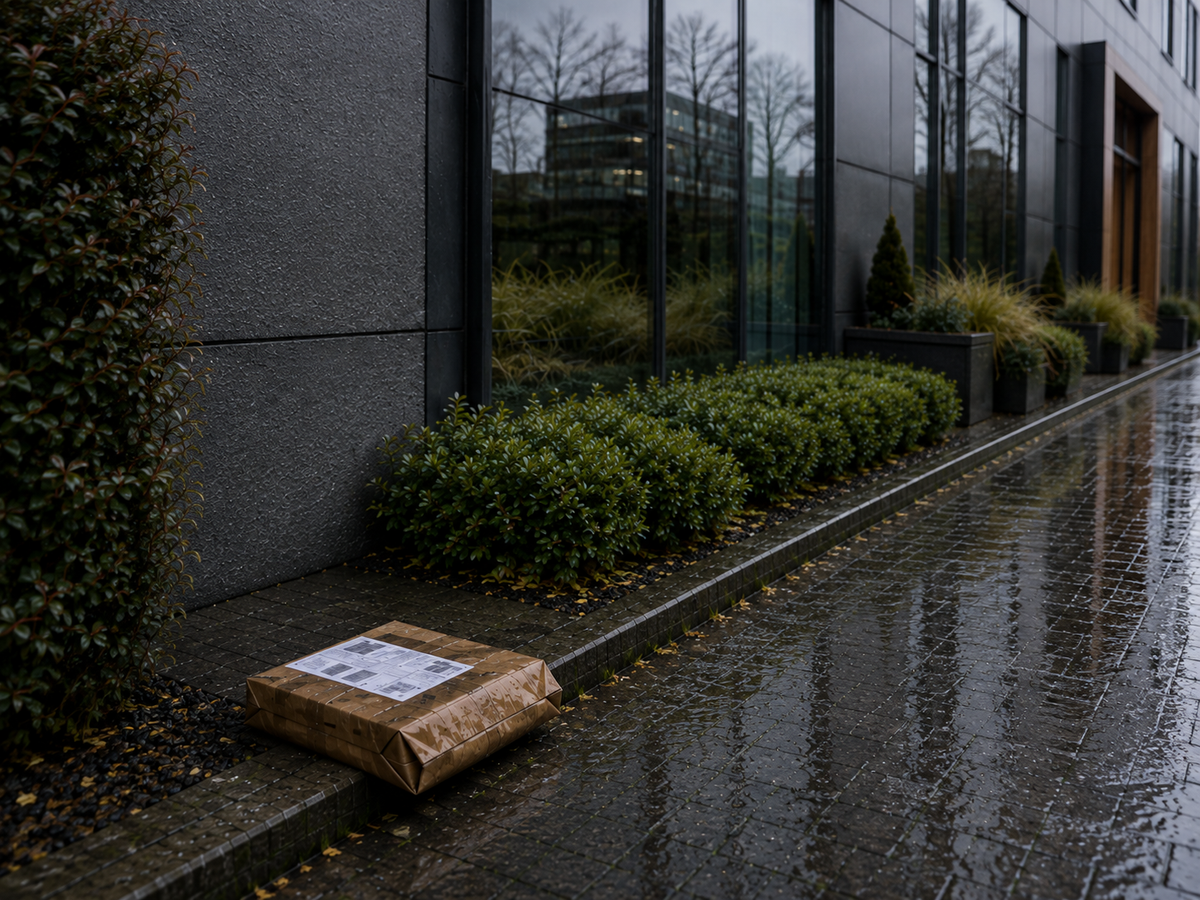
In short
- Eight ways: neighbours, service point, parcel locker, agreed place, your workplace, choosing a time slot, redirecting, or a parcel letterbox at home.
- 82.2 percent of all parcels go to the home address, 12.4 percent to a service point (ACM, 2025).
- Every pickup location keeps your parcel for 5 to 7 days, after which it goes back to the sender.
- Collecting it yourself costs €0.28 to €0.51 per car kilometre and is more polluting than home delivery after just half a kilometre.
- If you specify a delivery spot yourself, the risk shifts to you. A lockable box actually locks the parcel away.
- Complain to the seller, not the carrier (art. 7:11 paragraph 1 of the Dutch Civil Code).
Almost all parcels in the Netherlands go to the home address. In 2025, 82.2 percent were delivered at home, compared with 12.4 percent at a service point and 5.3 percent elsewhere. So home delivery is not disappearing, it is getting busier. And that is exactly where the problem lies: you have to be there.
Below are the eight options side by side, with three things per option: how much effort it costs you each time, who carries the risk if the parcel goes missing, and who it works for. After that come the two costs that appear in almost no comparison article: the holding period at each pickup location and what a trip to that pickup point really costs you. We make parcel letterboxes in our own factory, so we know exactly what does and does not fit through a flap. That is also why we describe the other seven options with figures rather than opinions.

How often that goes wrong is shown by research from the EenVandaag Opinion Panel among more than 24,000 panel members, published on 6 August 2026. Please note: that is a self-selecting opinion panel and not a random sample, so the percentages describe the participants and not the whole population.
- 1 in 3did not receive a parcel in the past year (EenVandaag, 6 August 2026)
- 63%received an unjustified not-at-home notice at least once (EenVandaag, 6 August 2026)
- 4 in 10saw a delivery driver leave a parcel without ringing the bell (EenVandaag, 6 August 2026)
- 82.2%of all parcels go to the home address (ACM, figures for 2025)
The eight options in a table
This table is the short version. The sections below set out for each option what the carriers themselves write about it, which article of their terms applies and what research says about it.
| Option | Effort per parcel | Who carries the risk | Works for | Hard figure |
|---|---|---|---|---|
| 1. With the neighbours | Low, but you are dependent on others | Unsettled: depends on whether you designated the neighbour | People with neighbours who work from home | PostNL may hand it to the neighbours without an additional service (T&C art. 13.1.2) |
| 2. Service point | High: you collect it yourself | The seller, until you collect the parcel | People who pass a point anyway | 12.4% of all parcels (ACM, 2025) |
| 3. Parcel locker | High: you collect it yourself | The seller, until you open the compartment | People who have one nearby | 9,309 parcel lockers, +90.6% in one year (ACM, 2025) |
| 4. Agreed place around the house | Set up once | You, as soon as the parcel is at the spot | People with a locked spot | 21% have a fixed drop-off spot, up from 11% in 2023 (Consumentenbond, 2025) |
| 5. Delivery to your workplace | Low | You, as soon as a colleague signs | People who work in an office | Geschillencommissie 15296/22874: a colleague counts as a designated third party |
| 6. Choosing a delivery time | Arranged per shipment | The seller, until you accept it | People who can plan when they are home | DHL: change until 11:59pm, up to 3 times per parcel |
| 7. Postponing or redirecting | Arranged per shipment | The seller, until you accept it | Holidays and exceptions | DPD: change until 30 minutes before delivery |
| 8. Parcel letterbox at home | One-off investment, then nothing | The parcel is locked away as soon as the flap closes | People who receive parcels every week | 82.2% of all parcels go to the home address (ACM, 2025) |
Where can my parcel go if I am not at home? Options 1 to 4
The first four options have one thing in common: the parcel ends up somewhere you are not at that moment. That is exactly where the discussion about liability begins.
1. Delivery to the neighbours
The default at PostNL if you have not set a preference. PostNL puts it like this itself: when you are not at home they follow your delivery preferences, and if you have not set any, the parcel goes to the neighbours or to a PostNL point. In its General Terms and Conditions for the Carriage of Goods, it is worded as a right. Article 13.1.2 gives PostNL the right to hand over a domestic shipment without an additional service to one of the neighbours, and article 13.2.1 under d explicitly lists handing over to neighbours as a permitted delivery method.
PostNL is not the only one. Trunkrs even makes it the first choice: "If you are not at home, by default we try to deliver to your immediate neighbours." On the track-and-trace page you can use a button to choose which neighbours you prefer. With Trunkrs, though, that route does not apply with 18-plus age verification, a one-time PIN code or if the webshop has prohibited it. Besides neighbours, DHL also counts family members and other people on the recipient's premises as substitute recipients (T&C art. 4.1b). Cycloon Post & Fietskoeriers sends an email with the house number when it hands a parcel to the neighbours, so you know where to ring.
Effort. Low at the moment of delivery, but you still have to chase it up. You do not always know which neighbour has it, and you depend on someone who may be out as well. Risk. Legally unsettled. No ruling by the Geschillencommissie has been found that specifically concerns the neighbour. The reasoning you can make: if you designated the neighbour yourself via a delivery preference, the transfer of risk seems obvious, because then the neighbour is a third party you designated. If the delivery driver handed it to a random neighbour on their own initiative, you have not designated anyone and the situation looks more like a parcel left outside the door. Works for. People with neighbours who are home during the day and do not mind.
2. Service point
Of all parcels in the Netherlands, 12.4 percent went to a service point in 2025 (ACM Post and Parcel Monitor 2025, published 18 June 2026). The network is dense: DPD has more than 1,500 pickup points in the Netherlands, GLS more than 700 ParcelShops, and PostNL and DHL have thousands.
An important difference between the two biggest carriers: DHL does not make a second home delivery attempt. In its own words: "If you are not at home at the time of delivery and we cannot hand the parcel to your neighbours either, we will deliver your parcel the next day to a DHL ServicePoint nearby." With DPD, the parcel goes to the nearest pickup point after the first attempt, with a not-at-home card through the door. GLS automatically makes a second attempt the next working day for business addresses, but not for private addresses.
The point most people miss: your parcel can end up there without you asking for it. The Radar panel of 25 May 2026, with 19,908 participants, shows that 60 percent of participants had a parcel sent to a pickup point instead of home without asking at least once in three years. 89 percent of them were simply at home at the agreed delivery time, and 81 percent suspect the delivery driver never came to the door. This too is a self-selecting panel and not a random sample. Why this happens is explained in why your delivery driver skips your parcel letterbox: the pay model per successful stop often makes driving on to the pickup point the fastest route.
Effort. High and recurring: the parcel does not come to you, you go to the parcel. Factor in the mileage costs further down this article. Risk. Low as long as the parcel is at the point, and legally interesting: on 13 November 2023, the Geschillencommissie ruled that a carrier's parcel point explicitly does NOT count as a third party designated by the consumer, because it is still part of the carrier itself. So if it disappears there, that is not your problem. Works for. People who walk or cycle past it every day.
3. Parcel locker nearby
This is the fastest-growing option in the Netherlands. The number of parcel lockers rose by 90.6 percent in 2025 to 9,309, after 4,800 in 2024 and 2,800 in 2023 (ACM Post and Parcel Monitor 2025). Twinkle reported on 3 April 2026 that PostNL is aiming for 3,600 parcel lockers in 2028 and DHL for 3,000 this year, with a national forecast of 7,000 to 8,000 lockers.
Users are positive about them. In the Consumentenbond (Dutch Consumers' Association) survey of 28 October 2025 among more than 12,000 panel members, use of parcel lockers rose from 4 percent in 2023 to 17 percent in 2025, and parcel lockers scored 8.1 out of 10. Pickup points scored slightly higher at 8.4. This too is a panel and not a random sample.
Two limitations remain. You still have to go there, and the locker needs a free compartment of the right size. In busy weeks a popular locker fills up and your parcel goes to a point further away. Budbee now works exclusively via the Budbee Box with a PIN code, because Budbee has dropped home delivery. What each carrier offers exactly is listed in parcel letterbox carriers: DHL, DPD, GLS, Budbee and Vinted Go.
Effort. High and recurring, with the advantage that the locker is open day and night. Risk. Low: until you open the compartment, the parcel is in the carrier's network. Works for. People with a locker within walking distance who do not get several parcels every week.
4. An agreed place around your home
PostNL calls it an afgesproken plek, DHL the Afgesproken Plek (agreed place), DPD calls it neerzettoestemming (permission to leave), and so does Trunkrs. You specify a spot, for example the shed or under the carport. The share of consumers doing this is growing: 21 percent now choose a fixed drop-off spot, compared with 11 percent in 2023 (Consumentenbond, 28 October 2025).
DHL sets requirements for that spot, and they are stricter than most people think. The spot must be "a covered spot that is not visible from the street. In the shed, for example, or under a small canopy", at your own address and easy to reach. The delivery driver also decides for themselves whether the spot is safe and may refuse. DHL advises against the option for valuable items and excludes it for signature, age check, PIN code, insured or guaranteed delivery.
DPD is the only carrier we looked at with a paper authorisation: a separate signed Neerzettoestemming (permission to leave) form, valid for up to two years after the last delivery and revocable by email. What you sign there cannot be misunderstood: "I accept the associated risks and liability for any loss and/or damage" and "Neither DPD nor the driver is obliged to check whether the above location is suitable." Trunkrs puts it just as directly: "As soon as a consumer gives permission to leave, responsibility for the parcel passes to the customer as soon as our driver has put it down."
So this is the option with the highest risk, and that is not down to the delivery driver but to the legal side. As a consumer law lawyer summed it up in a broadcast on NPO Radio 1 on 15 April 2021:
If you as the recipient choose a place yourself to have a parcel delivered to, you take on the responsibility that the parcel can be delivered safely at that place.Caspar Janssens, consumer law lawyer, NPO Radio 1, 15 April 2021
The Geschillencommissie confirmed that line in case 21163/37590 of 9 November 2020: a consumer gave permission via his video doorbell to leave a parcel at the door, a Philips Hue set worth €249.95 disappeared, and the complaint was rejected. That consent counted as acceptance. DHL says the same in its own words: it is responsible until the moment the parcel has been delivered, after which the risk lies with the recipient.
What matters is whether the spot can be locked. An unguarded spot behind a planter shifts the risk to you without giving you anything in return. A lockable box takes on that same risk and locks it away. More on this in can PostNL put a parcel in your parcel letterbox.
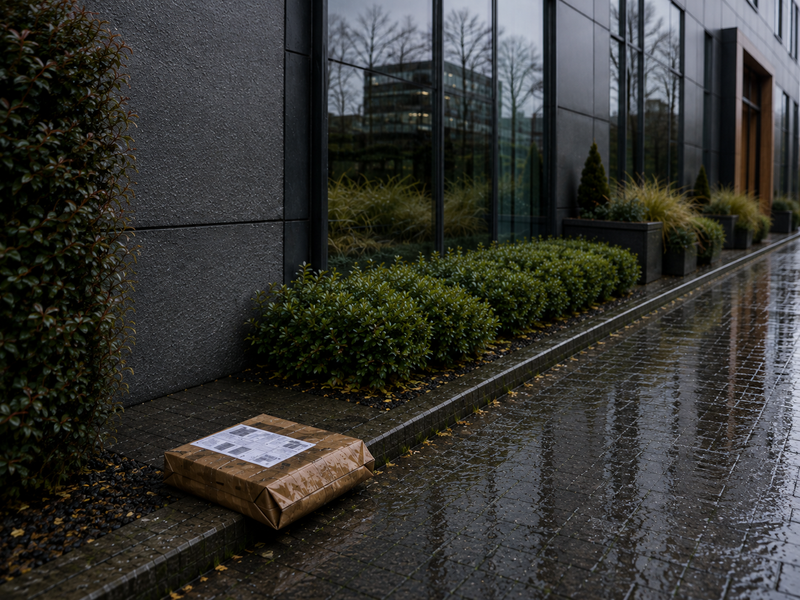
Effort. Set up once, then nothing. Risk. High with an open spot, because you designated the spot. Works for. People with a lockable shed or a lockable box by the door.
How do I get a parcel delivered to my own address? Options 5 to 8
The last four options are about timing and your own address. Only the last one asks something of you once and then never again.
5. Delivery to your workplace
Simple and effective, as long as your employer is happy with it and someone is there to accept it. There is also a ruling on this. In case 15296/22874 of 9 November 2020, a laptop was delivered to a business address, accepted by a colleague, and then disappeared. The complaint was rejected: the risk had passed, because a colleague at the specified address counts as a third party designated by the consumer, in the same way as family members at a home address.
Effort. Low, until you have to lug the box home. It does not work on your working-from-home days, and for most people that is now two a week. Risk. With you as soon as a colleague accepts it. Works for. People with fixed office days who order small parcels.
6. Choosing a delivery time yourself
Carriers increasingly let you choose a day or time slot, sometimes for an extra charge. With DHL you can change the delivery until 11:59pm and up to 3 times per parcel. With DPD it is possible until 30 minutes before delivery via the button in the DPD email, the myDPD app or the track-and-trace page. GLS is the only carrier that offers the choice before the first delivery attempt as a core proposition, with the FlexDeliveryService for date, time or location and the ShopDeliveryService to a ParcelShop.
Effort. One action per shipment. Fine for that one order you are waiting for, unworkable if you receive several parcels every week, because then you are arranging your week around delivery times. Risk. Low, because you accept it yourself. Works for. People who can plan when they are home and do not order much.
7. Postponing delivery or redirecting it to another address
With most carriers you can postpone a shipment or send it to another address via track and trace, provided you do so before the delivery attempt. FedEx offers this via its Delivery Manager, with options such as delivery to a pickup point, leaving it at a safe location, changing the delivery date, delivery to the neighbours or delivery to another address. FedEx itself notes that not all options are available in every country. UPS handles it via My Choice, with the "Change my delivery" button on the dashboard.
This is the ideal solution for a holiday and no solution for everyday life, because it requires an action every time and you have to get ahead of the delivery attempt. If you forget, the holding period starts running, and that is exactly the subject of the next section.
Effort. One action per shipment, with a deadline. Risk. Low. Works for. Holidays, hospital stays and other exceptions.
8. A parcel letterbox at home
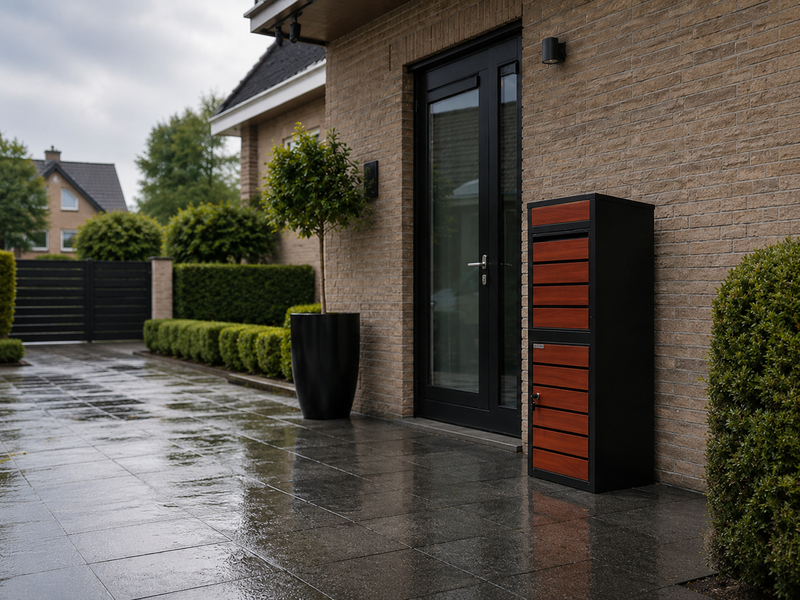
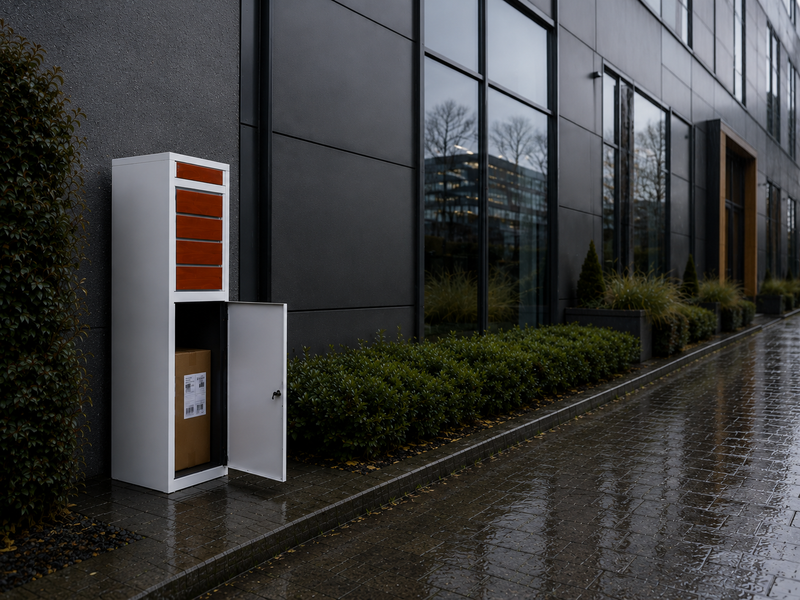
The only option in this list where the parcel comes to your home and you do not have to do anything afterwards. You set your delivery preference once, and after that your post and parcels go into a locked box. No trip, no holding period, no depending on a neighbour. How a sensor on the flap sends you a notification is explained in a smart parcel letterbox.

On its own campaign page about the parcel locker at home, PostNL describes exactly how to use it: place the locker visibly by your front door, register it as your delivery preference, and keep it unlocked and accessible to the delivery driver. PostNL adds that other delivery services use the locker too. At first glance that contradicts the DHL requirement that an agreed place must not be visible from the street. The difference lies in the type of spot: DHL describes an open spot such as a shed or canopy, where visibility means a risk of theft, and PostNL describes a lockable locker, where visibility only serves findability. Neither carrier makes that distinction explicit, so we call it what it is: two requirements that only fit together if the box can be locked.
Two conditions to keep the risk genuinely low: the box must lock, and it must not be possible to fish it empty. An open box on the facade is option 4 with a lid on, with the same risk. The best evidence that a lockable box works comes from offender research. On 22 July 2026, Stickle and Jackson published a survey in Crime Science of 309 self-identified parcel thieves in the United States. On a 5-point scale, a lockable box on the doorstep scored 4.38 as a deterrent, equal to visible neighbours and just below a doorbell camera at 4.54. Only the presence of the resident scored higher, at 4.61. That is a perception survey among offenders in another country, not a measurement of the effect in the Netherlands, but it is the best study available. In an earlier study by Stickle and colleagues (2019/2020), 98 percent of stolen parcels were visible from the street and 61 percent were within about 7.6 metres of the kerb. The full figures are in parcel theft in the Netherlands.
Small shipments count too. Of all post and parcel flows in 2025, 73 million were letterbox parcels, 11.9 percent of the total, compared with 71 million in 2024 (ACM). GLS even lists letterbox delivery as a product feature: EconomyParcel is delivered without a signature, "via the letterbox where possible". What does and does not fit through a standard slot is covered in does a parcel fit through the letterbox.
Effort. Install it once and set your delivery preference. After that, nothing per parcel. Risk. The parcel is locked away as soon as the flap closes. Works for. People who receive parcels every week and are rarely home during the day.
How long does a pickup point keep your parcel before it goes back?
This is the hidden cost of every pickup option, and it rarely appears in comparisons. A parcel does not wait until it suits you. Every pickup location has a holding period, and it is shorter than an average holiday.
| Carrier or location | Holding period | After that |
|---|---|---|
| PostNL point | Up to 1 week | Returned to sender |
| DHL ServicePoint | Up to 5 days | Returned to sender |
| DPD pickup point | 7 calendar days | Returned to sender |
| DPD parcel locker | 5 days | Returned to sender |
| Budbee Box | 5 days | Automatically returned |
For GLS, UPS and FedEx we found no holding period on their Dutch-language pages. That does not mean there is none, only that it is not published.
Work it out for an ordinary situation. You order on Thursday, the delivery driver comes on Friday while you are at work, the parcel goes to the point around the corner, and you leave on Saturday for a week's holiday. With DHL and with a DPD locker, your parcel is already on its way back to the sender by Wednesday. Illness works the same way: in exactly the week you cannot leave the house, the clock keeps ticking. The parcel is not lost then, but your order is: you have to order again, wait again and sometimes pay shipping costs again.
This is the sharpest difference between the eight options. Options 2, 3 and 7 all have a clock running. Option 8 does not: the parcel compartment of a freestanding model is almost half a metre high, so a week of orders fits in without anything having to go back.
What does it cost to collect your parcel yourself?
A service point and a parcel locker are free services. The trip there is not. According to the Vereniging Zakelijke Rijders (the Dutch association of business drivers), on 28 January 2026 a kilometre by car cost between €0.28 and €0.51, depending on the car. That is the full cost price: fuel, depreciation, insurance, maintenance and tax combined.
That the car is often involved is not an assumption. According to the ACM, 33 percent of consumers collect their parcel by car.
| Return distance | Cost at €0.28 per km | Cost at €0.51 per km | CO2 of the trip at 204 g per km |
|---|---|---|---|
| 2 km | €0.56 | €1.02 | 408 grams |
| 5 km | €1.40 | €2.55 | 1,020 grams |
| 10 km | €2.80 | €5.10 | 2,040 grams |
| 20 km | €5.60 | €10.20 | 4,080 grams |
So a five-kilometre round trip costs you €1.40 to €2.55 plus a quarter of an hour of your time. Two of those trips a month and you are spending around €34 to €61 a year collecting things you have already paid for. What a parcel letterbox costs by comparison, and how that price is built up, is in what does a good parcel letterbox cost.
Collecting it yourself is more polluting after half a kilometre
A home delivery is reckoned at an average of 100 grams of CO2, because the delivery van combines hundreds of addresses in one route. A petrol car emits about 204 grams of CO2 per kilometre. If you drive to the pickup point, after just half a kilometre you are already above the emissions of the home delivery you were trying to replace. On a five-kilometre round trip, the CO2 emissions are roughly ten times as high.
To be precise: these are two averages and this is a calculation, not a measurement of your situation. We found no primary Dutch source that puts these two figures side by side and publishes them. Walking or cycling to the point changes the picture completely.
CO2 PER PARCEL RECEIVED
Calculation based on 100 grams per home delivery and 204 grams per car kilometre. Both figures are averages.
What do the figures say about parcel delivery in the Netherlands?
The market in 2025 according to the ACM
On 18 June 2026, the ACM published its Post and Parcel Monitor for 2025. In that year, 615 million parcels were delivered, compared with 609 million in 2024, domestic growth of 0.9 percent. Internationally there were 447 million shipments, up 7.4 percent. The split by delivery location: 82.2 percent to the home address, 12.4 percent to a service point and 5.3 percent to another location. The number of parcel lockers almost doubled, from 4,800 to 9,309, growth of 90.6 percent. Letterbox parcels accounted for 73 million shipments.
Those two figures together tell the real story. The number of lockers is growing explosively, but only 5.3 percent of parcels end up there and the share of home deliveries is barely falling. The front door remains the battleground. Market shares from the ACM decision of 5 April 2024, for 2022: PostNL 50 to 55 percent, DHL 35 to 40 percent, other parties 10 to 15 percent.
What consumers report themselves: three panel surveys
There are three recent Dutch surveys that say something about how often things go wrong. All three are self-selecting panels and not random samples, so the results describe the participants and cannot simply be extrapolated to the whole of the Netherlands. But all three point in the same direction.
| Study | Date and scale | Key findings |
|---|---|---|
| Consumentenbond (Dutch Consumers' Association) | 28 October 2025, more than 12,000 panel members | 35% had a problem with a delivery in six months (2023: 30%, 2021: 27%). Use of parcel lockers from 4% to 17%. Score for parcel lockers 8.1, pickup points 8.4, customer service accessibility 4.6. |
| EenVandaag Opinion Panel | 6 August 2026, more than 24,000 panel members | 1 in 3 did not receive at least one parcel in the past year. 63% received an unjustified not-at-home notice. 4 in 10 saw a delivery driver leave a parcel without ringing the bell. |
| Radar panel | 25 May 2026, 19,908 participants | 60% had a parcel sent to a pickup point without asking in three years. 89% were simply at home at the time of delivery. 81% suspect the delivery driver never came to the door. 49% complained, 14% had their complaint acknowledged. |
Two things stand out. First, the contrast between rating and experience: people give parcel lockers 8.1 and pickup points 8.4, but the customer service you need when things go wrong scores 4.6. Second, the difference between the carrier and you: 89 percent of Radar participants were simply at home when, according to the system, the parcel could not be delivered. At DHL, 63 percent of the reports in that survey concerned a failed home delivery. Where that comes from is explained in why your delivery driver skips your parcel letterbox.
Who is liable if your parcel disappears?
Short answer: almost always the seller, so that is also where you complain. Article 7:11 paragraph 1 of the Dutch Civil Code puts it like this: in a consumer purchase where the item is delivered to the buyer, the item is at the buyer's risk from the moment the buyer, or a third party designated by them who is not the carrier, has received the item. Until then, the risk lies with the seller.
The ACM is explicit about this on ConsuWijzer, updated on 22 July 2026: "You do not need to complain to the delivery company yourself. Contact the seller." And: "Does the seller say the product was delivered to you? Then the seller must prove it."
Three rules many people do not know:
- A carrier's parcel point is not a third party you designated. The Geschillencommissie ruled this on 13 November 2023 in a case involving two smartphones worth €3,714: a parcel point is still part of the carrier itself.
- Leaving a parcel outside the door is not receipt. In case 227340/233108 of 6 December 2023, a parcel worth €425.72 left at the front door disappeared. The complaint was upheld: "Merely leaving a parcel on site does not count as handing it to the consumer in person." Full refund plus €52.50 complaint fee.
- If you give permission yourself, the picture changes. In case 21163/37590 of 9 November 2020, consent given via a video doorbell counted as acceptance and the complaint was rejected.
Note the nuance: the only ruling found on whether leaving a parcel counts as receipt concerned a case with no delivery preference set. What happens if you specified the place yourself has not been settled in the case law found. Carriers take the position that the risk then lies with you. The full details, including what you should and should not report to your home contents insurer, are in parcel theft in the Netherlands: the figures and what really helps.
Which option suits you?
| Your situation | Best option |
|---|---|
| A few parcels a year | Service point or parcel locker, with the holding period in your diary. |
| Ordering regularly, parcel locker within walking distance | That locker, as long as you walk or cycle there. |
| Several parcels every week, rarely home during the day | A parcel letterbox. The only option that takes no recurring effort. |
| Room by the street, no appetite for DIY | A freestanding model on the property boundary, close to the road. The placement requirements are in our article on letterbox requirements. |
| No garden, but a wall or porch | The Compact, pre-assembled on the wall, for parcels up to 300 x 200 x 200 mm. |
| Apartment or homeowners' association without your own facade | Start with the association. A shared solution works better here than eight separate letterboxes. |
| Holiday or a one-off exception | Postpone or redirect. That is what those options are for. |
| Lots of large boxes, for example shoes and clothing | The Plus, with parcels up to 450 x 320 x 210 mm and post in a separate compartment. |
The requirements for placement, height and accessibility of a letterbox are in letterbox requirements in the Netherlands. If you want to build the letterbox into a wall, gate or fence, have a look at building in a parcel letterbox. The ten-metre rule and the foundation for a freestanding post are covered in installing a freestanding parcel letterbox.
And if a parcel does disappear?
Report it to the party you bought from, not to the carrier: that is where your contract is. Keep the tracking number, the time of the delivery notification and, if possible, a photo of the situation to hand. Formally, a parcel may never be left unattended without your permission, so that delivery notification is relevant. The step-by-step plan with the relevant legal articles and a template letter is in parcel stolen: what to do now.
Also keep an eye on the claim deadlines, because they vary widely. PostNL asks for a report within 30 calendar days from the day of presentation (T&C art. 16). DHL applies 30 days after delivery for damage, partial loss or delay, and 60 days after acceptance for total loss (T&C art. 6.3), but refers the recipient to the webshop: at DHL, the sender reports it. DPD wants to hear about visible damage at the moment of delivery and about hidden damage within 7 days, not counting Sundays and public holidays (art. 11.1). DPD is also the only big carrier with an explicit complaint form for recipients.

From small to large: which model suits which order?
We make four models in our own factory, in 0.7 mm galvanised steel sheet with Qualicoat Class 2 powder coating with zinc phosphate pretreatment, with a door with a key lock and two keys and a flap on top for the delivery driver. They differ in what goes through them and where they stand. The comparison of Home, Style, Plus and Compact shows per model what fits inside and when to choose which.
The range goes up in steps. If you mainly order small boxes and have no room for a post, the Compact is the starting point: a wall-mounted model for parcels up to 300 x 200 x 200 mm, external dimensions 365 x 250 x 450 mm, and the only series supplied pre-assembled. You mount it and you are done. It takes nine phone boxes.
If you want post and parcels in a freestanding post with a wood-effect front, the Style is the next step: parcels up to 350 x 320 x 200 mm, a separate slot for letters, external dimensions 380 x 365 x 1000 mm. If you regularly get slightly wider boxes, the Home is the better choice, with parcels up to 370 x 320 x 210 mm and external dimensions of 410 x 380 x 1020 mm. Both the Home and the Style take fourteen book mailers or four shoeboxes.
If large boxes arrive regularly, or you want to keep post and parcels truly separate, the Plus is the better choice. It takes parcels up to 450 x 320 x 210 mm, is the only model with separate compartments for post and parcels, and holds eighteen book mailers or forty-two phone boxes. External dimensions 500 x 370 x 1120 mm. Which size suits your ordering pattern can be worked out with the size guide.
Shipments that require a signature or an age check are always handed over in person. That is a feature of the shipment and not of your letterbox: only the recipient may sign. For those shipments you set a delivery preference or a time slot, and for everything else the parcel simply goes into the box. Which preference you set where differs per carrier, and that is covered in parcel letterbox carriers. All models are available in RAL 9005 black, RAL 9010 white, RAL 7036 platinum grey and RAL 7016 anthracite, and in combinations with dark teak or light oak. Always someone home with a BunnyBox.


View the models
All models and colours are together in the parcel box collection. You will find the rest of the Knowledge base on the Knowledge base page.
Frequently asked questions
What happens if I am not at home when a parcel arrives?
PostNL follows the delivery preferences you have set. If you have not set any, the parcel goes to the neighbours or to a PostNL point. DHL does not make a second home delivery attempt: if it does not work with you or the neighbours, the parcel goes to a DHL ServicePoint the next day. DPD takes it to the nearest pickup point after the first attempt.
Can I have a parcel delivered without being at home?
Yes, via an agreed place, a parcel letterbox, a parcel locker or your work address. With a place you have specified yourself, though, you take on the responsibility: DPD even has you sign for it. With a lockable box at home, the parcel is locked away as soon as the flap closes.
How long does PostNL keep my parcel at a pickup point?
Up to one week, after which the parcel goes back to the sender. At a DHL ServicePoint it is up to 5 days, at a DPD pickup point 7 calendar days, at a DPD locker 5 days and at a Budbee Box 5 days.
Is a parcel locker nearby better than a parcel letterbox?
A locker is reliable and open day and night, and users give it a score of 8.1 out of 10 (Consumentenbond, 28 October 2025). But you have to go there yourself, there has to be a free compartment of the right size, and after 5 days your parcel goes back. A parcel letterbox comes to you and has no holding period.
What does it cost to collect a parcel yourself?
Driving costs €0.28 to €0.51 per kilometre (Vereniging Zakelijke Rijders, 28 January 2026). So a five-kilometre round trip is €1.40 to €2.55 plus your time. According to the ACM, 33 percent of consumers collect their parcel by car.
Is collecting it yourself more sustainable than home delivery?
Not by car. A home delivery is reckoned at an average of 100 grams of CO2, and a petrol car emits about 204 grams per kilometre, so after half a kilometre you are already more polluting. On foot or by bike it is a different story.
Can a delivery driver hand my parcel to the neighbours?
Yes. PostNL has even laid down that right without an additional service in article 13.1.2 of its General Terms and Conditions for the Carriage of Goods, and with Trunkrs the neighbours are the default. It is not allowed with age verification or a one-time PIN code.
Who should I complain to if my parcel is lost?
The seller, not the carrier. The ACM writes on ConsuWijzer: "You do not need to complain to the delivery company yourself. Contact the seller." If the seller says the parcel was delivered, they have to prove it (art. 7:11 paragraph 1 of the Dutch Civil Code).
What can I do about unjustified not-at-home notices?
Set your delivery preference, so there is an instruction with the shipment, and make sure your box is clearly meant for parcels. If it keeps happening, report it to the seller and use the carrier's complaints procedure. In the Radar panel of 25 May 2026, of the 49 percent who complained, only 14 percent had their complaint acknowledged.
Does a parcel letterbox also work if I live in an apartment?
Yes, if you have your own facade, porch or front door on the ground floor where you are allowed to mount something. A wall-mounted model such as the Compact is then the logical choice. If you are in a shared hallway, start with the homeowners' association: according to the police in Amsterdam, parcels often disappear precisely from a publicly accessible hallway.
Please note. Last checked on 25 August 2026. Main sources: ACM Post and Parcel Monitor 2025 (published 18 June 2026) and the ACM decision of 5 April 2024; ACM ConsuWijzer "Aankoop niet geleverd" (Purchase not delivered), updated 22 July 2026; Consumentenbond survey of 28 October 2025 among more than 12,000 panel members; EenVandaag Opinion Panel of 6 August 2026 among more than 24,000 panel members; Radar panel of 25 May 2026 with 19,908 participants; Twinkle, 3 April 2026; mileage costs from the Vereniging Zakelijke Rijders, 28 January 2026; the terms and conditions and customer service pages of PostNL, DHL, DPD, GLS, UPS, FedEx, Budbee, Trunkrs and Cycloon; rulings of the Geschillencommissie Thuiswinkel 227340/233108 (6 December 2023), 13 November 2023, 15296/22874 and 21163/37590 (both 9 November 2020); Stickle and Jackson, Crime Science, 22 July 2026; Stickle et al., Criminal Justice Studies, 2019/2020; art. 7:11 paragraph 1 of the Dutch Civil Code. The three Dutch consumer surveys are self-selecting panels and not random samples. We update this page at least twice a year, and sooner as soon as a carrier changes its terms.