In short
- Choose based on the box you actually order, not on the external size of the letterbox.
- Carriers' size classes are upper limits, not averages.
- Around 88 percent of all parcels delivered are not letterbox parcels (ACM, 2025).
- Ask for three dimensions: slot size, internal size of the parcel compartment and external size.
- Parcel sizes: Compact 300 x 200 x 200 mm, Style 350 x 320 x 200, Home 370 x 320 x 210, Plus 450 x 320 x 210.
- The parcel compartment of a freestanding model is almost half a metre high: 14 book mailers.
- If your box just does not fit, the next model up will take it.
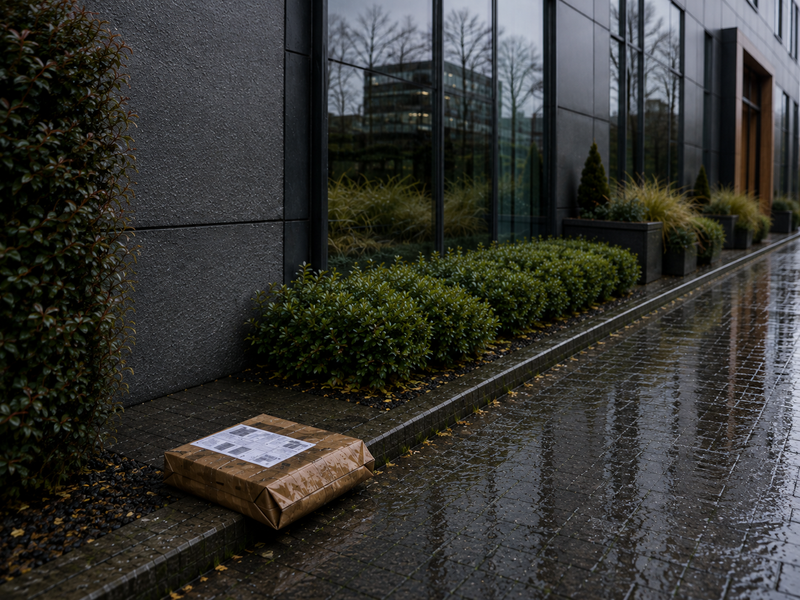
The size of parcel letterbox you need follows from the box you actually order, not from the name of the rate class that box is shipped in. Measure your largest normal parcel, put those three figures next to the internal size of the parcel compartment, and work your way up the range, Compact, Style, Home, Plus, until your box fits.
Below you will first find the carriers' size classes, with a clear warning on how to read them. Then the real box sizes per product category, with the source status alongside, because that is the figure that matters. Next come the four models we make ourselves, the step-by-step choice ladder, and the capacity per model. We make these boxes in our own factory, so we can write down and stand behind every dimension. A webshop that buys them in cannot.
- 615 mln parcels delivered in the Netherlands in 2025 (ACM Post and Parcel Monitor 2025, 24 June 2026)
- 88% of those are not letterbox parcels: 73 of the 615 million shipments were (ACM, 2025)
- 32 mm legal minimum for the height of the slot (Postregeling 2009, art. 6 para. 3)
- 450 mm widest parcel the BunnyBox Plus takes (own model overview, 18 August 2026)

Step 1: what parcel sizes actually exist?
Carriers work with fixed size classes. Before you look at the table, one thing needs to be clear, because almost everyone reads this wrongly: these are upper limits of a rate class. They tell you what is still just accepted in that class and where the price jumps. They say nothing about the size of a typical shipment. So the name of the class tells you nothing about how big your box really is.
| Size class | Upper limit of the class | Maximum weight |
|---|---|---|
| Letterbox parcel, PostNL private customers | 38 x 26.5 x 3.2 cm | 2 kg |
| Letterbox parcel, PostNL business customers | 38 x 26 x 3.2 cm | 2 kg |
| Letterbox parcel, DHL eCommerce | 38 x 26.5 x 3.2 cm | 2 kg (consumer page) or 1 kg (business page) |
| ParcelLetter, DPD Netherlands | 38 x 26 x 3 cm | 1 kg |
| Small parcel, PostNL | 38 x 28 x 15 cm, on the shipping page 34 x 28 x 15 cm | 3 kg |
| Medium parcel, PostNL | 100 x 50 x 50 cm | 10 kg |
| Large parcel, PostNL | 176 x 78 x 58 cm, on the shipping page 178 x 78 x 58 cm | 23 kg |
| DHL For You, classes S to XXL | 120 x 60 x 60 cm, the same size for all five classes | 5, 10, 15, 20 and 31.5 kg |
| DHL eCommerce, standard consumer parcel | 80 x 50 x 35 cm | 20 kg |
| DPD, online shipping portal and Parcel Point | length 100 cm, girth 250 cm | 20 kg |
| GLS Netherlands | length 200 cm, girth 300 cm | 32 kg |
| UPS Netherlands | length 274 cm, length plus girth 400 cm | 70 kg |
Two things stand out. First: the letterbox parcel, 3.2 centimetres thick, fits through an ordinary letterbox by definition, because that product was designed directly around the legal slot. The 265 mm and the 32 mm come word for word from article 6 paragraph 3 of the Postregeling 2009, the 380 mm from paragraph 5. There is more on that in letterbox requirements in the Netherlands. Second: the jump after that is huge. From 3.2 centimetres thick to 15 centimetres thick for the small parcel. That gap is exactly what a parcel letterbox exists for, and it is also the size most online orders come in: shoes, books, cosmetics, small electronics, clothing in a box.
Please note. The 100 x 50 x 50 cm for "medium parcel" is the size the carrier still accepts in that rate class, not the size of an average order. If you read that a medium parcel is 100 x 50 x 50 cm, you are reading a price limit and thinking you are seeing a product description. By far most shipments that go down the conveyor as medium parcels are the size of a book, clothing or shoebox and fit comfortably within the size of a freestanding parcel letterbox.
Why a class name tells you nothing about the size of your box
A rate class is a pricing agreement, not a measurement. PostNL, DHL and DPD classify shipments based on the most expensive combination of size and weight that occurs in that class, because that is what the sorting machine and the delivery van have to be designed for. Anyone who reads the upper limit as an average makes three mistakes at once. They overestimate the box they get at home, they underestimate what a parcel letterbox can handle, and they compare boxes on a figure that has nothing to do with their own orders.
DHL's figures show this most clearly. In the MyParcel carrier specification for 2026, the classes S, M, L, XL and XXL at DHL For You are not size classes but weight classes: 5, 10, 15, 20 and 31.5 kg. The maximum dimensions are the same for all five, 120 x 60 x 60 cm. So a parcel booked as XXL can be physically exactly the same size as a parcel booked as S. The label says something about the weight and the price, not about the box.
Another reason to distrust the class names: the carriers contradict themselves. PostNL gives 38 x 28 x 15 cm for the small parcel and 176 x 78 x 58 cm for the large one on its customer service page, while the shipping page says 34 x 28 x 15 and 178 x 78 x 58. DHL gives 2 kg for the letterbox parcel on its consumer page and 1 kg on its business page. We would rather publish those differences than turn them into an average.
How big is the box you actually order?
This is the figure your size follows from. Not the class, but the box. Below are the standard sizes stocked by Dutch packaging suppliers for the six categories that most often arrive at a front door. The source status is shown explicitly, because it is not the same for every row.
What we cannot do is give the box sizes used by the big webshops. For Coolblue, Zalando, Amazon.nl, Douglas, Bax Music and HelloFresh, no public packaging specifications were found after targeted searching. No reliable public source was found for pet food either. We do not fill those in with an estimate. What is solid: the boxes the suppliers stock, and the boxes PostNL itself sells.
| What you order | Typical box size, l x w x h in mm | Through a 32 mm slot | Smallest BunnyBox that takes it | Source status |
|---|---|---|---|---|
| Book, paperback or A5 | 217 x 155 x 10 and 230 x 165 x 15 | Yes | Compact | Packaging supplier's standard size, not confirmed by the webshop |
| Book A4, thin | 302 x 215 x 20 | Yes | Style | Packaging supplier's standard size |
| Book A4 thick, or several books | 302 x 215 x 75 and 330 x 230 x 100 | No | Style | Packaging supplier's standard size |
| Clothing, flat in a letterbox box | 310 x 220 x 28 | Yes | Style | Packaging supplier's standard size |
| Clothing, T-shirt box | 200 x 150 x 80 | No | Compact | Packaging supplier's standard size |
| Clothing, coat in a large box | 613 x 502 x 80 | No | 613 mm long: set your delivery preference | Packaging supplier's standard size |
| Trainers | 330 x 200 x 110 | No | Style | Packaging supplier's standard size |
| Women's shoe | 300 x 180 x 100 | No | Compact, exactly on the 300 mm limit; plenty of room in the Style | Packaging supplier's standard size |
| Children's shoes | 250 x 170 x 90 | No | Compact | Packaging supplier's standard size |
| Boots, packed lying down | 350 x 220 x 120 | No | Home | Packaging supplier's standard size |
| Boots, packed upright | 480 x 300 x 120 | No | 480 mm long: set your delivery preference | Packaging supplier's standard size |
| Toiletries, one item in an A6 letterbox box | 180 x 115 x 28 | Yes | Compact | Packaging supplier's standard size |
| Toiletries, several bottles | 240 x 170 x 80 | No | Compact | Packaging supplier's standard size |
| Small electronics | 200 x 140 x 80 to 305 x 215 x 110 | No | Compact for the small size, Style for the large one | Packaging supplier's standard size |
| Toys | 305 x 220 x 150 | No | Style | Packaging supplier's standard size |
| Groceries in a folding crate | 600 x 400 | No | 600 mm long: that crate goes from hand to hand | Albert Heijn, Euro standard size |
Read the fourth column as a ladder and not as a limit. Any box that falls just outside one model is simply taken by the next one. A 330 mm trainer box goes in the Style, a boot packed lying down in the Home, and the PostNL type 5 box of 430 x 300 x 90 mm in the Plus.
The five boxes PostNL sells itself
PostNL sells five boxes of its own. That is a solid source, because these are the boxes PostNL offers as standard to everyone who sends something. The sizes in millimetres: type 1 is 146 x 56 x 131, type 2 is 200 x 140 x 80, type 3 is 240 x 170 x 80, type 4 is 305 x 215 x 110 and type 5 is 430 x 300 x 90. None of the five goes through a letterbox slot: the lowest is 56 mm high, almost twice the 32 mm in the Postregeling. The first four fit in the Compact or the Style, type 5 fits in the Plus.
Why packaging suppliers stick to 28 mm and not 32 mm
This is the detail that shows how tight the letterbox slot really is. In article 6 paragraph 3 of the Postregeling 2009, the law requires a clear slot opening of at least 265 mm wide and 32 mm high. You would expect the packaging supplier's letterbox box to be 32 mm high as well. It is not. Two independent Dutch suppliers stock the same range of letterbox boxes, and across the board it is about 28 mm: A6 180 x 115 x 28, A5 255 x 160 x 28, A4 310 x 220 x 28 and A4-plus 350 x 250 x 28 mm.
The suppliers say why themselves. Verpakgigant states plainly that all sizes keep to a height of around 28 mm so that they pass effortlessly through the letterbox. G&F explains that the 28 mm is the usable product space and that the remaining millimetres go into the walls of the corrugated cardboard. In other words: of the 32 mm the law guarantees, around 28 mm is left for your order once the box itself is accounted for, and that 28 mm is the real limit of the letterbox channel. A T-shirt in an 80 mm box is already almost three times over it. Which shipments those are is covered in which parcels do not fit through the letterbox.
This range also explains why a parcel letterbox takes so much more than a letterbox with a large slot. The slot is a two-dimensional problem, the parcel compartment a three-dimensional answer. As soon as the flap is on top instead of a slot in the door, the 28 mm disappears as a limit and only the internal dimensions of the compartment count.
Why are almost 88 percent of all parcels not letterbox parcels?
The answer to the size question starts with this figure, because it determines how often you will deal with a parcel that does not fit. On 24 June 2026, the ACM published its Post and Parcel Monitor for 2025. It reports 615 million parcels delivered in the Netherlands, compared with 609 million in 2024. Of those 615 million, 73 million were letterbox parcels, almost 12 percent. In 2024 there were 71 million, or 11.7 percent, and in 2021 just 58 million, or 9 percent.
There is a methodological footnote, and it makes the figure stronger rather than weaker. The 88 percent is a lower limit. The ACM counts letterbox parcels as a product category booked by the carrier, not as a physically measured fit. A shipment booked as a letterbox parcel that still does not go into a shallow or full letterbox is still counted as a letterbox parcel in the statistics. So the real share of shipments that go through a standard letterbox slot is below 12 percent, and the share that does not is above 88 percent.
The share of letterbox parcels is growing, though, by about one percentage point a year. Reporting on the 2024 monitor, ecommerceNews said total parcel volume grew by 2.4 percent and that three quarters of that growth was down to letterbox parcels. At that rate it will take decades before letterbox parcels are the majority. For your choice today it means: plan for the parcel size, not the slot size.
Where that 88 percent ends up has been counted too. In 2025, 82.2 percent of parcels were delivered at home, 12.4 percent at a service point and 5.3 percent elsewhere. At the end of 2025 there were 9,309 parcel lockers across the Netherlands. What happens if a delivery driver takes your parcel away after all, and how to prevent it, is covered in why your delivery driver skips your parcel letterbox.
Step 2: what are the dimensions of the four BunnyBox models?
We make the boxes ourselves in our own factory, so we can simply write down all four sets of dimensions and be held to them. The "Parcels up to" column is the maximum parcel size: the largest single parcel that still fits. All dimensions in millimetres, in the order width x depth x height.
| Model | Parcels up to | External dimensions | Post and parcels | Finish |
|---|---|---|---|---|
| Compact | 300 x 200 x 200 | 365 x 250 x 450 | Separate slot, one compartment | Wall-mounted model, the only series supplied pre-assembled, 6.5 kg packed |
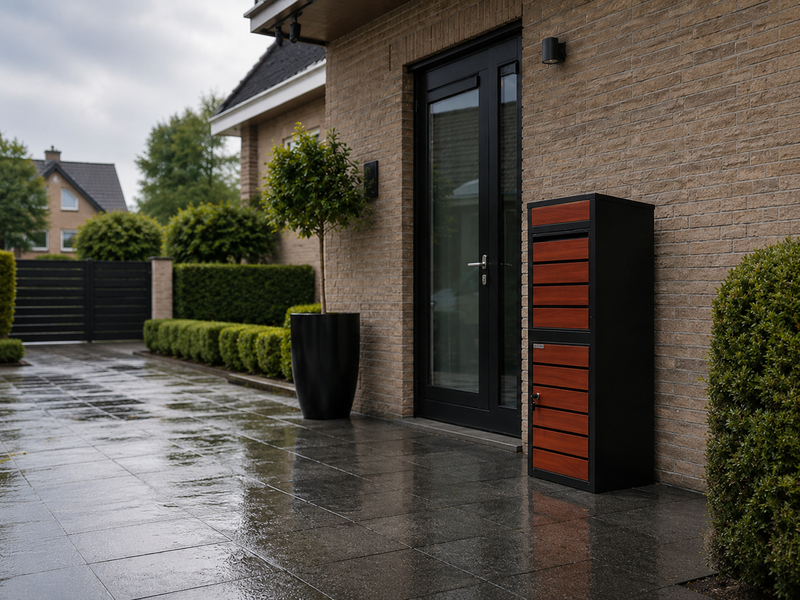
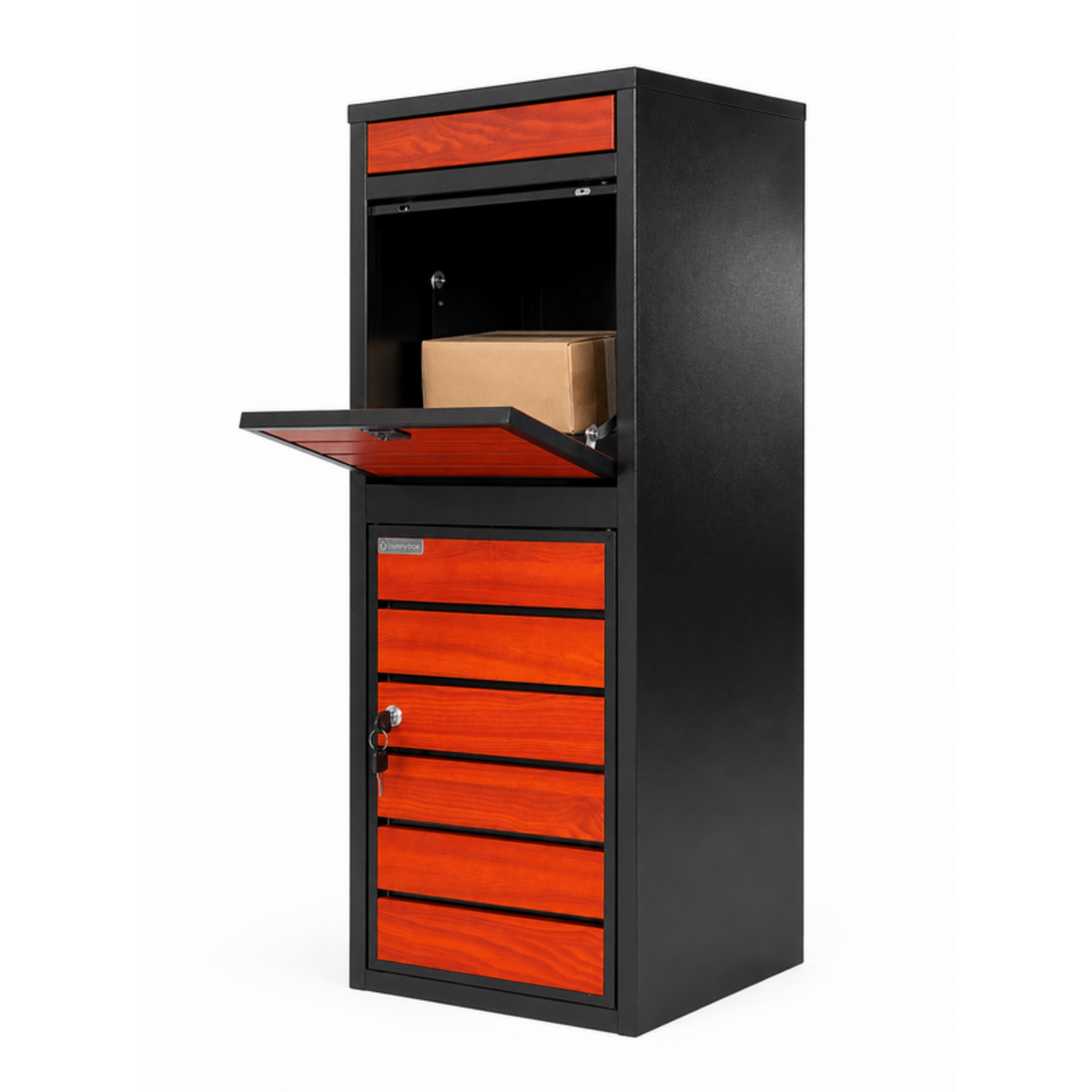
| Style | 350 x 320 x 200 | 380 x 365 x 1000 | Separate slot, one compartment | Freestanding post with wood-effect front, self-assembly kit, 17.0 kg packed |
| Home | 370 x 320 x 210 | 410 x 380 x 1020 | One compartment | Freestanding, flap on top, self-assembly kit, 16.0 kg packed |
| Plus | 450 x 320 x 210 | 500 x 370 x 1120 | Separate compartments for post and parcels | Tall freestanding post, self-assembly kit, 20.0 kg packed |
All four series are made of 0.7 mm galvanised steel sheet with Qualicoat Class 2 powder coating with zinc phosphate pretreatment, with a door with a key lock and two keys and a flap on top for the delivery driver. The colours are RAL 9005 black, RAL 9010 white, RAL 7036 platinum grey and RAL 7016 anthracite, plus combinations with dark teak or light oak. The three freestanding models are supplied as a self-assembly kit. The Compact is the only series that arrives pre-assembled: unpack, mount, done. Which tools you need and which wall plug suits which surface is explained in assembling a parcel letterbox.
A detail you will not read anywhere else: the difference between the external size and the parcel size is kept small on every model. On the Home, the external size is 410 x 380 mm and the largest parcel 370 x 320 mm, so 40 mm and 60 mm go into steel sheet, hinge and lock. With boxes where that difference runs to a hundred millimetres, the letterbox is big on the outside and small on the inside. So always ask for both figures.
From small to large: which model suits which order?
The four models form an ascending range. Each size limit is not an end point but a signpost: if your box falls just outside one model, the next one takes it. This is how the ladder works.
This is how you read that ladder in practice. If you mainly order books, cosmetics and small electronics, start with the Compact: it hangs on the wall, arrives pre-assembled and takes the A4 book mailer, the A6 toiletries box and the T-shirt box. If trainers and toys come on top of that, the Style takes the next step with 350 x 320 x 200 mm and a separate letter slot. If boots and boxes of around 370 mm regularly turn up, the Home is the model that fits. And if you regularly receive large boxes, the Plus is the better choice: 450 mm wide and post in a separate compartment.


Some shipments require a signature or an age check. That is a feature of the shipment, set by the sender: only the recipient may sign, and that applies at every delivery point. What you do control yourself is the delivery preference you set with the carrier, and that differs per carrier. We have looked into exactly what happens with each carrier and what you can set with DHL, DPD, GLS, Budbee and Vinted Go. For the chance that a parcel is left at the front door and disappears, we have gathered the figures in parcel theft in the Netherlands.
How many parcels fit in at the same time?
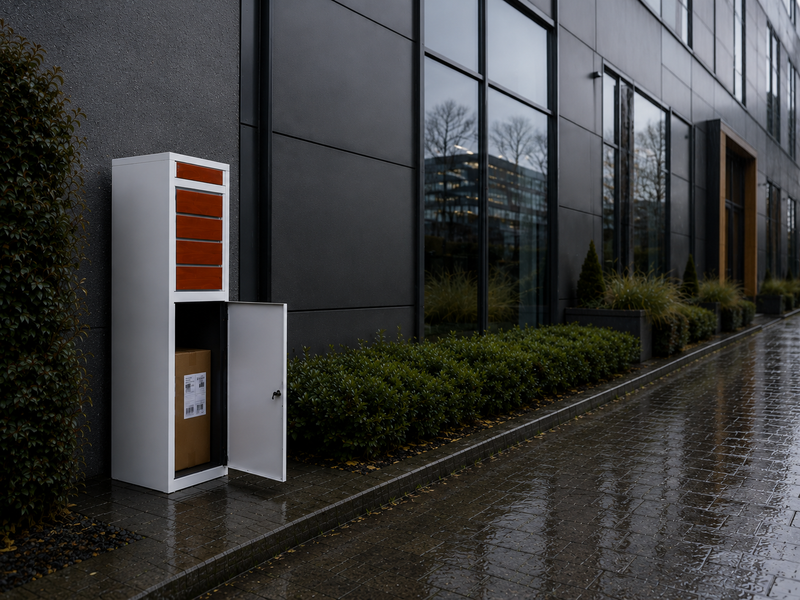
This is the question almost nobody asks and the one that matters most. The maximum parcel size is about the largest single parcel. Capacity is about the stack. A parcel letterbox is not a box the size of one parcel, but a post: the parcel compartment of a freestanding model is almost half a metre high. A week of orders fits in there.
The numbers below come from our own capacity model, Maximum column. That means: neatly stacked and turned on their side where possible, just as a delivery driver puts a box into the compartment. They are calculated on the cautious side, using the narrowest internal dimension we know for each box.
| Packaging | Compact | Style | Home | Plus |
|---|---|---|---|---|
| Book mailer | From the Style up | 14 | 14 | 18 |
| Shoebox | From the Style up | 4 | 4 | 4 |
| Phone box | 9 | 40 | 40 | 42 |
Fourteen book mailers in the Home and the Style, eighteen in the Plus. Four shoeboxes stacked in every freestanding model. And forty phone boxes in the Home and the Style, forty-two in the Plus. The Compact takes nine phone boxes, which is a pleasing ratio for a wall-mounted model with external dimensions of 365 x 250 x 450 mm. From the Style up the real stacking begins, because that is where you gain the height of the post.

Translate that into your own week. A household that receives something four times a week, with a mix of books, cosmetics, clothing and the occasional pair of shoes, will not reach the top of a freestanding model. Even in a peak week around Black Friday or mid-December there is room to spare, and that is exactly the point: you do not have to empty it every evening. That makes capacity more important than maximum parcel size, because you use the maximum parcel size a few times a year and the stacking height every day.
If you are choosing between two models, let capacity decide. The Plus gives you four extra book mailers and two phone boxes, and also separates the post from the parcels, so an envelope does not disappear under a box. The full comparison on placement, assembly and finish is in which BunnyBox is right for me.
Internal size, external size or slot size: which one do you ask for?
There are three dimensions in circulation and they differ considerably. The external size is the letterbox itself, from steel sheet to steel sheet. That is the one most often shown on a product page, because it is the largest and sounds best. The internal size is the usable space in the parcel compartment, so what actually fits inside. The slot size is the opening the shipment has to pass through, which on a letterbox is the slot and on a parcel letterbox is the flap on top.
THREE DIMENSIONS, THE SAME WALL, COMPARED BY HEIGHT
Slot size from Postregeling 2009 art. 6 para. 3, box height from two Dutch packaging suppliers, parcel size from our own model overview of 18 August 2026.
So always ask for three figures before you order: the internal size of the parcel compartment, the size of the parcel opening and the depth to the back wall. If you cannot get them, that is information in itself. That is why our table above does not lead with the external size, but with the parcel that fits inside.
Why depth matters more than height
A box usually goes in flat or slightly tilted. That means the depth of the compartment determines whether a parcel fits, not how tall the post is. A letterbox 80 centimetres tall with a compartment 20 centimetres deep will not simply take a 330 x 200 x 110 mm shoebox, because that box has to land somewhere. That is why all our freestanding models have 320 mm of depth in the parcel compartment, whether you choose the Style, the Home or the Plus. The difference between those three is in the width and the stacking height, not in the depth.
The height then does the other job: it determines how many fit in. That is why "does my parcel fit" and "does my week fit" are different questions, with different dimensions as the answer. You answer the first with width and depth, the second with height.

A practical test that always works: take the box from your last large order, measure length, width and thickness, and put those three figures next to the internal size of the parcel compartment. If the box stays comfortably within the size in two of the three directions, you are fine. If it falls just outside in one direction, read off in the table above which model does take it.
Which profile are you? Three households, three sizes
Get out your order history for the past three months and do not look at the number of orders, but at the largest parcel and at how many arrive on the same day. Those two figures determine your size. In practice, people fall into three profiles.
Profile A: post plus the occasional parcel
A few orders a month, mainly clothing, books and cosmetics. Largest box roughly trainer size, 330 x 200 x 110 mm. You are usually home within a day to empty the letterbox.
Any freestanding model will do here. The Home is the logical choice: parcels up to 370 x 320 x 210 mm, so the trainer box goes in easily, with room for a second and third parcel on top. If you would rather have a wood effect facing the street and a separate slot for your post, the Style is the same class in a different outfit. If you have no room for a post, or the box needs to go on a wall or in a porch, the Compact is the practical choice: parcels up to 300 x 200 x 200 mm, nine phone boxes, and it arrives pre-assembled so all you have to do is mount it.
Profile B: a household that lives online
Several orders a week, varying sizes, regularly a box of small electronics at 305 x 215 x 110 mm or a parcel from a second-hand seller. You are regularly out for a whole day, so two or three parcels may end up on top of each other.
This is the profile most people fall into. Do not plan for a single parcel here but for a stack: four shoeboxes, or fourteen book mailers, or forty phone boxes. The Home and the Style both handle that. If boots or boxes of around 370 mm regularly turn up, the Plus raises your limit to 450 mm and adds four book mailers of capacity.
Profile C: large household, home workers or a business run from home
Orders every day, several residents, and regularly a box approaching 450 mm. Or a practice or shop at home that receives deliveries.
Here the Plus is the strongest choice: the largest single parcel at 450 x 320 x 210 mm, eighteen book mailers, and post and parcels in separate compartments so your letters do not disappear under a box. With several independent residents at one address, two smaller letterboxes are often still smarter than one large one, because then everyone has their own post, parcels and key. If you want to build the box into a wall, gate or fence rather than stand it freely, read building in a parcel letterbox.
How often do you empty it, and what does that mean for your size?
A parcel letterbox is not storage, but it does bridge the time between the delivery driver and you. The longer that time, the more capacity you need. If you are out on weekdays and only empty it in the evening, plan for two to three shipments stacked on top of each other plus that day's post. If you are away for a weekend during a peak period, add more on top of that. How an outdoor box keeps parcels dry and where condensation comes from is explained in is a parcel letterbox waterproof.
There is a hard reason not to cut it too fine: carriers' holding periods are short. PostNL keeps a parcel at a service point for a maximum of one week and then returns it to the sender. DHL takes the parcel to a ServicePoint the next day and keeps it there for a maximum of five days. DPD keeps it for seven calendar days at a pickup point and five days in a parcel locker. If you are away for a week, there is a real chance that a parcel that did not fit in the letterbox is already on its way back to the webshop. A letterbox that takes in the whole week removes that deadline.
Rule of thumb: take the volume of your largest normal parcel and double it. That is almost always the size you will still be happy with in three years' time, because in three years you will almost certainly be ordering more than now. The number of parcels in the Netherlands has been growing for years, from 609 million in 2024 to 615 million in 2025. The alternatives to home delivery are compared side by side in receiving a parcel when you are not at home, and what PostNL specifically does and does not put in a parcel letterbox is covered in can PostNL put a parcel in a parcel letterbox.
What do you get for your money with a parcel letterbox?
Size is half the story, build quality the other half. Three things determine what you get.
0.7 mm steel sheet with Qualicoat Class 2 powder coating with zinc phosphate pretreatment. All four BunnyBox series are made of 0.7 mm galvanised steel sheet with Qualicoat Class 2 powder coating with zinc phosphate pretreatment. That is a specification most suppliers do not show you: on the product pages of Gamma, Praxis, Karwei, Hornbach, bol.com and Brievenbusdirect, the steel thickness was missing for every model we checked in August 2026, including models costing €346 and €549. The only manufacturer that does publish it is Logixbox, with 1.0 mm galvanised steel on the Frontbox-Uni. The missing steel thickness on the rest is a buying signal in itself: what is not stated cannot be compared.
A door with a key lock and two keys. That is our standard specification on all four series, together with the flap on top through which the delivery driver drops the parcel. A cylinder lock with two keys is the usual specification in this segment, including on models from €179 to €239. A quality mark you do not need to look for in this segment is SKG: that is a Dutch quality mark for cylinder locks and hardware on doors and windows, not for letterbox locks. Across the entire market range of €79 to €1,799 we went through in August 2026, no supplier carries that mark on a parcel letterbox. Anyone who mentions it anyway is stretching the meaning of the mark.
No separate post needed. The three freestanding models are posts in themselves: the Style is 1000 mm tall, the Home 1020 mm and the Plus 1120 mm. So the base is built in. That saves a hidden cost that is very common in the market. Other brands sell posts and stands separately, and in August 2026 they cost between €43.99 for a universal letterbox post and €149.00 for a stainless steel stand. If you compare a headline price without including the base, you are comparing two different things. And the Compact hangs on the wall, so the question does not arise there.
We deliberately do not give a price range for our own range here. The current price per model is on the product pages, and how the price of a parcel letterbox is built up, from steel thickness and coating class to lock and warranty, is set out in what does a good parcel letterbox cost. That article also has the worked example of the cost per year and the comparison of warranty periods, which in this market do not rise in line with the price.
In short: the seven rules for choosing a size
- Choose based on the box you actually order, not on the number of orders and not on gut feeling.
- Read every carrier size class as the upper limit of a rate class, never as the size of your box.
- Plan for the parcel size, not the slot size: around 88 percent of all parcels delivered are not letterbox parcels.
- Ask for three dimensions: the slot size, the internal size of the parcel compartment and the depth to the back wall.
- Use the depth to answer whether it fits, and the height to answer how many fit in.
- Double the volume for the days you are not at home, because the holding period at a service point is five to seven days.
- Work your way up the range: Compact, Style, Home, Plus. Every size limit points you to the model that does take your box.
More articles on sizing, carriers and placement are in the BunnyBox Knowledge base. Always someone home with a BunnyBox.
View the models
Frequently asked questions
How big should a parcel letterbox be?
Big enough for the boxes you actually order. A trainer box is 330 x 200 x 110 mm, an A4 book mailer 302 x 215 x 75 mm and the PostNL type 4 box is 305 x 215 x 110 mm. The BunnyBox models take parcels up to 300 x 200 x 200 mm (Compact), 350 x 320 x 200 mm (Style), 370 x 320 x 210 mm (Home) and 450 x 320 x 210 mm (Plus).
Does a PostNL medium parcel fit in a parcel letterbox?
Usually, yes. Medium parcel is a rate class with an upper limit of 100 x 50 x 50 cm, not a description of the box. The shipments carried in that class are in practice often the size of a book, clothing or shoebox, and those fit comfortably within the size of a freestanding model. If the box goes above 450 mm, set your delivery preference with the carrier for it.
How many parcels fit in a BunnyBox?
The Home and the Style take fourteen book mailers, four shoeboxes or forty phone boxes. The Plus takes eighteen book mailers, four shoeboxes or forty-two phone boxes. The Compact takes nine phone boxes. The parcel compartment of a freestanding model is almost half a metre high, so a week of orders fits in there.
Do I need an XXL parcel letterbox?
That depends on your largest normal box. If you stay below 370 mm, the Home and the Style are the right size. If you regularly receive boxes up to 450 mm, such as the PostNL type 5 box of 430 x 300 x 90 mm, the Plus is the model you are looking for. The Plus is our XXL model, with parcels up to 450 x 320 x 210 mm and separate compartments for post.
What is the difference between internal size, external size and slot size?
The external size is the letterbox itself, the internal size is the usable space in the parcel compartment and the slot size is the opening the shipment has to pass through. On the BunnyBox Home, the external size is 410 x 380 x 1020 mm and the largest parcel that fits is 370 x 320 x 210 mm. Ask every supplier for all three dimensions.
Why are letterbox boxes 28 mm high and not 32 mm?
In article 6 paragraph 3, the Postregeling 2009 requires a slot opening of at least 265 by 32 mm. Packaging suppliers deliberately keep to around 28 mm, because the walls of the corrugated cardboard take up the remaining millimetres and the box then passes through the slot effortlessly. So the usable height of a letterbox box is 28 mm, not 32.
How many parcels do not fit through a letterbox?
Around 88 percent of all parcels delivered in the Netherlands are not letterbox parcels: 73 of the 615 million shipments in 2025 were, according to the ACM Post and Parcel Monitor of 24 June 2026. That is a lower limit, because the ACM counts booked product categories, not physical fits.
Does a shoebox fit in a wall-mounted model?
A 330 x 200 x 110 mm shoebox needs a freestanding model: the Style, the Home and the Plus all take it, and four fit on top of each other. The Compact is the right size for children's shoes of 250 x 170 x 90 mm, book mailers and toiletries boxes up to 240 x 170 x 80 mm.
Is it better to get two small letterboxes than one large one?
With several independent residents or tenants at one address, yes, because then everyone has their own post, parcels and key. For a family at one address, a large model is more practical, because there the shared stacking height is what counts.
How do I measure what size I need?
Take the box from your last large order, measure length, width and thickness in millimetres, and put those three figures next to the "Parcels up to" column for each model. If the box stays comfortably within the size in two of the three directions, you are fine. If it falls just outside in one direction, the next model in the range takes it.
Last checked on 25 August 2026. Sources: Postregeling 2009 articles 5 and 6, based on article 20 paragraph 1 Postwet 2009, consulted via wetten.overheid.nl on 25 August 2026. ACM Post and Parcel Monitor 2025, published 24 June 2026. Size classes and weight limits of PostNL, DHL, DPD, GLS and UPS, checked on 25 August 2026, including the contradictions these carriers publish themselves. Box sizes from Dutch packaging suppliers and PostNL's own box range, 25 August 2026. Market prices of posts and stands and the missing steel thickness information at Gamma, Praxis, Karwei, Hornbach, bol.com and Brievenbusdirect, checked on 25 August 2026. Product dimensions from our own model overview of 18 August 2026, numbers from our own capacity model, Maximum column. Carriers change their size classes from time to time and packaging suppliers change their standard sizes. We check this page every six months and update it immediately as soon as any of the sources mentioned changes.