In short
- No carrier is obliged to use your parcel letterbox, and that includes PostNL.
- PostNL does not list the parcel letterbox as a delivery option, but it does list the Afgesproken Plek (agreed place): art. 13.2.1 sub e of its General Terms and Conditions.
- Register your box as your delivery preference in the PostNL app or your account. If you set nothing, your parcel goes to the neighbours or a PostNL point.
- For a parcel locker at home, PostNL requires: visible by the front door, unlocked, accessible to the delivery driver.
- Shipments requiring a signature or age check follow a different route.
- After delivery under art. 13.2.1, PostNL's responsibility ends. You can report a problem for up to thirty calendar days.
No carrier is obliged to use your parcel letterbox, and PostNL does not mention the parcel letterbox anywhere on its own site as a delivery option. There is, however, a feature your box effectively falls under: the Afgesproken Plek (agreed place) from article 13.2.1 sub e of the General Terms and Conditions for the Carriage of Goods, which you set yourself as your delivery preference.
Below you will find what PostNL's terms literally say, with article numbers, what PostNL itself writes about a parcel locker at home, how to set your delivery preference and what happens if you do not. You are reading this here rather than on just any webshop because we make these boxes ourselves in our own factory, so we deal every day with the question of what a delivery driver may and may not do. For DHL, DPD, GLS, UPS, FedEx, Budbee, Vinted Go, Trunkrs and Cycloon there is now a separate article: parcel letterboxes by carrier.
- 615 millionparcels in the Netherlands in 2025, ACM Post and Parcel Monitor 2025, 18 June 2026
- 82.2%of those went to a home address, not to a service point or locker, ACM 2026
- 50 to 55%PostNL's share of the parcel market in 2022, ACM decision of 5 April 2024
- 63%of EenVandaag panel members received a not-at-home notice while they were actually at home, 6 August 2026

Can PostNL put a parcel in your parcel letterbox?
Yes, it can. There is just no rule that requires it. PostNL's General Terms and Conditions for the Carriage of Goods contain a closed list of delivery methods the delivery driver may use, and the parcel letterbox is not named among them. What is included is delivery through the letterbox or letter slot and leaving the parcel at an Afgesproken Plek (agreed place). A parcel letterbox that you have specified yourself as your delivery preference falls under that last category.
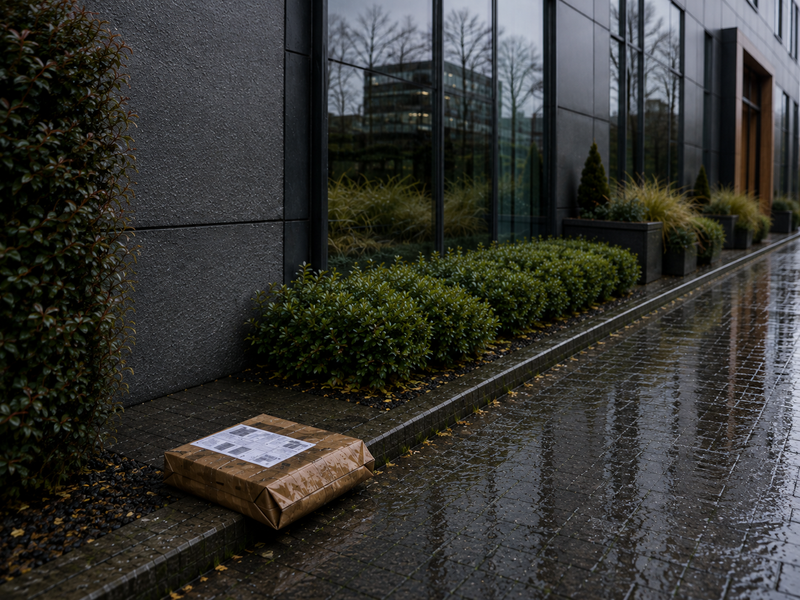
In practice, the difference between being allowed and being obliged is the whole story. As long as the box is just standing next to your door, to the delivery driver it is an unknown piece of furniture: it could be a meter cupboard, a wheelie bin enclosure or a cabinet belonging to the neighbours. As soon as the box is in PostNL's system as your delivery preference, it changes from an unknown piece of furniture into an instruction that appears on the delivery driver's handheld scanner.
People often think the legal requirements for letterboxes also say something about parcels. They do not: those requirements are about how accessible the letterbox is for post and about the dimensions of the slot. What they do and do not cover is set out in letterbox requirements in the Netherlands. No such regulation exists for parcels. The arrangement for parcels is a matter of private law: it is in the contract of carriage and in the terms and conditions, and those differ per carrier.
That sounds like a shortcoming in the regulations, but it works in your favour. Where there is no legal obligation, there is an adjustable preference, and you can word a preference so that there is no doubt about it. That is exactly what the rest of this article does.
What do PostNL's General Terms and Conditions literally say?
This is the hardest evidence that exists on this question, so we quote it with article numbers instead of summarising it. Article 13.2.1 of the General Terms and Conditions for the Carriage of Goods lists the ways in which PostNL may deliver a shipment. Five of them matter here.
| Article paragraph | What PostNL is allowed to do | What that means for your parcel letterbox |
|---|---|---|
| 13.2.1 sub a | Delivery through the letterbox or letter slot | Applies to everything that fits through the slot. A parcel compartment is not a letter slot, so this is usually where it stops |
| 13.2.1 sub c | Handing over to the addressee or an adult member of the household | The route the delivery driver tries by default: ring the bell and hand it over |
| 13.2.1 sub d | Handing over to neighbours | Happens if you have not set anything and you are not at home |
| 13.2.1 sub e | Leaving it at an Afgesproken Plek (agreed place) | This is the provision your parcel letterbox falls under, provided you have specified it |
| 13.1.2 | PostNL has the right to hand over a domestic shipment without an additional service to one of the neighbours | A right, not an obligation to ask you first. Only your own preference takes priority over this |
The most important sentence is in the next paragraph. Article 13.2.2 reads, word for word:
Upon delivery as referred to in article 13.2.1 a. to e., the carriage and the responsibility of PostNL under the Contract of Carriage will have ended.PostNL, General Terms and Conditions for the Carriage of Goods, art. 13.2.2
Read that sentence twice, because it says something sharp. The moment your parcel is in your box, the job is done as far as PostNL is concerned. That is exactly the same moment the parcel ends up in the neighbours' hallway or disappears through your letter slot: the contract of carriage has then been performed. Whatever happens to the parcel after that falls outside the contract of carriage. That is not a small-print trick, but the core of why the quality of the place you specify matters.
Thirty calendar days to report
Article 16 of the same terms puts a clock on it: a claim must be reported within thirty (30) calendar days, counting from the day of presentation. Thirty calendar days is shorter than it seems if you lose a parcel you only miss after a holiday, and it is a deadline you never come across until you need it. Keep it in mind alongside the "delivered" status in Track and Trace.
Pay attention to who you contact first. As a consumer, your purchase contract is with the webshop, not with PostNL. So the webshop is your first point of contact, even if it clearly went wrong during delivery. The thirty-day period is the time within which the party that concluded the contract of carriage, usually the sender, must report to PostNL. So report it quickly to the webshop, with the tracking number and the time of the status update. What to do when there is a delivery scan but no parcel is set out step by step in the step-by-step plan for a stolen parcel.
Please note. The text of terms and conditions changes. We checked these articles in PostNL's General Terms and Conditions for the Carriage of Goods on 25 August 2026. In a specific dispute, always check the version that applied on the day of shipping.
What is an Afgesproken Plek at PostNL?
The Afgesproken Plek (agreed place) is the only category in article 13.2.1 that you have any say over yourself. PostNL describes its policy for when you are not at home like this:
When you are not at home, we always follow your delivery preferences. Not set your preferences? Then we deliver your parcel to the neighbours or to a PostNL point.PostNL, on delivery when you are not at home, consulted 25 August 2026
Those two sentences are the whole mechanism. "We always follow your delivery preferences" is a promise that only does something if there is a preference. If there is no preference, the delivery driver falls back on the neighbours or a PostNL point, and that is not a punishment but the default route under the terms.
Within PostNL's delivery preferences you can choose from a number of destinations. The overview below shows what each choice means in practice.
| Delivery preference | Where you set it | What happens next |
|---|---|---|
| Home address, with an alternative if you are out | PostNL app or account, under My delivery preferences | The delivery driver rings first and uses the alternative if you do not answer |
| Agreed place around your home | PostNL app or account, under My delivery preferences | The place you describe becomes the delivery point. This is where your parcel letterbox belongs |
| Favourite parcel locker | PostNL app or account | You collect the parcel yourself from the locker of your choice |
| PostNL point | PostNL app or account | You collect the parcel from the shop, with ID |
| Nothing set | Not applicable | Neighbours or PostNL point, under art. 13.1.2 and 13.2.1 sub d |
What you put in the description field determines whether the delivery driver gets it within a few seconds. Do not write a category but an action, for example: black parcel letterbox to the left of the front door, flap on top, closes by itself and is locked. Filling in your delivery preferences with "in the box" leaves too much open. Naming the colour, the side and the flap leaves nothing open.
If you want to see all routes side by side, including the parcel locker and the service point, that is worked out in receiving a parcel when you are not at home.
The PostNL parcel locker at home: what PostNL itself prescribes
PostNL has its own campaign page about the parcel locker at home. That is where the carrier comes closest to recognising a box on your property, and it is remarkably specific. PostNL mentions four things.
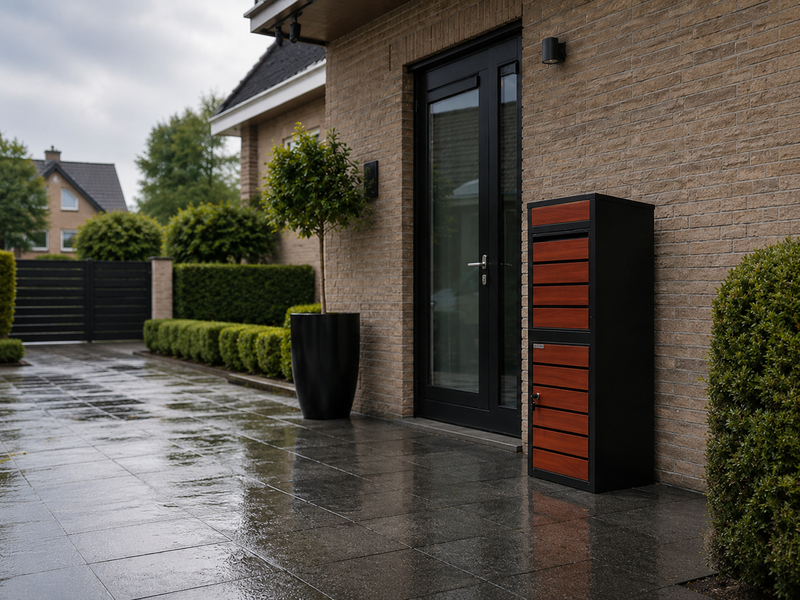
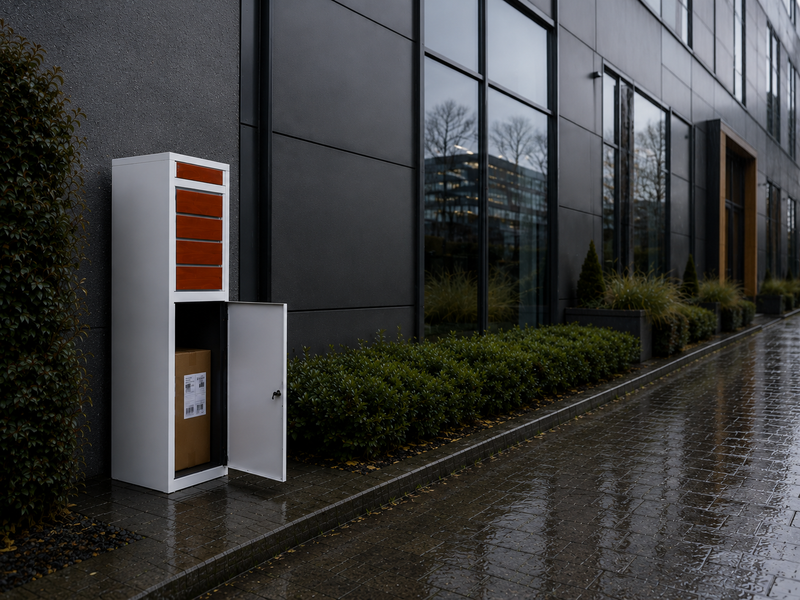
Point three in particular needs explaining, because "unlocked" sounds contradictory next to the word locker. PostNL means that the delivery driver must be able to get in without a key, code or app. A box with a flap on top solves that: the flap opens without a key, the parcel drops into the compartment and the flap closes again. Meanwhile, the door you use to take the parcel out stays locked. All our models work like this, with a flap on top for the delivery driver and a door with a key lock and two keys for you. How that flap keeps the water out and where condensation forms is explained in is a parcel letterbox waterproof.
On that same page, PostNL states that other delivery services use the locker too. And for buying one, PostNL refers to external suppliers: the carrier does not sell a locker itself and does not prescribe a brand or model. It is an open market, and it means there is no PostNL-approved box. Anyone who claims otherwise is selling you a quality mark that does not exist. What you should look out for when choosing is covered in what a good parcel letterbox costs.

Where the limit lies, and which route applies then
Two kinds of shipment do not go into a locker: shipments that require a signature and parcels that do not fit. That is not a feature of the locker but of the shipment. For a signature shipment, the contract of carriage requires a person to sign, and that requirement comes from the sender. For those shipments, set up a second route in your delivery preferences, for example a regular parcel locker or a PostNL point around the corner, so that nothing goes wrong on that day either.
On size the answer is simpler: choose the size based on your largest normal order. A parcel that does not fit in a wall-mounted model will fit in a freestanding model, and what does not fit in a standard freestanding model fits in the Plus, with a parcel compartment up to 450 x 320 x 210 mm. In what size parcel letterbox you need you can work it out with your own order history.
PostNL says visible, DHL says not visible: how can both be right?
This is the most confusing contradiction in the entire parcel market, and almost nobody points it out. The two biggest carriers in the Netherlands, together handling 85 to 95 percent of parcels, give exactly opposite advice on visibility.
In its requirements for the Afgesproken Plek (agreed place), DHL states that it must be a covered spot that cannot be seen from the street, and gives the shed or a spot under a small canopy as examples. PostNL, on the other hand, writes on its page about the parcel locker at home that you should place the locker visibly by your front door. The same question, two opposite answers, both from the carriers themselves.
Both carriers are right within their own definition, and the key lies in the word they both leave out. DHL describes an open spot, where the parcel lies unprotected once it has been left. There, visibility really is a risk: anything you can see lying there from the pavement, someone else can see too. PostNL describes a lockable locker, where the parcel sits behind a closed flap once it has been left. There, visibility is not a risk but a precondition, because a locker the delivery driver cannot see does not get used.
Neither carrier makes that distinction itself. Nowhere does DHL say "unless it is a lockable locker", and nowhere does PostNL say "as opposed to an open spot". So we are saying it here, because the practical conclusion is worth it: the contradiction disappears the moment the place you specify closes by itself. A box that stands visibly by the front door and is closed once the parcel is in meets the intention of both instructions at the same time. It does not meet the letter of the DHL requirement, and the DHL delivery driver decides for themselves whether to use the spot.
What the other carriers think about visibility, and what their own features are called, is in the overview by carrier. And if you would rather build the box right into the facade, gate or fence, building in a parcel letterbox explains how to do that without the delivery driver overlooking it.
How to set your delivery preference with PostNL
This takes a few minutes and then stays in place. The option is called Mijn bezorgvoorkeuren (My delivery preferences) and is in the PostNL app and in your account on postnl.nl, under Je account (Your account).
- Open the PostNL app or log in to your account. Without an account, delivery preferences do not exist: they are linked to your address in PostNL's system, not to an individual shipment.
- Go to Your account and then to My delivery preferences. Here you will find the four destinations together: home address with alternative, agreed place, favourite parcel locker and PostNL point.
- Choose the agreed place around your home. This is the category from art. 13.2.1 sub e. Anything that is not your letter slot, the neighbours or a service point falls under this.
- Describe the box so there is nothing left to explain. Colour, which side of the door, where the flap is and that it closes by itself. So not "in the box", but "black parcel letterbox to the right of the front door, flap on top".
- Add a second route for shipments that may not go in the box. A regular parcel locker or a PostNL point you pass every week anyway saves you a trip.
- Check it with your next order in Track and Trace. If the preference is set, you will see it on the shipment before the delivery driver arrives.
What happens if you set nothing
Then the default route from the terms applies, and that is not unreasonable but it is unpredictable. The delivery driver rings the bell. If you do not answer, they try the neighbours, because art. 13.1.2 gives PostNL the right to hand over a domestic shipment without an additional service to one of the neighbours. If that does not work either, the parcel goes to a PostNL point and you get a message.
The result is that the place your parcel ends up is chosen by someone other than you. In the Radar panel of 25 May 2026, with 19,908 participants, 60 percent said a parcel had been sent to a pickup point instead of home without being asked in the past three years, and 82 percent found that annoying or frustrating. A preference you have set is the only way to keep that choice in your own hands.
Why does a PostNL delivery driver skip a parcel letterbox?
If the preference is set and the parcel fits, there is still one reason why a box sometimes gets skipped anyway, and it is economic. The delivery driver has little time per stop and in many cases is paid per successful stop.
The figures on this come from investigative journalism and trade union documents. A ride-along report by EenVandaag with a PostNL subcontractor on 27 November 2020 recorded hundreds of parcels a day and about two minutes per parcel. Radar wrote on 25 May 2026 that delivery drivers sometimes have only one minute per parcel. The FNV (Dutch trade union) black book "Onderbetaling door onderaannemers PostNL" (Underpayment by PostNL subcontractors) from December 2023 quotes a courier's statement saying: you only get paid per successful stop, €0.77 per stop, and €0.12 per extra parcel. The same black book states that in 2022 PostNL had about 1,900 parcel delivery drivers on its payroll and had about 5,000 drivers working through hundreds of subcontractors.
That changes how you look at a box. A delivery driver who is paid per stop loses money with every second of hesitation at your front door. A box that is visible, with a flap that opens without explanation and a parcel compartment the parcel drops into, is that driver's fastest route to a successful stop. That is not sentiment but arithmetic, and it is why how a box operates matters more than how it looks.
The full explanation of why a box gets skipped, including the pay model and what you can do about it yourself, is in why your delivery driver skips your parcel letterbox. Below are the four practical steps that matter for this article.
- Register the box as your delivery preference. This is the only step that changes anything in PostNL's system. The rest is extra.
- Put your house number on or next to the box. With two addresses on one path or in a homeowners' association, this is the difference between delivered and delivered to the wrong place.
- Keep the box empty. A box holding three days of post looks full. In a freestanding model this is rarely a problem: the parcel compartment is almost half a metre high, so a week of orders fits in there.
- Add a sticker or sign. All three big carriers link permission to their own system, so a sticker does not replace a delivery preference you have set. What a sticker does do is make it clear to a delivery driver within seconds what is intended.
Who is liable if a parcel disappears from your box?
The legal starting point is in art. 7:11 paragraph 1 of the Burgerlijk Wetboek (the Dutch Civil Code): in a consumer purchase, the risk only passes when the buyer, or a third party designated by them who is not the carrier, has received the item. Until then, the risk lies with the seller. The ACM, through its spokesperson Jeannette Duin on 7 December 2025 on EenVandaag, put it this way: the sender is responsible in almost all cases when a parcel goes missing, with the caveat that consumers should be careful about giving permission, because liability may then no longer lie with the sender.
So the question is when you have "received" something. There are four rulings by the Geschillencommissie (the Dutch disputes committee) on that which complete the picture.
| Case number and date | What it was about | Outcome |
|---|---|---|
| 227340/233108, 6 December 2023 | Parcel worth €425.72 left at the front door, consumer could not find it, trader cited the track-and-trace code as proof | Upheld. "Merely leaving a parcel on site does not count as handing it to the consumer in person." Full refund plus €52.50 complaint fee |
| 15296/22874, 9 November 2020 | Laptop delivered to a business address, accepted by a colleague, then disappeared | Rejected. A colleague at the specified address counts as a third party designated by the consumer, just like a family member at a home address |
| 21163/37590, 9 November 2020 | Consumer gave permission via the video doorbell to leave a Philips Hue worth €249.95 at the door | Rejected. That consent counts as acceptance, even though it was given remotely |
| Ruling of 13 November 2023, case number not stated in the source consulted | Shipment delivered to a carrier's parcel point instead of to the consumer | A carrier's parcel point explicitly does not count as a third party designated by the consumer, because it is part of the carrier itself |
Put those four side by side and a pattern emerges. If someone you designated accepts it, you are the recipient. If you give permission yourself, even via a video doorbell, you are the recipient. If the carrier is still in charge, for example at its own parcel point, you are not. And if nobody accepts it and nothing has been agreed, merely leaving it there is not receipt.
The nuance you will not read anywhere else
It is tempting to conclude from this that a box "therefore" shifts the risk to you. That is not what it says. The only ruling found on whether leaving a parcel counts as receipt, case 227340/233108, concerned a case with no delivery preference set: the parcel was left at the door without any arrangement. What applies when the consumer has specified and described the place themselves has not been settled in the case law found.
What we can say: carriers take the position that the risk passes as soon as the parcel is at the agreed place. PostNL does so in art. 13.2.2, DHL says it is responsible until the moment the parcel has been delivered, DPD has it signed word for word in its form for permission to leave parcels, and Trunkrs spells it out in so many words. Consumer law lawyer Caspar Janssens put that position like this in a broadcast on NPO Radio 1 on 15 April 2021:
If you as the recipient choose a place yourself to have a parcel delivered to, you take on the responsibility that the parcel can be delivered safely at that place.Caspar Janssens, consumer law lawyer, NPO Radio 1, 15 April 2021
In practice it comes down to this. Assume that the place you specify is also the place where the parcel is expected to be safe. Then the question is which place actually delivers on that. A corner behind the planter does not. A lockable box made of 0.7 mm galvanised steel sheet with a door with a key lock does, because once the parcel is in, it cannot simply be taken out again. How often it goes wrong and what really gets stolen in the Netherlands is covered in parcel theft in the Netherlands.

What about the other carriers? DHL, DPD, GLS, UPS, Budbee, Vinted Go, Trunkrs and Cycloon
This article is about PostNL, because in practice that is what the question is about: PostNL had a market share of 50 to 55 percent in 2022 according to the ACM decision of 5 April 2024. But more than one carrier comes to your door, and the name of the feature differs from company to company. That is exactly where it goes wrong: people look for "delivery preferences" at DHL and cannot find the Afgesproken Plek (agreed place), or look for an agreed place at DPD and miss the Neerzettoestemming (permission to leave).
Below is the bridge in a table. The full details per carrier, with the literal terms, claim deadlines and photo policy, are in parcel letterboxes by carrier.
| Carrier | What the feature is called | Where you arrange it |
|---|---|---|
| PostNL | Delivery preferences, with the agreed place | App or account, stays in place for your address |
| DHL eCommerce | Afgesproken Plek (agreed place), plus delivery preferences in My DHL | Per shipment via the app or track and trace, with a photo |
| DPD | Neerzettoestemming (permission to leave) | Per shipment in myDPD, or once with a signed form |
| GLS | FlexDeliveryService and ShopDeliveryService | Before the first delivery attempt, via the GLS notification |
| UPS | UPS My Choice | Dashboard, Change my delivery button |
| FedEx | FedEx Delivery Manager | Account, not all options are available in every country |
| Trunkrs | Permission to leave, and a choice of which neighbours | Track-and-trace page, before delivery |
| Budbee | No more home delivery in the Netherlands, only the Budbee Box | Not applicable, collect with a PIN code |
| Vinted Go | Formerly Homerr, works largely via pickup points | No safe-place feature found |
| Cycloon | Two delivery attempts, no pickup locations or parcel lockers | If handed to the neighbours, an email follows with the house number |
One thing stands out as soon as you look down the list: exactly one carrier names the letterbox as a delivery point for a parcel. Trunkrs writes that the delivery driver takes a photo with every delivery and that this photo may show, among other things, the parcel in the letterbox or at an agreed place. Across the rest of the field, the word parcel letterbox does not appear in any official delivery option. That is what makes the delivery preference you fill in yourself so important: it is the only place your box exists in their system.
Which BunnyBox model suits what PostNL delivers to you?
Choose the size based on your largest normal order, not your average. Watch out for a misunderstanding that is doing the rounds everywhere: carriers' size classes are upper limits of a rate class, not average parcel sizes. A parcel that falls into the most expensive class is usually a good deal smaller than that class's upper limit.
| Model | Type | Parcels up to (mm) | Post and parcels |
|---|---|---|---|
| Compact | Wall-mounted model, supplied pre-assembled | 300 x 200 x 200 | Separate slot, 1 compartment |
| Style | Freestanding post with wood-effect front | 350 x 320 x 200 | Separate slot, 1 compartment |
| Home | Freestanding | 370 x 320 x 210 | 1 compartment |
| Plus | Tall freestanding post | 450 x 320 x 210 | Separate compartments for post and parcels |
From small to large it works like this. If you mainly receive small boxes, phone cases, accessories and books, the Compact is enough: a wall-mounted model supplied pre-assembled, so you mount it and it works. It takes nine phone boxes. If clothing or footwear arrives regularly, the Style is the better choice, with a parcel compartment up to 350 x 320 x 200 mm and a separate letter slot so the post does not disappear under a box. If you order a bit of everything, the Home is the workhorse at 370 x 320 x 210 mm. And if you regularly receive large boxes, the Plus is the better choice: 450 x 320 x 210 mm and post and parcels in separate compartments.
LENGTH OF THE PARCEL COMPARTMENT PER MODEL
Maximum parcel length per model, from our own model overview. Width and height are in the table above.
All four series are built the same way: 0.7 mm galvanised steel sheet with Qualicoat Class 2 powder coating with zinc phosphate pretreatment, a door with a key lock and two keys, and a flap on top for the delivery driver. That is exactly the combination PostNL describes as accessible to the delivery driver and locked to everyone else. A freestanding model takes four shoeboxes at once, and the parcel compartment is almost half a metre high, so a week of orders fits in. So if you are away for more than a day, you do not come home to a full box and a not-at-home card. What fishing through the slot is and what the standard requires on it is covered in anti-fishing protection for a letterbox.
If you are torn between two models, the comparison of Home, Style, Plus and Compact goes through it situation by situation. If you first want to know what will never go through an ordinary letter slot, that is in which parcels do not fit through the letterbox. Always someone home with a BunnyBox, even when you are not.


View the models
All articles on delivery, sizing and assembly are together in the BunnyBox Knowledge base.
Frequently asked questions
Can PostNL put a parcel in my parcel letterbox?
Yes. Article 13.2.1 sub e of the General Terms and Conditions for the Carriage of Goods allows PostNL to leave a shipment at an Afgesproken Plek (agreed place). A parcel letterbox you have registered as your delivery preference falls under that provision. It is not compulsory: there is no law requiring a delivery driver to use your box.
Is PostNL obliged to use my parcel letterbox?
No. No carrier is, and PostNL does not list the parcel letterbox as a separate delivery option on its own site either. With a delivery preference set, a description that leaves no doubt and a box that can be filled without a key, you maximise the chances.
How do I set my delivery preference with PostNL?
In the PostNL app or in your account on postnl.nl, under Your account and then My delivery preferences. Choose the agreed place around your home and describe the box with its colour, which side of the door and where the flap is. The preference is linked to your address, so you only set it once.
What happens if I do not set a delivery preference?
Then PostNL delivers your parcel to the neighbours or to a PostNL point. Article 13.1.2 of the terms gives PostNL the right to hand over a domestic shipment without an additional service to one of the neighbours, without needing prior permission.
Should my parcel locker be locked or open?
For the parcel locker at home, PostNL requires it to be unlocked and accessible when the delivery driver arrives. A box with a flap on top solves that: the flap opens without a key and closes again, while the door you use to take the parcel out stays locked.
Why does PostNL say visible and DHL say not visible from the street?
Because they are talking about different things. DHL describes an open spot such as a shed or canopy, where visibility means a risk of theft. PostNL describes a lockable locker, where visibility only serves findability. Neither carrier makes that distinction itself.
Who is liable if my parcel disappears from the box?
Under art. 7:11 paragraph 1 of the Dutch Civil Code, the risk lies with the seller until you or a third party you designated has received the parcel, and the webshop remains your first point of contact. Carriers take the position that the risk passes as soon as the parcel is at the agreed place. For a designated place, that question has not been settled in the case law found.
How long do I have to report a missing parcel to PostNL?
Article 16 of the General Terms and Conditions for the Carriage of Goods states thirty calendar days from the day of presentation. In the meantime, report it straight away to the webshop as well, because that is where your purchase contract is.
Do parcels that require a signature go in the box?
No, those shipments follow a different route, because the sender requires a signature or age check. Set a second destination in your delivery preferences for them, for example a regular parcel locker or a PostNL point on your route.
How does it work with DHL, DPD and the other carriers?
Each carrier has its own name for the same feature: Afgesproken Plek (agreed place) at DHL, neerzettoestemming (permission to leave) at DPD and Trunkrs, FlexDeliveryService at GLS, My Choice at UPS. The full details are in the article on parcel letterboxes by carrier.
Sources and last check
Please note. Last checked on 25 August 2026. Carriers regularly adjust their delivery options and terms. We check this page twice a year and after every announced change to the PostNL terms.
- PostNL, General Terms and Conditions for the Carriage of Goods, art. 13.1.2, 13.2.1, 13.2.2 and 16, consulted 25 August 2026.
- PostNL, information on delivery when you are not at home and on the parcel locker at home, consulted 25 August 2026.
- DHL eCommerce, requirements for the Afgesproken Plek, consulted 25 August 2026.
- ACM, Post and Parcel Monitor 2025, published 18 June 2026: 615 million parcels, 82.2 percent to a home address.
- ACM, decision of 5 April 2024: PostNL market share 50 to 55 percent in 2022, DHL 35 to 40 percent.
- EenVandaag Opinion Panel, published 6 August 2026, more than 24,000 panel members. Self-selecting panel.
- Radar panel, 25 May 2026, 19,908 participants.
- FNV, black book "Onderbetaling door onderaannemers PostNL", December 2023.
- EenVandaag, ride-along report with a PostNL subcontractor, 27 November 2020.
- Geschillencommissie Thuiswinkel (Dutch online shopping disputes committee), cases 227340/233108 (6 December 2023), 15296/22874 (9 November 2020) and 21163/37590 (9 November 2020), and the ruling of 13 November 2023 on parcel points.
- Art. 7:11 paragraph 1 Burgerlijk Wetboek (Dutch Civil Code).
- NPO Radio 1, interview with consumer law lawyer Caspar Janssens, 15 April 2021.
- Product dimensions from our own model overview of 18 August 2026.