In short
- Outdoors, a mechanical key lock is the choice that always opens: no battery, no code, no stated temperature limit.
- A code is handy to share, and that is why it gets passed around. The code lock supplied in the Dutch letterbox range has three wheels: mathematically 1,000 positions.
- Electronics have a stated operating temperature. SwitchBot states +10 to +45 °C for the Lock Pro.
- Energizer rates lithium AA down to 40 degrees below zero and alkaline AA down to 18 degrees below zero: a 22 °C difference.
- IP54 is splashing water, IP65 is dust-tight plus a water jet from a 6.3 mm nozzle.
- No standard, no quality mark and no insurer that we checked sets a requirement for the lock on a letterbox or parcel box.
- Every BunnyBox has a door with a key lock and two keys.
For a lock that lives outdoors, a mechanical key lock is the choice that works in all conditions: no battery, no code doing the rounds, no stated operating temperature that a Dutch winter morning drops below. You buy a combination lock for the convenience of sharing, a smart lock for the notification on your phone, and both come with conditions that the manufacturer writes down itself and that you need to check before you buy.
Below is the comparison that did not yet exist in Dutch: the three types of lock side by side on what they really do outdoors, with the manufacturer's stated temperature range, the IP code, the battery type and the documented number of variations. We make parcel letterboxes ourselves in our own factory, so we know what a lock on a facade or in a front garden has to endure, and where the specification sheets stop. Where a figure is not public, we say so literally, with the name of the party where we looked for it. That is exactly the difference from a webshop page that puts three quality mark logos side by side.
- +10 to +45 °CStated operating temperature of the SwitchBot Lock Pro, according to SwitchBot itself, 26 August 2026.
- 22 °CDifference in lower limit between lithium AA and alkaline AA, according to the Energizer L91 and E91 datasheets.
- 100,000Effective key variations in the highest EN 1303 key security grade, against 1,000 positions for three code wheels.
- €5.99Starting price of a separate letterbox cylinder lock with two keys, against €149 for the cheapest smart lock at Coolblue.

What should you choose outdoors: a combination lock, a key lock or a smart lock?
Short answer: a key lock. Not because a code or an app works badly, but because outdoor conditions put different strains on the three types. A mechanical key lock needs no power, no firmware, no range and no keypad that gets rained on. The only thing you need to know about it is how many different keys can fit it, and that is exactly what EN 1303 expresses in figures.
A combination lock is the choice if you want to share access without handing over a key. That is a real advantage: you give the code to the babysitter, the cleaner or your son. The downside lies in the same feature. A code is information, and information spreads. Whoever has it keeps it, and you cannot ask for it back the way you ask for a key back. On top of that, the code lock supplied by the Dutch letterbox trade is a three-wheel version. Three wheels from 0 to 9 give 1,000 positions. That is not a sourced claim but arithmetic you can check yourself, and it is an order of magnitude less than what a cylinder lock achieves in the higher EN 1303 grades.
You buy a smart lock, or a separate code keypad that goes with a smart lock, for something else: the notification, the log and remote revocation of access. Those are functions a mechanical lock does not have. But each of those devices has a stated operating temperature, an IP rating and a battery, and together those three figures determine whether the thing still opens at seven o'clock on a February morning. For one of the models we looked at, the stated range only starts at +10 °C. If you do want a notification when a parcel arrives, read how to do that without lock electronics in our article on the smart parcel letterbox with sensor and notification: a sensor in the box is a different device from a lock in the door, and you do not need both.
Which locks are actually fitted to letterboxes and parcel letterboxes?
The market talks about many types of lock and documents few. Below are only the types for which we have a source with a name and a date. What you do not see here, we looked for and did not find, and we would rather not mention it than mention it by halves.
Cylinder lock, the ordinary letterbox lock
According to the Dutch hardware retailer MijnIJzerwaren, a cylinder lock is "a type of lock operated with a key and widely used in a day and night lock". It works with pins set at different heights that only line up with the matching key. For a front door, the common size is 30/30 mm with a height of 33 mm. That is a common size, not a requirement of a standard: the same source gives no complete size table.
What is fitted to a letterbox is something else. It is not a euro profile cylinder but a small screw or nut cylinder that goes through a round hole in the door. A concrete example at Allekabels has an 18 mm lock hole and a 15 mm thread, costs €11.19 including VAT and comes with small keys. In the wider Dutch range you find hole sizes of 16, 17, 18, 20, 22 and 30 mm. That last size belongs to the code lock.
Warded lock, the simple plate lock
A warded lock works with obstructions in the lock housing. The key turns around a central pin and has notches that pass exactly by those obstructions. According to the English Wikipedia, the number of unique keys is "very limited", so many different keys open the same door, and a well-made skeleton key bypasses the obstructions. The same source says warded locks are "generally used in low-security applications". We could not find an exact number of key variations for a warded lock; no source puts a figure on it.
Mechanical combination lock
In the Dutch letterbox range, the version you come across is a three-digit 30 mm code lock, listed at €15.48 on the Letterbox locks category page at Bol.com. Three wheels from 0 to 9 give 1,000 possible positions. With four wheels that becomes 10,000. That is arithmetic, not a manufacturer's claim: none of the manufacturers we looked at publishes the number of combinations of its mechanical code lock.
For outdoor use there is one brand finding that hits exactly what this article is about. For one of its combination locks, under the heading for its area of use, Master Lock literally states "Environment & Applications: Indoors". So a manufacturer of combination locks writes itself that the product is intended for indoor use. That model has since been discontinued and works with directional movements rather than digits, but the qualification is there.
Electronic code lock
With the electronic versions the documentation suddenly becomes more generous, because these are devices with a manual. The Burg-Wächter TSE 5021 PRIME handles up to 48 users, has an IP65 keypad and runs on two AA alkaline cells in the keypad plus two AA alkaline cells in the cylinder. The Nuki Keypad 2.0 combines code and fingerprint, talks via Bluetooth 5.0 in the 2.4 GHz band and runs on four AAA cells, alkaline or 1.5 V lithium. The SwitchBot Keypad Touch is IP65, measures 112 x 38 x 36 mm, weighs 130 grams with batteries and, according to SwitchBot, lasts "up to 2 years". Operating temperature, battery type and number of codes are not on the product page for that last model, and we looked for them there.
Smart lock with Bluetooth, wifi or Zigbee
A smart lock replaces the cylinder or sits on top of it and is opened by your phone or a keypad. The Aqara Smart Lock U100 works with Bluetooth 5.0 over more than 20 metres in open space and Zigbee 3.0 over more than 20 metres indoors. The SwitchBot Lock Pro reaches up to 120 metres with Bluetooth without obstacles and "within 20 metres when the door is closed"; with that model, Matter only works via a Hub Mini Matter Enabled as a secondary device. The Dutch manufacturer Bold makes a smart cylinder and claims SKG three-star certification for its Duracore cylinder concept, with a battery that achieves "at least 2 years and 20,000 activations". In this research it is the only smart lock with an explicit SKG three-star claim. Operating temperature, IP rating and cylinder lengths are not on Bold's homepage and could not be read via the support centre.
A carrier's own lock or key
Here the answer is an empty box, and that is an answer. We searched PostNL's own pages on post delivery for whether a dedicated key or lock system for home boxes exists. That page refers to a PDF on the requirements for your letterbox, and that PDF returned a 404 at the URL we tried. The PostNL pages we searched say nothing about lock requirements, nothing about parcel letterboxes and nothing about a lock a delivery driver would operate. What suppliers describe themselves is something else: Post-Point writes that "thanks to a smart locking system" the delivery driver can leave the parcel and that the box can then "only be opened with the key". That describes a one-way flap, not a separate key for delivery drivers. Nor can we find anywhere whether PostNL or DHL have a preference or requirement for the lock type of a parcel letterbox. What carriers actually do in practice is set out in our overview of what each carrier does with a parcel letterbox and in the article on whether PostNL may put a parcel in your parcel letterbox.
What can be demonstrated: the Dutch supplier Logixbox offers models with a PIN code lock, and does so explicitly to make sending from the parcel letterbox possible. So there a code is not a security choice but a functional one: it lets you hand something over from the box, not keep something more tightly shut.

Does a smart lock work outdoors in a Dutch winter?
That depends on one line in the specifications that almost nobody looks up: the stated operating temperature. Manufacturers publish it, and the differences between models are big enough to reverse the buying decision.
Put the models we looked at side by side, and you see that the width of the stated range varies greatly from device to device. That range is not a promise that the lock belongs outdoors; it is the band within which the manufacturer says the device works. Outside that band you should expect nothing, and that is exactly the situation in which you want to get to your parcel.
WIDTH OF THE STATED TEMPERATURE RANGE
Width in degrees between the stated lower and upper limits, shown to scale. Sources: SwitchBot, Burg-Wächter, Nuki and Aqara, all consulted on 26 August 2026.
| Product | Stated operating temperature | IP code | Battery | Stated battery life |
|---|---|---|---|---|
| Nuki Keypad 2.0 | 20 degrees below zero to +70 °C, up to 95% relative humidity non-condensing | IP54, described by the manufacturer as "splash-proof" | 4x AAA, alkaline or lithium, 1.5 V | Not stated in the manual |
| SwitchBot Keypad Touch | Not stated on the product page | IP65 | Type not stated | "Up to 2 years" |
| SwitchBot Lock Pro | +10 to +45 °C | Not stated on the product page | 4x AA, 1.5 V, 2900 mAh | Up to 9 months, up to 12 months with the Dual Power Pack |
| Aqara Smart Lock U100 | 35 degrees below zero to +66 °C on the specification page | IP65 for the outdoor panel | 4x AA | More than 8 months at 8 unlocks a day |
| Burg-Wächter TSE 5021 PRIME | 15 degrees below zero to +50 °C, and elsewhere in the same document 20 degrees below zero to +50 °C | IP65 for the keypad | 2x AA alkaline in the keypad plus 2x AA alkaline in the cylinder | About 50 openings left after the battery warning |
| Bold Smart Lock | Not stated on the homepage | Not stated on the homepage | Built in | "At least 2 years and 20,000 activations" |
That table throws up two contradictions you need to know about, because you will come across them yourself when you start comparing. Within one and the same Burg-Wächter document there are two temperature ranges: 15 degrees below zero to +50 °C in one place and a "zulässige Bereich" (permitted range) of 20 degrees below zero to +50 °C in another. Both are there, so we quote both. At Aqara, the marketing page gives a range in Fahrenheit that works out at about 35 degrees below zero to 65 degrees above zero, while the specification page gives 35 degrees below zero to +66 °C. One degree of difference at the top, but it shows that you should look at the specification page and not at the sales page.
And then there is a third thing, and it is the sharpest. Nuki gives the Keypad 2.0 a lower limit of 20 degrees below zero, but writes in the same manual: "Do not expose the device to extreme heat or cold, direct sunlight, open flames or other extreme conditions." So the stated range and the instructions for use point in two directions. That is not a mistake by Nuki, that is how specification sheets work: the range is a laboratory limit, the instruction is practice. For a device hanging in the sun on the south side of your facade or standing outside on a frosty night, that is a difference to factor into your decision. Rain and frost are an issue for parcel boxes even without electronics, by the way; see our article on waterproofing and winterproofing.
Which battery holds up in frost, lithium or alkaline?
Lithium. That is not an opinion but a figure from two datasheets by the same manufacturer, which makes the comparison clean. Energizer gives its Ultimate Lithium AA, type L91, an operating temperature of 40 degrees below zero to +60 °C. For the Max alkaline AA, type E91, the same manufacturer gives 18 degrees below zero to +55 °C. At the bottom end that is 22 °C apart. For a lock facing the street, that is the difference between a cell working within its stated range and a cell sitting below it.
| Battery type | Model | Nominal voltage | Stated operating temperature | Weight per cell |
|---|---|---|---|---|
| Lithium AA | Energizer Ultimate Lithium L91 | 1.5 V | 40 degrees below zero to +60 °C | 15 g |
| Alkaline AA | Energizer Max E91 | 1.5 V | 18 degrees below zero to +55 °C | 23.0 g |
It is important to know what this figure is not. It is an operating temperature limit, not a statement about how much capacity you lose in frost. We searched both datasheets for a manufacturer statement in the form "x per cent less capacity at y degrees" and it is not there. Energizer gives no fixed mAh value at all, only discharge curves: for the L91 that comes roughly to 2500 to 5000 mAh depending on the discharge current, for the E91 roughly 2000 to 3000 mAh at 25 to 100 mA, falling to about 1000 mAh at a 500 mA discharge. Anyone presenting a percentage of capacity loss in frost as a hard figure did not get it from a datasheet.
In practice this means three things. One: if a manual specifies alkaline and allows lithium, as with the Nuki Keypad 2.0, which accepts four AAA cells, alkaline or 1.5 V lithium, lithium is the logical choice outdoors. Two: where the manufacturer explicitly names alkaline, as Burg-Wächter does for the TSE 5021 with two AA alkaline cells in the keypad and two in the cylinder, follow that specification, because you do not know how the electronics will react to a different voltage curve. Three: the higher the peak current, the sooner a cold cell runs into trouble. Energizer states the internal resistance of a fresh E91 as 150 to 300 milliohms, and a small motor moving a bolt asks for a peak, not a steady trickle.
Please note. Replace the batteries of an outdoor lock before winter, not after. A flat cell in November is an inconvenience; a flat cell in January stands between you and your parcel. The only manufacturer that publishes how much leeway you have after the warning is Burg-Wächter: about 50 openings, after that only with the administrator code.

What does IP54, IP65 or IP66 mean on a lock that hangs outdoors?
An IP code is not a quality mark but a classification from IEC 60529, "Degrees of protection provided by enclosures (IP Code)". The consolidated edition 2.2 dates from 29 August 2013 and consists of the 1989 base standard plus the amendments of 1999 and 2013, with corrigenda up to January 2019. The scope covers enclosures of electrical equipment with a rated voltage up to 72.5 kV. The first digit concerns solid objects and dust, the second concerns water. That is all it is, and that is exactly why the code is useful: it says something precise about a small subject.
| IP code | First digit, solids and dust | Second digit, water | What the test involves |
|---|---|---|---|
| IP44 | Protection against solid objects larger than 1 mm | Splashing water from all directions | Oscillating tube or spray nozzle without shield, 10 minutes |
| IP54 | Dust-protected: dust must not get in in such quantities as to interfere with safe operation | Splashing water from all directions | Same water test as IP44, plus a dust test |
| IP65 | Dust-tight, with vacuum test of up to 8 hours | Water jet | Jet from a 6.3 mm nozzle, 12.5 l/min, 30 kPa, at 3 m distance, at least 3 minutes |
| IP66 | Dust-tight, with vacuum test of up to 8 hours | Powerful water jet | Jet from a 12.5 mm nozzle, 100 l/min, 100 kPa, at 3 m distance, at least 3 minutes |
Pay close attention to the difference between a 4 and a 5 at the end. A 4 is splashing water from an oscillating tube or a spray nozzle without a shield. A 5 is a real jet with a flow rate of 12.5 litres per minute. That is a bigger difference than the single step in the digit suggests, and it is also where many summaries on the internet go wrong: we came across a summary describing IP54 as resistant to water jets, which according to the digit definitions is not correct.
The question you are really asking is: what is the minimum code I want outdoors? There is no normative answer to that. We looked for a normative or official technical source on the minimum IP code required for outdoor mounting on a facade or freestanding, and there is none: the IEC page on IP ratings returned a 403 and the full standard is paid for. What you can do is look at what the market supplies for components that hang outdoors. Nuki rates its outdoor-mountable Keypad 2.0 IP54. Aqara rates the outdoor panel of the U100 IP65. SwitchBot rates the Keypad IP65. Burg-Wächter rates the TSE keypad IP65. That leads to a market observation, not a standard: IP54 is the minimum supplied for a panel under a canopy, and IP65 is what three of the four manufacturers supply for a keypad that really stands in the rain.
There is one more group that is strikingly silent here, and that is the letterbox industry itself. We found not a single published IP code at the letterbox manufacturers and letterbox lock suppliers we looked at. An IP code belongs to electrical equipment rather than to a steel box, so that is technically explicable, but it means that with a letterbox or parcel letterbox you have to look at material, construction and water drainage rather than at a numeric code.
How many combinations does a combination lock have, and how many does a key lock have?
This is the comparison that carries the article, because it is the only place where key and code can be set side by side with real numbers. For cylinders there is a European classification, EN 1303, and it has eight classification positions: category of use, durability, door mass, fire resistance, safety, corrosion and temperature, key security and attack resistance. Position seven, key security, expresses exactly how many effectively different keys exist.
| EN 1303 key security grade | Effective variations | Minimum number of pins | Maximum share of identical depths |
|---|---|---|---|
| Grade 1 | 100 | 2 | 100% |
| Grade 2 | 300 | 3 | 70% |
| Grade 3 | 15,000 | 5 | 60% |
| Grade 4 | 30,000 | 5 | 60% |
| Grade 5 | 30,000 | 6 | 60% |
| Grade 6 | 100,000 | 6 | 50% |
| Three-digit letterbox code lock, for comparison | 1,000 positions, our own arithmetic | Not applicable, three wheels | Not applicable |
Put that side by side and the spread is enormous. The lowest cylinder grade, with 100 variations, sits below a three-digit code, and the highest, with 100,000, sits a factor of a hundred above it. So a three-wheel code lock falls somewhere between EN 1303 grade 2 and grade 3, if you look purely at the number of positions. With four wheels that becomes 10,000 mathematically, but none of the manufacturers we looked at publishes that number itself, so that remains your own calculation.
Two warnings with this table. The first: the number of variations says nothing about how a lock holds up against tools. That is a different position in the same standard, position eight, attack resistance, and that is exactly where our sources contradict each other. BauNetz Wissen says position eight has three grades. Schliessanlage.de names five levels, 0, A, B, C and D, with a drilling time of 3 to 5 minutes for A and C and 5 to 10 minutes for B and D, and a pulling force of 10 kN for C and 15 kN for D. Both sources are secondary. We report this as a contradiction and not as a hard figure, because we could not find a primary NEN page for NEN-EN 1303: the URLs we tried returned a 404.
The second warning: in this research there is no standard for mechanical combination locks that classifies the number of positions or a resistance. The Wikipedia article on combination locks gives no numbers of combinations, no opening times and no standard. We also looked for a measured time in which a cheap four-digit lock can be opened, and that time does not exist in a citable source. Anyone who gives such a time has made it up, and that is why this article says not a second or a minute about opening a code lock.
There is one thing that is documented about combination locks, and it concerns a specific manufacturer.
Almost all of the company's locks are known to have serious security flaws, which allow for easy bypass through lock picking or bump keys or other forms of bypassing.
English Wikipedia on Master Lock, with as underlying source Deviant Ollam, Practical Lock Picking (2012), consulted 26 August 2026
And on electronic code locks, the same encyclopaedia names a weakness that has nothing to do with technology: with fixed digits it is "easy to determine the locking sequence by viewing several successful entries". In plain English: worn or dirty keys and one glance over your shoulder give the code away. That is a reason, with a code lock placed outdoors, to allow for wear on exactly those four keys you press every day. How a thief actually goes about it at a letterbox is in our article on anti-fishing protection, and we cover the scale of the problem in the Netherlands in parcel theft in the Netherlands.
Which standards and quality marks say anything about your letterbox lock?
Almost none. That is the shortest summary of one of the most surprising outcomes of this research, and it is why you see so many logos on webshops that turn out, on closer inspection, to be about something else.
| Standard or quality mark | What it does test | What it does not test | Source and date |
|---|---|---|---|
| EN 13724:2013 | The posting opening of a private letterbox or letter plate, with security, inaccessibility of the post, ease of use for the recipient and ergonomics for the delivery driver in scope | The box, the door and the lock. We did not find a burglary resistance class in it | NEN, product page NEN-EN 13724:2013 en, 26 August 2026 |
| EN 1303 | Cylinders for locks, in eight classification positions, including key security and attack resistance | Letterboxes and letterbox locks as a product group. The standard is about cylinders, not boxes | BauNetz Wissen and Schliessanlage.de, both 26 August 2026, secondary |
| SKG stars | Product certification for the construction and property sector in the Netherlands, with laboratory and field tests, carried out by SKG-IKOB | The SKG-IKOB pages consulted contain no explanation of the stars with standards or resistance times, and no letterboxes or letterbox locks | SKG-IKOB, 26 August 2026 |
| VdS classes | Mechanical security technology, certified by VdS Schadenverhütung in Germany | The class requirements for cylinders are not on the page consulted and the glossary page returned a 404. We did not find concrete class requirements | VdS, 26 August 2026 |
| Politiekeurmerk Veilig Wonen | Home security in the Netherlands, with "certified locks and hardware" as a concept; part of Het CCV (the Dutch Centre for Crime Prevention and Safety) | On the page consulted, no SKG star requirement, no NEN 5089, no NEN 5096 and no requirements for letterboxes or parcel boxes | Politiekeurmerk.nl, 26 August 2026 |
| Postregeling 2009, article 6 | The clear posting opening of at least 265 mm by 32 mm, a mounting height between 0.6 and 1.8 metres and internal dimensions of at least 270, 150 and 380 mm | The lock. The version of the regulation consulted contains no lock requirement and no burglary resistance requirement | BBK Ede, "Normen en Eisen postkasten", which quotes the regulation, 26 August 2026 |
The point about EN 13724 is the most important one in this table, because webshops sell that standard as a quality mark for the whole letterbox. The official title is "Postal services - Apertures of private letter boxes and letter plates - Requirements and test methods", and the scope says literally that the standard sets out the requirements and test methods for the openings for the delivery of postal items. Openings. The standard was published on 1 April 2013, runs to 33 pages, is in English, costs €92.65 and replaces NEN-EN 13724:2002, with a corrigendum C1:2016 from 1 January 2016. We have not read the full document, because it is paid for; the title, scope and summary are freely available and they are about the posting opening. So anyone reading "complies with EN 13724" on a letterbox knows something about the slot and nothing about the door.
- The posting opening of a private letterbox or letter plate
- Requirements and test methods for that opening, when mounted according to the manufacturer's instructions
- Security and inaccessibility of the post via that opening
- Ergonomics and efficiency for the delivery driver
- A requirement for the door lock
- A burglary resistance class for the box
- A star rating or a resistance time
- An IP code or a temperature range
One more thing about the Dutch rules, because most pages get it wrong: the Besluit brievenbussen (Letterbox Decree) was revoked on 1 April 2009. What you find now is in the Postregeling 2009, and article 6 of it gives the dimensions of the clear posting opening: at least 265 mm in length and 32 mm in width. The same source gives a mounting height of no lower than 0.6 metres and no higher than 1.8 metres, a minimum usable internal width of 270 mm and other internal dimensions of at least 150 and 380 mm. A source caveat belongs here: we could not locate the primary text on wetten.overheid.nl, because the BWBR number could not be traced without a working search function, and the figures above now rest on one secondary source quoting the regulation. In the same summary, WoonKeur (a Dutch housing quality label) gives a lock height between 700 and 1350 mm above the floor. NEN 1770 is mentioned there as withdrawn since 1988. We have set out all letterbox dimensions and the rules that go with them in letterbox requirements in the Netherlands.
Finally, the only hard figure the Police Quality Mark itself publishes about burglars, because it puts the rest in perspective.
A burglar sometimes needs only 30 seconds to get into a poorly secured home.
Politiekeurmerk Veilig Wonen, politiekeurmerk.nl, consulted 26 August 2026
That is about a home and not about a letterbox. We include it anyway, because it shows the scale the security world thinks in: delay measured in minutes and seconds, not absolute impregnability. Incidentally, the Dutch police tips page on preventing burglary gives no burglary times and no burglary figures, but it does give two tips that apply directly here: "Do not hide house keys under a doormat or in a flowerpot" and "Do not attach an address label to your key(s)".
Does your insurer require a particular lock on your parcel letterbox?
No. We checked four parties and none of them sets a requirement for the lock of a letterbox or a parcel box, and none of them mentions parcels or letterboxes. This is negative evidence, and negative evidence is only worth something if you write down exactly where you looked. So: Interpolis, Centraal Beheer, Univé and the Dutch Association of Insurers (Verbond van Verzekeraars), plus the CCV as the manager of the instrument the sector refers to. All five consulted on 26 August 2026.
On its service page about home contents insurance, Interpolis lists cover against damage from fire, lightning, explosion, storm and theft, and as an explicit limitation outside the home, that theft of a bicycle, moped or scooter in the garden or under the carport is not insured. Theft of animals is insured up to €35,000. There are no requirements for locks or burglary protection, and parcels and letterboxes do not appear on the pages consulted.
Centraal Beheer covers damage from fire, burglary, theft, storm and precipitation, and writes that belongings in the garden, in the yard, on the balcony or on the roof terrace are insured, giving garden furniture and garden tools as examples. This insurer defines theft-prone contents as "items you can easily carry or take under your arm, such as mobile phones, laptops". There are no lock requirements or forced-entry requirements on the page; for those Centraal Beheer refers to the policy conditions in PDF, which we have not read.
Univé is the sharpest and the least comfortable: damage to belongings that happens outside your home is only covered if you take out the additional Buitenshuis (away from home) cover. Literally: "Damage to your belongings that happens anywhere in the Netherlands outside your home. Take out the Buitenshuis cover for this." Here too, no lock requirements, no forced-entry conditions and not a word about parcels or letterboxes.
The Dutch Association of Insurers (Verbond van Verzekeraars), the trade association whose members represent more than 95 per cent of the insurance market, has one central prevention instrument: the VRKI, the Improved Risk Class Classification. According to the Association, it is "an instrument to determine the burglary risk of homes and establish which preventive measures are needed", developed with the security and installation sector and managed by the CCV. Insurers use it, for example, by giving a premium discount if a home is secured according to the VRKI. The CCV describes VRKI 2.0 as an instrument that looks at the goods present, their attractiveness to criminals, their value and the storage location, and that proposes measures in three categories: organisational, structural and electronic. The number of risk classes is not on the page, SKG and NEN 5096 are not mentioned, and letterboxes and parcel boxes do not appear anywhere.
So the conclusion is substantiated and not polished: the Dutch insurance sector does not regulate the lock on a letterbox or parcel box. The instrument that exists is about the home and the commercial building. So if a parcel is stolen you cannot fall back on an insurance lock requirement, and with at least one insurer, damage outside the home is only covered with an additional module. At the same time, that means the choice is yours and not a policy condition's: you decide which lock goes on your box. What to do if things go wrong anyway is set out step by step in our article your parcel has been stolen, with a template letter. And what you can arrange in general when you are not home is in receiving a parcel when you are not home.
What do you do if the key is lost, the code gets around or the battery is flat?
Every type of lock has one scenario in which you are briefly stuck. The difference is how expensive and how complicated that scenario is, and whether you can solve it yourself.
Key lost
Every letterbox lock comes with two keys, and that is exactly why there are two. If you lose the first, you use the second and do not keep it on the same bunch. If both are gone, you replace the cylinder and not the box: a separate letterbox lock with two keys starts at €5.99 and a brand-specific one costs up to about €35. Follow the two police tips while you are at it: no key under the doormat or in a flowerpot, and no address label on the bunch. The Police Quality Mark has a separate section on key safes, which shows that the subject of passing on keys is taken seriously; we did not read the content of that section, so we make no statement about it.
Code that gets around
A mechanical code lock has one code. If you give it to the babysitter, the cleaner and your neighbours, you have one code with five holders, and you do not know who has passed it on again. With electronic systems you can issue codes per person and revoke them again: the Burg-Wächter TSE 5021 PRIME handles up to 48 users. How many codes a SwitchBot Keypad or an Aqara U100 can handle is not in those manufacturers' specifications, and we looked. On the question of who passes a code on and how often, none of the sources consulted says anything. The only substantiated mechanism remains that of wear and observation from the previous section.
Battery flat or power cut
All the locks we looked at run on batteries, so a power cut in the neighbourhood does not lock you out. What does drop out is the connection: without a router, no notification and no remote control, because a Bluetooth lock needs your phone within range and a Zigbee lock needs a hub that has power. For the battery itself there is exactly one primary documented emergency scenario in this entire research, and that is Burg-Wächter's: after the battery warning you can still open the door about 50 times, after that only with the administrator code. Bold states that its battery achieves "at least 2 years and 20,000 activations", but what happens when it is flat is not on the homepage and could not be read in the support centre. At Nuki, the support articles on flat batteries returned a 404. So for two of the three brands, the flat-battery scenario is not public, and for a lock facing the street that is a fact you will want to take into account.
Please note. Combine the two figures in this article that speak most for themselves: according to Energizer, alkaline AA works down to 18 degrees below zero, and Burg-Wächter gives you about 50 openings after the battery warning. That makes a mechanical emergency option you can always reach not a luxury but the basis of your plan.
Can I replace the lock on my letterbox, and what does a new lock cost?
You can often replace a letterbox lock, but rarely with just any other lock. That is because a letterbox lock has no standardised size the way a door cylinder does. For a front door, 30/30 mm and 33 mm height is a common size. For a letterbox, you are talking about a hole diameter, a thread length and the position of the cam, and all three vary by brand and by series.
What we could find as hard data is the range of hole diameters in the Dutch range: 16, 17, 18, 20, 22 and 30 mm, the last of which belongs to the three-digit code lock. For one concrete example the thread length is also known: 15 mm with an 18 mm hole. What we could not find is the cylinder length, cam position and backset of letterbox locks in manufacturer data. On its category page with eighteen locks, Brievenbusdirect says explicitly that those specifications are not listed and refers you to phone contact for sizes. Two other lock webshops were closed to automated reading via robots.txt. So there is no public size table for letterbox locks, and anyone who says a lock "fits universally" is not backing that up with manufacturer data.
The best indirect evidence that locks are not freely interchangeable is what the trade itself does: it sells them by brand. There is an automatic lock specifically for Allux and Stoer, and Bobi has its own cylinder lock, its own knob and its own lock guard, each with its own price. We did not find a manufacturer that says outright that letterbox locks are not interchangeable, but a brand-specific range is a strong signal.
And then the prices. This is about the market for separate locks, checked on 26 August 2026, with all amounts including VAT.
| Lock | Size | Price including VAT | Source and date |
|---|---|---|---|
| Unbranded cylinder lock with 2 keys | 16 mm | €5.99 | Bol.com, Letterbox locks category, 26 August 2026 |
| Perel letterbox lock with 2 keys | 17 mm | €16.95 | Bol.com, Letterbox locks category, 26 August 2026 |
| Letterbox lock with thread, including small keys | 18 mm hole, 15 mm thread | €11.19 | Allekabels.nl, product page 1351872, 26 August 2026 |
| ABC-Led tilt lock Z-2106 | 22 mm | €11.95 | Bol.com, Letterbox locks category, 26 August 2026 |
| Unbranded combination lock with three-digit code | 30 mm | €15.48 | Bol.com, Letterbox locks category, 26 August 2026 |
| Automatic lock for Allux and Stoer | Brand-specific, size not published | €24.95 | Brievenbusdirect.nl, 26 August 2026 |
| Bobi cylinder lock | Brand-specific, size not published | €34.95 | Brievenbusdirect.nl, 26 August 2026 |
| Nuki Smart Lock Go | Door cylinder, not for a letterbox | €149 | Coolblue, smart door locks overview, 26 August 2026 |
| LOQED Touch Smart Lock | Door cylinder, not for a letterbox | €162, in black €192 | Coolblue, smart door locks overview, 26 August 2026 |
| Bold Smart Lock SX-35 | Door cylinder, not for a letterbox | €198 | Coolblue, smart door locks overview, 26 August 2026 |
On the reference date, the whole letterbox locks category at Bol.com ran from €5.99 to €69.95 across 165 products. For door cylinders, the hardware retailer MijnIJzerwaren gives an indication of around €20 for a cylinder with two SKG stars and about €50 for a cylinder with three stars. The ratio to take away above all: a separate letterbox cylinder lock starts at €5.99, a three-digit code lock for a letterbox costs €15.48 and the cheapest smart lock at Coolblue costs €149. That is roughly a factor of 25 between the simplest key lock and the entry-level electronics. We did not find separate keypads with a Dutch price: the relevant Coolblue page returned a 404, and so did Nuki's own webshop. What a complete parcel letterbox costs and where that money goes is covered in what a good parcel letterbox costs.
Which lock is on a BunnyBox, and which model suits you?
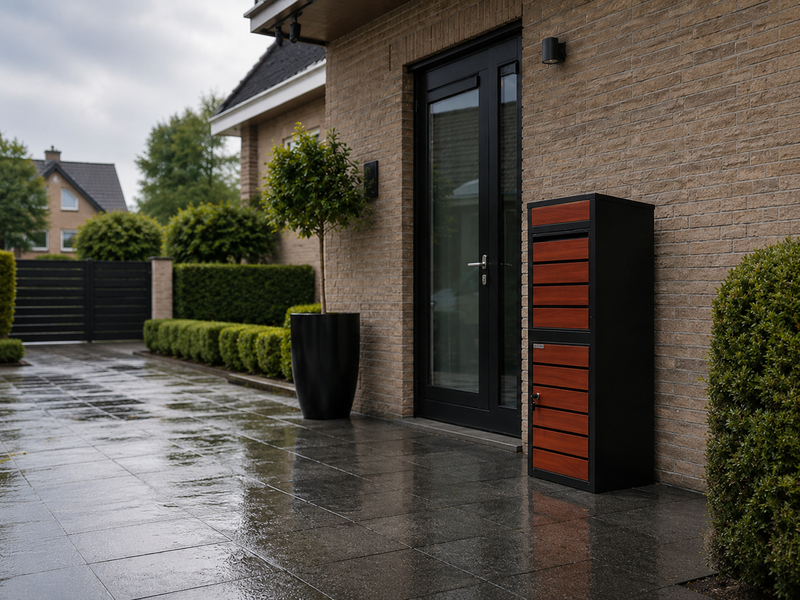
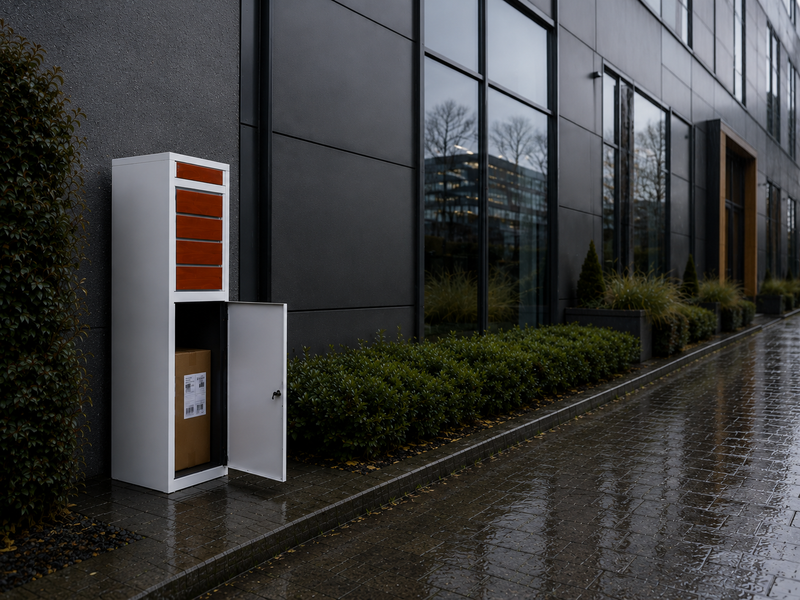
Every series has a door with a key lock and two keys. On top there is a flap where the delivery driver puts the parcel in, so the delivery driver needs no key, no code and no app: they do what they do at any letterbox. You take the parcel out at the front with the key. That is the feature that comes out strongest throughout this article for something that stands outdoors: a key lock works without a battery, without a code you have to share and without a stated operating temperature that a winter morning drops below.
All series are made of 0.7 mm galvanised sheet steel with Qualicoat Class 2 powder coating with zinc phosphate pretreatment, in RAL 9005 black, RAL 9010 white, RAL 7036 platinum grey or RAL 7016 anthracite, plus combinations with dark teak or light oak. Given their height, the posting opening of the freestanding models falls exactly within the band of 0.6 to 1.8 metres named in the Dutch Postregeling 2009, which is exactly where a delivery driver expects it. The parcel compartment of a freestanding model is almost half a metre high, so it holds a week of orders. That is not theory: a Home or a Style takes 14 book packages if you tilt them the way a delivery driver does, a Plus takes 18, and every freestanding model takes four shoeboxes. Phone boxes: 40 in a Home or Style, 42 in a Plus, 9 in a Compact.
| Model | Type | Parcels up to | External dimensions | Lock and installation |
|---|---|---|---|---|
| BunnyBox Compact | Wall-mounted model | 300 x 200 x 200 mm | 365 x 250 x 450 mm | Door with key lock and two keys, supplied pre-assembled |
| BunnyBox Style | Freestanding column with wood-effect front | 350 x 320 x 200 mm | 380 x 365 x 1000 mm | Door with key lock and two keys, self-assembly kit |
| BunnyBox Home | Freestanding | 370 x 320 x 210 mm | 410 x 380 x 1020 mm | Door with key lock and two keys, self-assembly kit |
| BunnyBox Plus | Tall freestanding column | 450 x 320 x 210 mm | 500 x 370 x 1120 mm | Door with key lock and two keys, self-assembly kit, post and parcels in separate compartments |
The choice runs from small to large. If you have a facade and want as little work as possible, the BunnyBox Compact is the answer: it is the only series that arrives pre-assembled, so you hang it up and you are done. If you want a freestanding column that suits a wooden fence or a warm-toned front door, the Style, with its wood-effect front and separate letter slot, is the logical choice. If you want more space in the same shape, the Home is the one, with parcels up to 370 x 320 x 210 mm. If you order large boxes or want to keep post and parcels strictly separate, the BunnyBox Plus is the model: parcels up to 450 x 320 x 210 mm and two separate compartments. If you want to see that trade-off in more detail, use which BunnyBox suits me or the sizing article which size parcel letterbox do I need.


If you still want a notification on your phone on top of the key lock, you do not need to change the lock for it. A sensor in the box reports that something has arrived and leaves the opening mechanical: for that, read the article on the smart parcel letterbox with sensor, notification and Home Assistant. That way you have the convenience of electronics in the place where a flat battery only costs you a notification, and you keep the opening mechanical. When you come to install it, you will find the practical side in installing a parcel letterbox and fixing it in place in anchoring a parcel letterbox. Fix a freestanding model to paving slabs or in concrete; that is good advice for any outdoor box. All other topics are gathered together in our knowledge base. Always someone home with a BunnyBox, even when you are not.
View the models
Frequently asked questions about locks on a parcel letterbox
Is a combination lock safer than a key lock?
Not when measured by the number of positions. The code lock supplied by the Dutch letterbox trade has three wheels, which mathematically gives 1,000 positions. A cylinder in EN 1303 grade 3 has 15,000 effective variations and grade 6 has 100,000. On top of that, a code is information you cannot ask for back. A measured forced-opening time for a combination lock does not exist in a citable source, so we do not use that argument.
Does a smart lock work outdoors in frost?
That depends on the model, and it is in the specifications. SwitchBot states +10 to +45 °C for the Lock Pro. Nuki states 20 degrees below zero to +70 °C for the Keypad 2.0, but warns against extreme cold in the same manual. Aqara states 35 degrees below zero to +66 °C for the U100. Always look at the specification page and not the sales page, because at Aqara those two already differ by a degree.
What is the minimum IP code I need outdoors?
There is no standard that prescribes it; we looked, and the IEC page on IP ratings returned a 403. What the market supplies: Nuki rates its outdoor keypad IP54, and Aqara, SwitchBot and Burg-Wächter rate their outdoor panel or keypad IP65. IP54 is splashing water, IP65 is dust-tight plus a water jet from a 6.3 mm nozzle at 12.5 litres per minute.
Should I put lithium or alkaline batteries in an outdoor lock?
If the manufacturer allows both, lithium. Energizer gives the lithium AA L91 an operating temperature of 40 degrees below zero to +60 °C and the alkaline AA E91 18 degrees below zero to +55 °C. That is a 22 °C difference at the bottom end. If the manufacturer specifies alkaline, as Burg-Wächter does for the TSE 5021, follow that specification.
Does PostNL have its own lock or key for a parcel letterbox?
We looked on PostNL's own pages about post delivery, and they say nothing about lock requirements, nothing about parcel letterboxes and nothing about a lock a delivery driver would operate. The PDF that page refers to returned a 404. Whether PostNL or DHL have a preferred lock type is not public either. What suppliers describe is a one-way flap, after which the box opens with the key.
Is there a quality mark for a letterbox lock?
Not that we could find. The SKG-IKOB pages consulted list no letterboxes or letterbox locks and give no explanation of the stars with standards or resistance times. The VdS class requirements for cylinders are not on the page consulted and the glossary page returned a 404. EN 13724 is about the posting opening. For mechanical combination locks we found no standard at all.
Does my insurer require a particular lock on a parcel box?
Not at the four parties we checked: Interpolis, Centraal Beheer, Univé and the Dutch Association of Insurers name no lock requirement for a letterbox or parcel box, and do not mention parcels or letterboxes. The VRKI, the Association's instrument managed by the CCV, is about homes and commercial buildings. At Univé, damage outside the home requires the additional Buitenshuis (away from home) cover.
Can I replace the lock on my letterbox with a combination lock?
Only if the dimensions match. The three-digit code lock in the Dutch range has a 30 mm hole size, while ordinary letterbox locks are 16, 17, 18, 20 or 22 mm. Cylinder length, cam position and backset are not in manufacturer data: Brievenbusdirect says explicitly that those specifications are not on its site and refers you to phone contact. So measure your hole and your sheet thickness first.
What happens when the battery of a code lock runs flat?
Only Burg-Wächter publishes this: after the battery warning you can still open about 50 times, after that only with the administrator code. Bold states a battery life of at least 2 years and 20,000 activations, but the flat-battery scenario is not on the homepage. Nuki's support pages on this returned a 404. So for two of the three brands, this is not public.
Which lock is on a BunnyBox?
A door with a key lock and two keys, on every series. The delivery driver uses the flap on top and so needs no key, no code and no app. All series are made of 0.7 mm galvanised sheet steel with Qualicoat Class 2 powder coating with zinc phosphate pretreatment. If you still want a notification, you can use a sensor in the box without touching the lock.
Please note. This article is built from primary sources where they exist, and states explicitly where they are missing. Consulted on 26 August 2026: NEN (product page NEN-EN 13724:2013 en, published 1 April 2013, corrigendum C1:2016), IEC Webstore (IEC 60529:1989 with amendments 1999 and 2013, consolidated edition 2.2 of 29 August 2013), SKG-IKOB, VdS Schadenverhütung, Politiekeurmerk Veilig Wonen, Politie.nl (tips to prevent burglary), Het CCV (Improved Risk Class Classification), Dutch Association of Insurers, Interpolis, Centraal Beheer, Univé, PostNL (post delivery), Energizer (datasheets L91 and E91), Burg-Wächter (installation and operating instructions TSE 5021 PRIME), Nuki (Keypad 2.0 manual), SwitchBot (Keypad and Lock Pro product pages), Aqara (Smart Lock U100 specification page), Bold, TOOOL, BauNetz Wissen (DIN EN 1303), Schliessanlage.de (Verschlusssicherheit and Angriffswiderstand), MijnIJzerwaren, BBK Ede (Normen en Eisen postkasten, with the Postregeling 2009 and WoonKeur), Brievenbusdirect.nl, Allekabels.nl, Bol.com (Letterbox locks category, 165 products), Coolblue (smart door locks), Logixbox, Post-Point and the English Wikipedia (Warded lock, Combination lock, Master Lock, IP code). Where sources contradict each other, the text says so: the number of attack resistance grades in EN 1303, the two temperature ranges in one Burg-Wächter document and Aqara's two ranges. We update this page at least twice a year and immediately whenever a manufacturer changes its specifications or a standards body changes its standard. Last checked on 26 August 2026.