In short
- A subcontracted delivery driver gets €0.77 to €1.80 per successful stop and nothing for a failed attempt (FNV black book December 2023, NPO Radio 1 27 November 2020).
- They have one to two minutes per stop. Anything that takes longer than ringing the bell drops out.
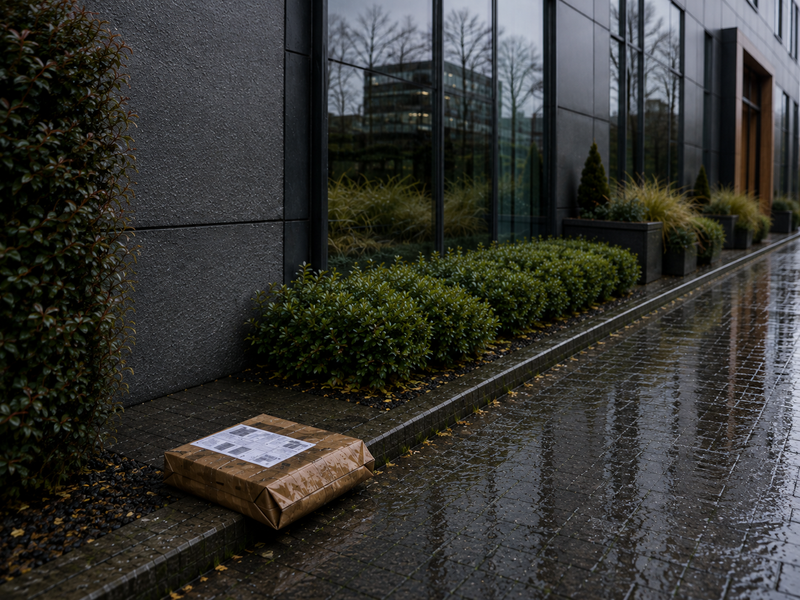
- So your box is not competing with handing over at the door, but with "quickly to the neighbours" and "on to the pickup point".
- 63 percent received a not-at-home notice at least once while they were actually at home (EenVandaag Opinion Panel, more than 24,000 members, 6 August 2026).
- Set a delivery preference with every carrier. A sticker on the box is a supplement, not a replacement.
- DHL wants a spot that cannot be seen from the street, PostNL wants the locker visible by the front door. Both are right, for different reasons.
Your delivery driver does not skip your parcel letterbox because they are lazy, but because they are paid per successful stop and have one to two minutes to complete that stop. Anything that causes doubt, searching or an extra action in that time loses out to the quickest way out: handing it to the neighbours or driving on to the pickup point.
Below you can read exactly how that calculation works, with the rates per stop from the FNV (Dutch trade union) black book and NPO Radio 1, the stop times from ride-along reports, and the panel figures on how often it goes wrong. Then we translate that into what you can do yourself: which setting is where, why DHL and PostNL contradict each other on visibility, what a sticker does and does not solve, and what the Geschillencommissie (the Dutch disputes committee) has decided so far about missing parcels. You are hearing this from us rather than from just any webshop because we make our parcel letterboxes ourselves in our own factory, so we hear every day what really happens at the front door. We state which claims come from research and which are our own practical advice.
- €0.77per successful stop according to a courier's statement in the FNV black book, December 2023
- 2 minutesper parcel at a PostNL subcontractor, EenVandaag ride-along report 27 November 2020
- 63%received a not-at-home notice while they were at home, EenVandaag Opinion Panel 6 August 2026
- 60%had a parcel sent to a pickup point without asking, Radar panel 25 May 2026, 19,908 participants

Why does my delivery driver skip the parcel letterbox?
The short answer: because in their view the box is not the quickest way to complete this stop successfully. That sounds cold, but it is exactly how the work is organised. In most cases, the delivery driver at your door is not an employee of the carrier whose logo is on the van. According to the FNV black book "Onderbetaling door onderaannemers PostNL" (Underpayment by PostNL subcontractors) from December 2023, in 2022 PostNL had about 1,900 parcel delivery drivers on its payroll, while about 5,000 drivers worked through hundreds of subcontractors. The undercover investigation by de Volkskrant (a Dutch national newspaper) from 2021 puts the share of outsourced routes at about 70 percent.
That man or woman is paid per stop that the system records as successful. Not per kilometre driven, not per hour at the door, and certainly not for an attempt that leads nowhere. The whole logic of your front door follows from that. Every action that takes time without increasing the chance of a successful stop is a loss for them. Every action that increases the chance of a successful stop within the same time is a gain.
A parcel letterbox sits exactly on that line. If it can be found, opened, filled and scanned within that minute, it is pure gain: it replaces ringing the bell, waiting, ringing again, trying the neighbours, and in the worst case a second trip tomorrow. If anything at all gets in the way, doubt about whether the box is meant for them, a flap that sticks, a parcel that does not fit in one go, a gate that is closed, they choose the way out they already know. That is the core of this article, and everything below works it out.
The four reasons we see in practice
From the sources and from what customers tell us, the causes fall into four groups. The first is uncertainty about permission. All three big carriers told the consumer programme Kassa (25 November 2021) that leaving parcels unattended is only allowed with prior permission: "it is absolutely not intended that parcels may simply be left outside the door or in the hallway. That is only allowed if permission has been given in advance." A delivery driver who cannot see in their scanner that you have given permission would rather not take the risk.
The second is time. See the next section. The third is route policy from above. Radar reported on 25 May 2026 that a DPD employee called the workload "inhumanly high" and that management sometimes sends delivery drivers straight to the pickup point. Then it is no longer about your box, but about a decision that was made before the van turned into your street. The fourth is unfamiliarity with the device. On 12 April 2017, Thuiswinkel.org (the Dutch online retail association) described a practical test with a smart parcel box in which the first delivery driver was initially reluctant to use the box, despite visible instructions. Once it had been explained to him, he asked whether all signed-for parcels could go in the box from then on too. That is the turnaround in a nutshell: first resistance out of uncertainty, then enthusiasm, because it saves him time.
How much time does a delivery driver really have per stop?
One to two minutes, and that includes parking, finding the parcel in the cargo area, walking, handling and driving off again. On 27 November 2020, EenVandaag rode along with a delivery driver from a PostNL subcontractor and recorded "hundreds of parcels a day, 2 minutes per parcel". The quote from that driver in the same report: "What is expected is more than you can handle." Radar wrote on 25 May 2026: "We often hear that the workload is high and that a lot of parcels have to be delivered in a short time. Sometimes they have only a minute per parcel."
The daily numbers match that. In its #PakketAAN investigation (2020), BNNVARA (a Dutch broadcaster) arrived at about 170 parcels a day per delivery driver. The undercover investigation by de Volkskrant from 2021 comes out higher: more than 200 parcels a day, with peaks above 300, and working days running from 10am to 10pm.
One figure we deliberately leave aside. In statistics on post and parcel transport, a figure of around 38 stops a day crops up. That covers the whole transport category including business trips and is off by a factor of four to eight from everything ride-along reports show. We do not use it, and you should distrust it too if you come across it elsewhere.
| Source | Date | What was measured | Outcome |
|---|---|---|---|
| EenVandaag ride-along report | 27 November 2020 | Riding along with a delivery driver from a PostNL subcontractor | Hundreds of parcels a day, 2 minutes per parcel |
| BNNVARA #PakketAAN | 2020 | Investigation into workload in parcel delivery | Around 170 parcels a day per delivery driver |
| Volkskrant undercover investigation | 2021 | Journalist worked as a delivery driver | 200+ a day, peaks above 300, days from 10am to 10pm |
| Radar | 25 May 2026 | Reports from delivery drivers and consumers | Sometimes only a minute per parcel |
Put those two minutes next to what ringing the bell costs. Ring, wait ten to twenty seconds, ring again, wait again, and only then conclude that nobody is in. That already takes up half of the stop time, with a failed attempt as the result, which is not paid. A box the parcel disappears into within fifteen seconds is not extra work for the delivery driver. It is a way out.
How is a parcel delivery driver paid, and why does that decide everything?
This is the engine under the whole article. In subcontracting, payment is not per hour but per stop, and only if that stop succeeds. On 27 November 2020, NPO Radio 1 cited a subcontractor rate of €1.20 to €1.80 per stop, plus a 16 cent supplement per extra parcel at the same address. The FNV black book of December 2023 quotes a courier word for word: "You only get paid per successful stop. That is €0.77 per stop. Per extra parcel you get €0.12." De Volkskrant arrived at about €0.60 per successful delivery in 2021, and noted just as firmly that nothing is paid for a failed attempt.
| Source and date | Per successful stop | Per extra parcel | On a failed attempt |
|---|---|---|---|
| NPO Radio 1, 27 November 2020 | €1.20 to €1.80 (subcontractor rate) | €0.16 | Not stated in this source |
| FNV black book, December 2023 | €0.77 (courier's statement) | €0.12 | No payment |
| Volkskrant, 2021 | Around €0.60 | Not stated in this source | No payment |
Do the maths and the picture becomes stark. At €0.77 per stop, an hour's work only pays if enough stops succeed in that hour. Every minute spent at a door that does not open is a minute that earns literally nothing. Two failed attempts in a row take as much time as three or four successful stops, and pay zero.
On 25 May 2026, Radar summed up the consequence in a sentence worth remembering: "Delivery drivers who are paid per parcel more often drive straight to the pickup point." At a pickup point you scan twenty or thirty parcels in one go, all successful, without a single door. For a delivery driver under time pressure, that is the rational choice. Not nice, but understandable.
It is important to see this: this is not a story about unwilling people. It is a story about a rate structure. As long as pay depends on the successful scan and not on time, every system at the front door will be judged on one question: does this cost me time, or save me time? Your box has to answer that question with "saves time" within seconds.
What is your parcel letterbox actually competing with?
Almost everyone thinks a parcel letterbox competes with the delivery driver who rings the bell and puts the parcel in your hands. It does not. The moment the delivery driver is at your door, they have three realistic options, and handing it over in person is usually not one of them, because nobody is in or nobody hears the bell. The real choice is: put it in the box, hand it to the neighbours, or drive on to the pickup point.
Seen that way, the yardstick changes. Your box does not have to be "better than the door". It has to be faster and more certain than ringing two or three neighbours' bells, which can easily take two minutes with an uncertain outcome, and more attractive than the guaranteed successful scan at the pickup point.
The ACM Post and Parcel Monitor 2025, published in June 2026, shows how big that playing field is: 615 million parcels in 2025 compared with 609 million in 2024, of which 82.2 percent were delivered at home, 12.4 percent to a service point and 5.3 percent to another location. The number of parcel lockers grew from 2,800 in 2023 to 4,800 in 2024 and 9,309 in 2025. That is more than a threefold increase in two years, while the share of home deliveries is barely falling. So the front door remains the battleground, and that is exactly where your box stands. If you want to know how each carrier deals with it, read what each carrier does with a parcel letterbox.
What route does your parcel take if the delivery driver does not use the box?
If your box is skipped, your parcel does not disappear straight away. It enters a chain that costs you time and the carrier money. That is why carriers themselves would also rather your box got used.
Every step in that chain is a moment where something can go wrong. The parcel is with a neighbour who goes on holiday, the card blows away, the pickup point only keeps it for a limited number of days. In receiving a parcel when you are not at home we go into more depth on what you can do in each situation.
How often does it go wrong? The figures, with sample and method
There are three large Dutch surveys on this subject, and they all point in the same direction. We set them out in full, including sample size, period and method, so you can judge for yourself how much weight to give them.
The EenVandaag Opinion Panel published a survey on 6 August 2026 among more than 24,000 panel members, 96 percent of whom had ordered online. Its findings: 1 in 3 did not receive at least one parcel in the past year, 63 percent received a not-at-home notice at least once while they were actually at home, and 4 in 10 saw the delivery driver leave a parcel without ringing the bell. A republication on Warehouse Totaal gives 32 percent as the headline figure and refers to more than 23,000 panel members. That is why we quote EenVandaag itself.
The Consumentenbond (Dutch Consumers' Association) surveyed more than 12,000 panel members on 28 October 2025 about the previous six months. 35 percent had a problem with parcel delivery, compared with 30 percent in 2023 and 27 percent in 2021. At UPS that share was almost 50 percent. More striking for this article: 21 percent now choose a fixed drop-off spot, compared with 11 percent in 2023, and use of parcel lockers went from 4 percent in 2023 to 17 percent in 2025. The scores show exactly where it hurts: resolving problems scores 3.7 out of 10 and customer service accessibility 4.6, while parcel lockers get 8.1 and pickup points 8.4.
The Radar panel of 25 May 2026 had 19,908 participants. 60 percent had a parcel sent to a pickup point instead of home without asking in the past three years, 82 percent find that annoying or frustrating, and 89 percent say they were simply at home at the agreed delivery time. 81 percent suspect the delivery driver never came to the door. 49 percent submitted a complaint, of whom only 14 percent had their complaint acknowledged. At DHL, 63 percent of the reports concerned a failed home delivery.
| Study | Date | Sample | Key finding |
|---|---|---|---|
| EenVandaag Opinion Panel | 6 August 2026 | More than 24,000 panel members, 96% ordered online | 63% received a not-at-home notice while they were at home |
| Consumentenbond (Dutch Consumers' Association) | 28 October 2025 | More than 12,000 panel members, last six months | 35% had a delivery problem, at UPS almost 50% |
| Radar panel | 25 May 2026 | 19,908 participants, last three years | 60% had a parcel sent to a pickup point without asking |
| ACM Post and Parcel Monitor 2025 | Published June 2026 | Market-wide registration, not a panel | 615 million parcels, 82.2% delivered at home, 9,309 lockers |
Please note. All three surveys above are opinion panels and not random samples. People who sign up for a panel on parcel delivery and people who fill in such a questionnaire are more likely to have had an experience than the average person in the Netherlands. The percentages are therefore almost certainly higher than the national average. What they do reliably show is the direction: using the same method, the Consumentenbond measured 27 percent in 2021, 30 percent in 2023 and 35 percent in 2025. That increase within a consistent method is the figure that counts. The ACM monitor is not a panel but a market registration, and this caveat does not apply to it.


DHL and PostNL contradict each other on visibility, and both are right
This is the contradiction that is almost never pointed out, and it is one of the most useful things you can know about this subject.
DHL requires the Afgesproken Plek (agreed place) to be covered and not visible from the street, easy to reach, and genuinely part of your own home. The delivery driver decides for themselves whether the spot is safe and may refuse. DHL also advises adding a photo so the delivery driver can find the spot, and advises against the option for valuable items.
PostNL writes exactly the opposite about the parcel locker at home: place the locker visibly by your front door, register it as your delivery preference, and keep it unlocked and accessible.
So two of the biggest carriers in the Netherlands give opposite advice about the same square metre next to your door. Who do you follow?
Why they are both right
The key is that they are talking about two different things, without writing that down anywhere. DHL describes an open spot: a shed, a canopy, a spot behind the planter. There the parcel lies unprotected. Visibility from the street is then pure risk, because everyone walking past can see there is something to take. The rule "not visible from the street" makes complete sense in that context, and the fact that DHL advises against the option for valuable items fits seamlessly.
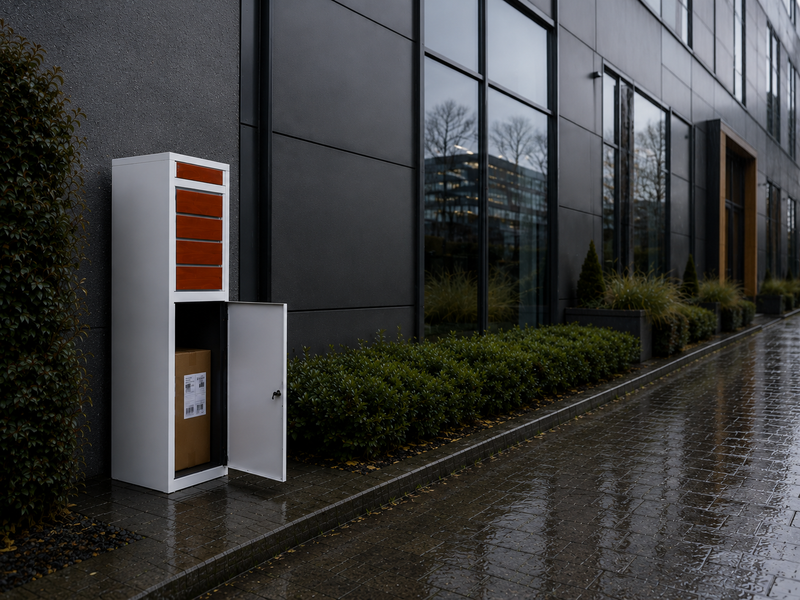
PostNL describes a lockable locker. Whatever is inside is out of sight and behind a lock. Visibility then no longer creates any risk, it only serves findability: the delivery driver, who has one to two minutes, needs to see the locker in the first few seconds. A locker that is not found does not get used. So findability is not a detail but the first precondition. That a visible box must not be possible to fish empty is covered in anti-fishing protection for a letterbox.
Neither carrier makes that distinction explicit, but it resolves the contradiction completely. The underlying rule is:
If the parcel lies out in the open, visibility is a risk. If it is behind a lock, visibility only means findability, and is therefore a gain.
Our reading of DHL's requirements for the Afgesproken Plek and PostNL's placement advice for the parcel locker at home.
In practice, that means the following. If you have a lockable parcel letterbox, follow the PostNL line: visible from the pavement, in sight of the front door, so the delivery driver sees it in the first second. If you do not have a box and use an Afgesproken Plek with DHL, follow the DHL line: out of sight and covered. The two pieces of advice only clash if you apply them to the same kind of spot. And note DHL's sentence that the delivery driver decides for themselves whether a spot is safe and may refuse: that is exactly where a locked steel box makes the difference compared with a corner of the carport, because there is much less for the delivery driver to judge.
On how to handle that line of sight in practice when building into a wall, gate or fence, we wrote a separate article on building in.
What does the delivery driver have to record, and what does that mean for your box?
A delivery driver does not close a stop with just a scan. What else is required of them differs per carrier, and that explains part of the hesitation at your box. On 25 November 2021, Kassa described how it works at the three big carriers: for parcels requiring identification, PostNL records the last three characters of the ID document, DPD records via GPS that the driver was on site, and DHL asks for the recipient's first name for the signature.
On camera images, Ius Mentis wrote on 21 November 2025 that PostNL and DPD say they do not use photos as evidence, while DHL and UPS do use cameras, but only for a photo of the parcel when it is left at an agreed location, so not when it is handed over in person. In addition, all three big carriers state explicitly that a delivery driver may not sign for receipt themselves.
What does this mean for your box? Two things. First: a parcel requiring a signature or ID needs to be handed over in person, because the carrier needs a name or ID. If you want to receive exactly that kind of shipment without hassle, look at the options per carrier for fixing a delivery time or a neighbour's address. Second, and this is the positive part: at DHL and UPS, the photo of the parcel at the agreed location is the standard procedure. So a box with the parcel clearly visible inside and the flap open is exactly what their process expects.
One thing you will not find here: a description of the exact screen steps on the handheld scanner. There is no public source that describes this reliably, so we are not making it up. Anyone who tells you there is "a parcel locker button" on the scanner cannot back that up.

Does a sticker or sign on the box help?
The honest answer has two parts, and they are almost always mixed up.
Operationally it helps. The delivery driver has one to two minutes and needs to understand within seconds what is intended. A clear text on the flap, in the local language and large enough to read from two metres away, removes exactly the doubt that made the first delivery driver hesitate in the Thuiswinkel.org practical test (12 April 2017). Once it had been explained to him, that same driver asked whether all signed-for parcels could go in the box from then on too. Explanation works, and a sticker is an explanation that is always there.
Contractually it solves nothing. There is not a single source saying that a sticker or sign counts as a valid instruction or permission. So we do not claim that it does, nor that it does not. What we do know is how the carriers have arranged it themselves: all three big carriers told Kassa (25 November 2021) that leaving parcels unattended is only allowed with prior permission, and they link that permission to their own system. At PostNL and DHL that is a delivery preference in your account, at DPD a signed form.
The conclusion is clear: a sticker supplements a delivery preference you have set, it does not replace it. Set the preference in the system, because that is the trail the delivery driver sees in their scanner and the one the carrier relies on later. Add the sticker, because it bridges the seconds in which the delivery driver stands in front of your box and decides. If you only do one, the delivery driver misses the confirmation on the spot. If you only do the other, the status in the system is missing.
What to put on a sticker
Keep it short and instructive, in the imperative, without explanation. Something along the lines of "Parcels in here, flap on top, closes by itself" works better than a three-sentence request. What it definitely needs: the house name or house number, so it is clear the box belongs to this address and not the neighbours. That last point is our own practical advice and not a research finding.
Checklist: what you can do yourself so your box does get used
Below are the steps in order of importance. Points 1 and 2 come from what the carriers themselves publish. The points after that on height, line of sight, gate, lighting and name plate are our own practical advice, based on what we hear back from customers and installers. There is no research measuring the link between these points and how often a box actually gets used, so we do not present it as a research finding either. Where a freestanding post may stand and at what height is covered in installing a freestanding parcel letterbox.
- Set a delivery preference with each carrier separately. This is the only step that is recorded in the system the delivery driver works from. A preference with PostNL says nothing about a shipment arriving with DHL or DPD. Do all four or five, once.
- Make sure the box is always accessible. PostNL states explicitly that the locker must be unlocked and accessible. So keep the drop side clear: on our models, the flap on top is open for the delivery driver and the key lock is on the parcel retrieval door, which only you need to reach.
- Put the box in the line of sight from the pavement to the front door. Our practical advice: if the delivery driver only sees the box once they are already at the door, they have already decided to ring the bell. Next to the door or along the path works better than around the corner of the house.
- Keep the drop flap at a workable height. Our practical advice: between hip height and shoulder height can be operated with a parcel in both hands. Our freestanding models are 1000 to 1120 mm tall, so the flap is automatically within that range. With a wall-mounted model you decide that height yourself when mounting it.
- Remove obstacles between the pavement and the box. Our practical advice: a locked gate, a garden gate that sticks and a dog in the front garden are all three reasons to drive on. If the box is behind a gate, put the box on the street side of that gate or make the gate openable from outside.
- Think about the dark. Our practical advice: in winter, deliveries go on until late in the evening, and de Volkskrant recorded working days until 10pm. An outdoor light or a motion sensor by the box costs little and saves searching.
- Put your name or house number on the box. Our practical advice: with two boxes side by side on a shared path, that is the difference between being used and being skipped.
- Choose a box your usual parcels fit into in one go. A parcel that has to be turned or squeezed takes time, and time is exactly what there is none of. See what size parcel letterbox you need.
- Empty the box regularly. Make sure there is room for tomorrow's delivery. A week of orders fits in the parcel compartment of a freestanding model, so emptying it daily is more than enough.
- Thank the delivery driver who does use it. Not research, but experience: the same person often drives the same route for weeks.
Where do you set your delivery preference with each carrier?
The setting has a different name with every carrier and is in a different place. The table below gives the broad outline. The full details per carrier, including DPD, GLS, Budbee and Vinted Go, are in what each carrier does with a parcel letterbox.
| Carrier | How the feature works | What the carrier itself says |
|---|---|---|
| PostNL | Register a parcel locker at home as your delivery preference in your account | Place the locker visibly by your front door, keep it unlocked and accessible. The delivery driver rings the bell unless you have set a different delivery preference yourself. |
| DHL | Set an Afgesproken Plek (agreed place), with the option of adding a photo of the spot | The spot must be covered, not visible from the street, easy to reach and genuinely part of your own home. The delivery driver decides for themselves whether the spot is safe and may refuse. Not recommended for valuable items. Without a preference set, the delivery driver always rings the bell. |
| DPD | Permission via a signed form | There is no legal obligation to ring the bell, but drivers are instructed to do so. GPS records that the driver was on site. |
| All three big carriers | Prior permission, linked to their own system | Leaving parcels unattended is only allowed with prior permission (Kassa, 25 November 2021). |
There is no legally defined waiting time after ringing the bell. Carriers speak of a "reasonable time", without defining it. That is exactly why 63 percent of EenVandaag respondents received a not-at-home notice while they were at home: if nobody sets out how long you have to wait, three seconds formally counts as waiting too. More on whether PostNL is allowed to put your parcel in your own box at all is in can PostNL put a parcel in your parcel letterbox.
Who pays for a parcel that disappears? Art. 7:11 of the Dutch Civil Code and four rulings
The legal starting point is in article 7:11 paragraph 1 of the Burgerlijk Wetboek (the Dutch Civil Code): in a consumer purchase, the risk only passes to the buyer at the moment the item is received by the buyer themselves or by a third party designated by them who is not the carrier. Two things are hidden in that: there has to be receipt, and the carrier explicitly does not count as a designated third party.
The Geschillencommissie (the Dutch disputes committee) has filled this in across four cases.
| Case | Date | Situation | Outcome |
|---|---|---|---|
| 227340/233108 (Thuiswinkel) | 6 December 2023 | Parcel worth €425.72 left at the front door, consumer could not find it, trader cited the track-and-trace code as proof | UPHELD. "Merely leaving a parcel on site does not count as handing it to the consumer in person." Full refund plus €52.50 complaint fee. |
| 15296/22874 | 9 November 2020 | Laptop delivered to a business address and accepted by a colleague, then disappeared | REJECTED. The risk had passed. A colleague at the specified address counts as a third party designated by the buyer, in the same way as family members at a home address. |
| 21163/37590 | 9 November 2020 | Consumer gave permission via a video doorbell to leave a Philips Hue worth €249.95 at the door | REJECTED. That consent counts as acceptance. |
| Ruling without a case number in our source | 13 November 2023 | Parcel delivered to a carrier's parcel point | A carrier's parcel point explicitly does NOT count as a third party designated by the consumer, because it is still part of the carrier itself. |
Put those four side by side and a consistent picture emerges. Leaving a parcel without you having said anything about it is not receipt, and then the risk stays with the seller. As soon as you have said something, or a person at your address accepts the parcel, the picture shifts. The video doorbell case is the sharpest: a single "just leave it by the door" over the intercom was enough for the complaint to be rejected.
The nuance you will not read anywhere else
Carriers take the position that the risk passes as soon as the parcel is at the agreed place. That is their position, and it is not the same as settled law. The only ruling we found on whether leaving a parcel counts as receipt says it does not, and that concerned a case without a delivery preference set. What exactly happens when the customer has specified the place themselves, for example by registering a parcel locker at home, has not been settled in the case law found.
So we do not write that your own box "therefore" shifts the risk to you. We do not know that, and nobody who claims otherwise can back it up with a ruling. What we do know: ACM spokesperson Jeannette Duin said on EenVandaag on 7 December 2025 that "the sender is responsible in almost all cases when a parcel goes missing", and at the same time warned that consumers should be careful about giving permission, because that may mean liability no longer lies with the sender.
Finally, a practical point about signatures. On 2 December 2025, Ius Mentis wrote that a signed proof of delivery is a private deed and therefore provides compelling evidence. But article 159 paragraph 2 of the Rv (the Dutch Code of Civil Procedure) provides that the burden of proof returns to the party relying on the document as soon as the recipient firmly denies that the signature is theirs. So if you are shown a scanned scribble that is not yours, you are in a stronger position than you think. How to handle police reports and claims if something really does disappear is covered in parcel theft in the Netherlands.
Which BunnyBox gives you the best chance of your box being used?
Everything above comes down to a fifteen-second action that has to work first time. That is a question of size: does the parcel you normally receive fit in one go, without forcing it? That is exactly where our four series differ. We make them ourselves in our own factory, so these are our own measured dimensions and not a supplier specification copied from elsewhere.
| Model | Type | Parcels up to (w x d x h in mm) | External dimensions (w x d x h in mm) | Post and parcels |
|---|---|---|---|---|
| BunnyBox Compact | Wall-mounted model, supplied pre-assembled | 300 x 200 x 200 | 365 x 250 x 450 | Separate slot, 1 compartment |
| BunnyBox Style | Freestanding post with wood-effect front | 350 x 320 x 200 | 380 x 365 x 1000 | Separate slot, 1 compartment |
| BunnyBox Home | Freestanding | 370 x 320 x 210 | 410 x 380 x 1020 | 1 compartment |
| BunnyBox Plus | Tall freestanding post | 450 x 320 x 210 | 500 x 370 x 1120 | Separate compartments for post and parcels |
What matters on this subject is space. The parcel compartment of a freestanding model is almost half a metre high, so a week of orders fits in. That is exactly what you need to prevent the day's second delivery driver from facing a full box. In the Maximum column, so with tilting as a delivery driver does it, the Home and the Style take 14 book mailers and the Plus 18. Four shoeboxes fit in every freestanding model. As for phone boxes, the Compact takes 9, the Home and the Style 40 and the Plus 42.
The choice in short:
- If you regularly receive larger boxes, the BunnyBox Plus is the answer: parcels up to 450 x 320 x 210 mm, and post and parcels in separate compartments, so your post does not disappear under the boxes.
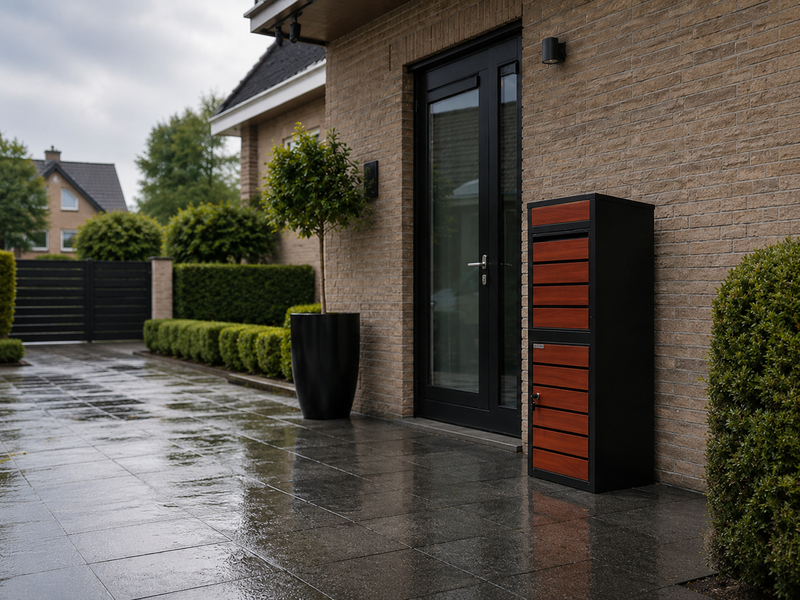
- If you want a freestanding post by the garden path, the BunnyBox Home fits: parcels up to 370 x 320 x 210 mm and external dimensions of 410 x 380 x 1020 mm.
- If it needs to match the facade, the Style is the slimmest freestanding option with a wood-effect front, in combinations with dark teak or light oak.
- If there is only a wall and no ground, the BunnyBox Compact is the solution. It is also the only series supplied pre-assembled: out of the box, onto the wall, done. You decide the mounting height yourself, and that is exactly the height at which the delivery driver opens the flap in one movement.
All series are made of 0.7 mm galvanised steel sheet with Qualicoat Class 2 powder coating with zinc phosphate pretreatment, have a door with a key lock and two keys, and a flap on top for the delivery driver. You choose from RAL 9005 black, RAL 9010 white, RAL 7036 platinum grey and RAL 7016 anthracite, plus the wood combinations. Ideally, fix a freestanding model to paving slabs or in concrete, so it cannot be carried off or fall over. Still unsure? Go through which BunnyBox is right for you, or view all parcel boxes side by side.

View the models
What if your box is consistently skipped by the same carrier?
Then something other than time pressure on an individual delivery driver is going on. Work through this order. First check whether the delivery preference is really registered with that specific carrier, and not just with a different one. This is by far the most common cause, because people assume that a setting with PostNL also applies to DHL.
If that is in order, report it per shipment to the carrier itself rather than the webshop, and keep the tracking codes. The Radar panel shows how lopsided that process is: 49 percent of participants submitted a complaint, and only 14 percent had their complaint acknowledged. On 28 October 2025, the Consumentenbond measured a score of 3.7 out of 10 for resolving problems and 4.6 for customer service accessibility. So expect to have to persevere. Whether the delivery driver actually used the flap is reported by a sensor in a smart parcel letterbox.
If it is a missing parcel and not just a detour via the pickup point, contact the webshop rather than the carrier. Article 7:11 of the Dutch Civil Code places the risk with the seller until the moment of receipt, and the seller is the party you have the contract with. The ruling of 6 December 2023 in case 227340/233108 is the most useful one to mention: a tracking code alone is not proof of receipt.
If things keep going wrong with one carrier, the last lever you have yourself is the choice at the webshop checkout. More and more shops let you choose between carriers. And take a critical look at your box itself: 21 percent of Consumentenbond respondents now choose a fixed drop-off spot, compared with 11 percent in 2023, and locker use went from 4 to 17 percent. So delivery drivers are seeing these things more and more often and getting used to them. More background on the whole chain can be found in our Knowledge base.
What will change in the coming years?
Two trends can be backed up with figures. The first is volume. The ACM counted 615 million parcels in 2025 compared with 609 million in 2024. That is modest growth, but on a base that is already enormous, and the share of home deliveries remains virtually unchanged at 82.2 percent. So there is no easing of the pressure at the front door on the way.
The second is infrastructure. The number of parcel lockers in the Netherlands grew from 2,800 in 2023 to 4,800 in 2024 and 9,309 in 2025, while only 5.3 percent of parcels end up at a location other than home or a service point. So there is heavy investment in lockers, but the bulk of parcels still go to the door. As long as that ratio stays so lopsided, the spot next to your front door remains the place where it is decided.
What we expect from this, and that is an expectation and not a finding: as more households have a box, using one becomes routine for delivery drivers, and the hesitation still visible in the Thuiswinkel.org practical test from 2017 disappears. That is where it is heading once a delivery driver comes across three boxes in a street instead of one. Always someone home with a BunnyBox.
Why does my delivery driver not ring the bell?
PostNL says the delivery driver rings the bell unless you have set a different delivery preference yourself, DHL says the delivery driver always rings the bell if no preference has been set, and DPD says there is no legal obligation but drivers are instructed to ring. There is no legally defined waiting time after ringing the bell. Carriers speak of a reasonable time without defining it.
Can the delivery driver just put my parcel in my parcel letterbox?
All three big carriers told Kassa (25 November 2021) that leaving parcels unattended is only allowed with prior permission. You arrange that permission in their own system: a delivery preference at PostNL and DHL, a signed form at DPD.
I got a not-at-home notice while I was at home, how can that be?
You are not the only one. In the EenVandaag Opinion Panel of 6 August 2026 among more than 24,000 members, 63 percent received such a notice at least once while they were at home, and in the Radar panel of 25 May 2026 among 19,908 participants, 89 percent said they were simply at home at the time of delivery, while 81 percent suspect the delivery driver never came to the door.
Why does my parcel go to the pickup point while I am at home?
Because for the delivery driver, a pickup point is a guaranteed successful stop. Radar wrote on 25 May 2026 that delivery drivers who are paid per parcel more often drive straight to the pickup point, and a DPD employee reported that management sometimes sends delivery drivers straight there.
Does a sticker on my parcel letterbox help?
Operationally, yes: the delivery driver understands within seconds what is intended. Contractually, no: not a single source says that a sticker counts as valid permission, and all carriers link permission to their own system. So see a sticker as a supplement to a delivery preference you have set, not as a replacement.
Should my parcel locker be visible from the street or not?
That depends on the type. For an Afgesproken Plek (agreed place), DHL requires it to be covered and not visible from the street, because the parcel lies there in the open. PostNL, on the other hand, advises placing the locker visibly by the front door, because a locked locker carries no risk of theft and just needs to be found. With a lockable box, follow the PostNL line.
Who is liable if my parcel disappears?
Article 7:11 paragraph 1 of the Dutch Civil Code places the risk with the seller until receipt by you or a third party you designated who is not the carrier. On 6 December 2023, in case 227340/233108, the Geschillencommissie ruled that merely leaving a parcel on site does not count as handing it to the consumer in person. ACM spokesperson Jeannette Duin said on 7 December 2025 that the sender is responsible in almost all cases.
Does having my own parcel letterbox shift the risk to me?
That is not settled. Carriers take that position, but the only ruling found on whether leaving a parcel counts as receipt concerned a case with no delivery preference set and went in the consumer's favour. What applies when you have specified the place yourself has not been settled in the case law found.
How much does a parcel delivery driver earn per stop?
On 27 November 2020, NPO Radio 1 cited a subcontractor rate of €1.20 to €1.80 per stop plus 16 cents per extra parcel. The FNV black book of December 2023 quotes a courier who receives €0.77 per successful stop and €0.12 per extra parcel. De Volkskrant arrived at about €0.60 per successful delivery in 2021. Nothing is paid for a failed attempt.
How big does my box need to be for the delivery driver to actually use it?
Big enough for your usual parcel to fit in one go without forcing it. Our freestanding models take parcels up to 370 x 320 x 210 mm (Home), 350 x 320 x 200 mm (Style) and 450 x 320 x 210 mm (Plus). The Compact wall-mounted model takes parcels up to 300 x 200 x 200 mm. See also what size parcel letterbox you need.
Please note. Last checked on 25 August 2026. The main sources behind this article: FNV black book "Onderbetaling door onderaannemers PostNL" (December 2023) for the rates per stop, NPO Radio 1 (27 November 2020) for the subcontractor rate, EenVandaag ride-along report (27 November 2020) and the undercover investigation by de Volkskrant (2021) for stop times and daily volumes, BNNVARA #PakketAAN (2020), the EenVandaag Opinion Panel (6 August 2026, more than 24,000 members), the Consumentenbond panel (28 October 2025, more than 12,000 members), the Radar panel (25 May 2026, 19,908 participants), the ACM Post and Parcel Monitor 2025 (published June 2026), Kassa (25 November 2021) on registration and permission, Ius Mentis (21 November 2025 and 2 December 2025) on evidence, Thuiswinkel.org (12 April 2017) on the practical test with a parcel box, DHL's requirements for the Afgesproken Plek and PostNL's placement advice for the parcel locker at home, article 7:11 paragraph 1 of the Dutch Civil Code, article 159 paragraph 2 of the Dutch Code of Civil Procedure, and the rulings of the Geschillencommissie in cases 227340/233108 (6 December 2023), 15296/22874 (9 November 2020) and 21163/37590 (9 November 2020) plus the ruling of 13 November 2023 on parcel points. The checklist points on mounting height, line of sight, gate, lighting and name plate are practical advice from BunnyBox and not a research finding: there is no public source measuring the link between those points and how often a box is used. We update this page twice a year, and sooner if a carrier changes its terms or a relevant ruling is added.