In brief
- Freestanding is allowed: your box must be reachable within ten metres of the boundary of a road (Postregeling 2009, the Dutch postal regulation, article 5 paragraph 4).
- Slot at 1.1 m, no lower than 0.6 m and no higher than 1.8 m (article 6 paragraph 2).
- Drop opening at least 265 by 32 mm (article 6 paragraph 3).
- Foundation: a hole of 25 by 25 by 25 cm filled with rapid-set concrete.
- A frost-free depth appears nowhere in the law; the rule of thumb in practice is 60 to 80 cm.
- Permit-free in the garden area up to 1 m high and 2 m2 (Bbl article 2.29 under r). If in doubt, call your local council.
- House number required (article 5 paragraph 3), surname not.
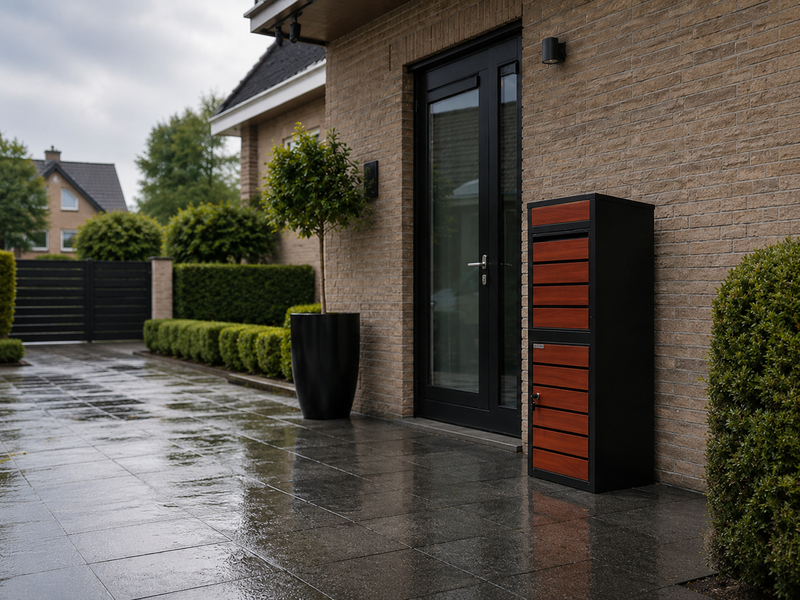
In the Netherlands, a freestanding parcel letterbox can simply stand in your front garden, beside your driveway or along your garden path, as long as it can be reached within ten metres of the road boundary and the letter slot sits between 0.6 and 1.8 metres high. You make it stable by setting the base in concrete rather than screwing it onto a loose paving slab, because wind pushes on a post of this size with roughly as much force as the post itself weighs.
Below you will find the ten-metre rule, for the first time complete with article and paragraph number, plus the three other legal requirements that go with it. After that come the foundation methods with the dimensions, quantities and curing times as the manufacturers state them, the frost depth per soil type, a worked example of the wind load, the permit question under the Omgevingswet (the Dutch Environment and Planning Act), the neighbour law at the property boundary, and whether you need to file a dig notification before you put a spade into your own front garden. We make parcel letterboxes ourselves in our own factory, so we know what a post of sixteen to twenty kilos does when it is set up the wrong way. A webshop that resells boxes cannot tell you that. Where a source is missing, or where two sources contradict each other, we say so explicitly, with name and date.
- 10 mmaximum distance to the road boundary, Postregeling 2009 article 5 paragraph 4
- 1.1 mtarget height of the letter slot, article 6 paragraph 2
- 265 x 32 mmminimum clear drop opening, article 6 paragraph 3
- 25 cmhole depth and hole size from the only letterbox instruction published by a concrete manufacturer

Can I place a freestanding parcel letterbox in my front garden?
Yes. The regulations are not about whether your box hangs on the wall or stands on its own in the garden, but about whether the postal delivery person can reach it in time and without a detour. The postal market regulator says so in as many words: if your house is too far from the road, a separate box by the road is the solution. A freestanding post is therefore not an exception you have to work around, but exactly the solution the regulator itself names.
"Your letterbox must be no more than 10 metres from the public road. Is your house further away? Place a separate letterbox by the road."
ACM ConsuWijzer (Dutch consumer authority), "Eisen aan mijn brievenbus", last updated 29 July 2025
That makes a freestanding setup interesting for three kinds of home. The first is the home with a long driveway or a deep front garden, where the facade is simply more than ten metres from the road. The second is the home where the front door is close by, but a fence, a gate or steps make the last few metres awkward. The third is the home where the facade offers no good spot, for example because there is insulation or a brick plinth you would rather not drill through. In all three cases you place the post where the delivery driver sees it straight away from the van.
A freestanding installation does bring two questions of its own that a wall-mounted model does not have: how do you make it stable, and where exactly may it stand in relation to the road, the property boundary and public land. Those two questions make up the rest of this article. If your box hangs on the facade, the heart of the story lies elsewhere, namely in the fixing into the brickwork and preventing leaks. For that we have a separate article on hanging a wall-mounted model without leaks or a cold bridge. Want to know which size you need before you start on the foundation? Then read which size parcel letterbox you need. It would be a shame to dig a hole and only then discover that your collection compartment is too small for the boxes you order.
One more reason to go freestanding: you decide the height of the slot yourself. On a facade you are stuck with what the brickwork and the plinth allow, and that sometimes ends up at 1.4 or 1.5 metres. With a standing post of around a metre, the slot automatically lands close to the 1.1 metre target in the Postregeling 2009. That sounds like a detail, but it is exactly the height at which a delivery driver with an armful of parcels can work without bending or stretching.
What is the ten-metre rule and which legal article contains it?
The ten-metre rule is in the Postregeling 2009, identification number BWBR0025578, which came into force on 1 April 2009. Article 5 paragraph 4 states that letterboxes in or on buildings or homes must be fitted or placed so that they can be reached within ten metres of the boundary of a road. Note the word boundary. It does not say ten metres from the carriageway, nor ten metres from the kerb. The road boundary is the starting point, and that is usually the edge of the public area in front of your plot.
Even more important is article 5 paragraph 1, which is almost never quoted. It says that a letterbox intended for the delivery of postal items must be fitted as close as possible to the carriageway of a public road that motor vehicles with more than two wheels can drive on. So the standard is "as close as possible to the carriageway". The ten metres in paragraph 4 is an outer limit, not a target. Anyone who puts their post at nine and a half metres because it is just allowed is reading the regulation wrong. Anyone who puts it two metres from the pavement is doing exactly what it says.
Article 5 paragraph 2 adds which roads count: roads that are passable all year round without obstruction, are not a dead end and make the delivery route possible. Article 5 paragraph 3 covers the house number: on or near the letterboxes, a number must clearly indicate which home, building or part of it they belong to. Article 5 paragraph 7 says that the level at which the letterboxes are used may be no more than 2.5 metres above or below the road surface. That is why PostNL writes in its own flyer that steps may be no higher than 2.5 metres. Article 5 paragraphs 5 and 6 deal with grouped placement at gallery flats, communal buildings and holiday parks, and do not apply to an ordinary front garden.
The Besluit brievenbussen (Letterbox Decree) was withdrawn back in 2009
Almost every webshop and every knowledge base you read on this subject still quotes the Besluit brievenbussen. That decree, identification number BWBR0004448, applied from 1 January 1989 up to and including 31 March 2009 and was withdrawn on 1 April 2009. Article 1 covered placement near a road that motor vehicles can drive on, article 2 the technical side: the letter slot had to be horizontal, the drop opening at least 265 by 32 mm, the collection space at least 270 mm wide with 150 and 380 mm for the other dimensions. Article 3 set the entry into force on 1 January 1989 and article 4 the short title.
The dimensions were carried over almost identically into the Postregeling 2009, so anyone who followed the old decree is usually fine. But the source is wrong, and you notice that as soon as you want to prove something to your local council or a carrier. So quote the Postregeling 2009 with article and paragraph. If you want to know exactly what other requirements apply to an ordinary letterbox, you will find them in our overview of letterbox requirements in the Netherlands.
Ten metres walking distance or ten metres as the crow flies?
Here two sources contradict each other. The Postregeling 2009 says "can be reached within ten metres of the boundary of a road". PostNL writes in its own flyer about "a maximum of 10 metres walking distance from the public road". That is not the same thing: walking distance follows the path, as the crow flies goes straight through the flower bed. We found no provision on how to measure in the regulation text itself, nor any primary source that resolves the difference. The practical consequence: stick to the strictest reading and measure along the path the delivery driver walks. Then you are fine under both interpretations.
| Requirement | What the regulation says | Article and paragraph | What PostNL and ACM say about it |
|---|---|---|---|
| Distance to the road | Reachable within ten metres of the boundary of a road, and as close as possible to the carriageway | Postregeling 2009 art. 5 paragraphs 4 and 1 | PostNL: maximum 10 metres walking distance. ACM: maximum 10 metres from the public road, otherwise a separate box by the road |
| Height of the slot | At 1.1 metres, in any case no lower than 0.6 metres and no higher than 1.8 metres, horizontal in a vertical surface or in the top surface | Postregeling 2009 art. 6 paragraph 2 | Both state 110 cm from the ground, with the same lower limit of 60 cm and upper limit of 180 cm |
| Drop opening | Clear opening at least 265 mm long and 32 mm wide, designed without risk of injury | Postregeling 2009 art. 6 paragraphs 3 and 4 | PostNL: at least 26.5 cm wide and 3.2 cm high. ACM: minimum length 26.5 cm, minimum width 3.2 cm, no sharp edges |
| Space behind the slot | At least 270 mm wide, with 150 mm and 380 mm for the other dimensions | Postregeling 2009 art. 6 paragraph 5 | ACM: at least 27 by 15 by 38 cm. PostNL: at least 15 cm deep as the legal minimum, with a recommendation of at least 25 cm |
| Number on or near the box | A number must clearly show which home or building the box belongs to | Postregeling 2009 art. 5 paragraph 3 | PostNL: make sure your house number is clearly visible on or near your letterbox |
| Operating level | No more than 2.5 metres above or below the road surface | Postregeling 2009 art. 5 paragraph 7 | PostNL: steps no higher than 2.5 metres |
| Shape and colour | Such that confusion with the letterboxes of the universal postal service provider is not possible | Postregeling 2009 art. 6 paragraph 1 | ACM: your letterbox must not look like the orange PostNL postbox |
That last row matters more for a freestanding post than for a wall-mounted model. A separate orange or red post by the street looks more like a PostNL street postbox than a box that clearly belongs to a facade. So choose your post in a neutral colour. Anthracite, black, white and platinum grey are the colours we make our models in, and none of them comes anywhere near the orange of the universal postal service provider.

At what height should the letter slot of a standing post be?
Article 6 paragraph 2 of the Postregeling 2009 is very precise here: the letter slot is fitted horizontally in a vertical surface or in the top surface of the letterbox and sits at 1.1 metres, or in any case no lower than 0.6 metres or higher than 1.8 metres. So there is a target value and a range. The target is 1.1 metres, the range runs from 0.6 to 1.8 metres. PostNL and ACM ConsuWijzer give exactly the same figures, just in centimetres: 110 cm, no lower than 60 cm, no higher than 180 cm.
For a freestanding post this means you have to take the height of your hole and the height of your paving into account. A post 100 to 112 cm tall automatically puts the slot or drop flap in the upper half of that range, around the target. Put that same post on a raised base of thirty centimetres, for example a low wall or a raised flower bed, and everything moves up with it. So measure from the level where the delivery driver stands, not from the top of your foundation.
The dimensions of the opening itself are in article 6 paragraph 3: the clear drop opening is at least 265 mm long and 32 mm wide. Article 6 paragraph 4 adds that the opening must be designed so that the letterbox can be used without risk of injury. Article 6 paragraph 5 covers the space behind it: at least 270 mm wide, and 150 and 380 mm respectively for the other dimensions.
On that collection space the sources half contradict each other. The Postregeling 2009 and ACM give the same dimensions, just in different units: 27 by 15 by 38 cm. PostNL translates the 150 mm into "at least 15 cm deep" and adds a recommendation of at least 25 cm deep. That 25 cm is not a legal requirement, it is advice from the carrier itself. For a parcel letterbox the difference is academic: the parcel compartment of a freestanding model is almost half a metre tall, so a week of orders fits inside. That puts you well above both the legal minimum and PostNL's recommendation.
Is there a rule about dogs, gates or putting your name on the letterbox?
No, and this is where most pages on this subject go wrong. We went through article 5 and article 6 of the Postregeling 2009 word for word, read PostNL's letterbox flyer and checked the "Eisen aan mijn brievenbus" page from ACM ConsuWijzer. None of those three sources contains a provision about dogs, fences or gates. Nor is there any obligation to put your surname on the box.
What they do say is phrased more generally. ACM ConsuWijzer writes that the postal worker must be able to find your letterbox easily and reach it without difficulty. Article 6 paragraph 4 of the Postregeling 2009 requires that the box can be used without risk of injury. Those are open standards. A delivery driver who does not dare to enter your property because a dog is running loose, or who first has to open a locked gate, will not get through in practice. But that is not a breach of a numbered article, so it is also not something anyone can hold you to with a legal reference.
For the house number it is the other way round: there are actually two legal bases. The first is article 5 paragraph 3 of the Postregeling 2009, which requires a number that makes clear which home the box belongs to. The second is municipal. The municipality of Vught, for example, has a Verordening naamgeving en nummering (adressen) 2026 (a bylaw on street naming and numbering), in force since 22 May 2026, whose article 6 paragraph 1 obliges the owner to display the house number and whose article 6 paragraph 2 attaches a deadline of four weeks after notification. Article 5 paragraph 2 of the same bylaw requires the number plates to remain clearly legible from the public space. Almost every municipality in the Netherlands has a version of this bylaw, but the exact wording and article numbering differ from one municipality to the next. So check your own municipality's bylaw if you want to know precisely.
In practice it comes down to this: a large, high-contrast house number on the post, legible from the street, covers both legal bases in one go. It is also the first thing we recommend to people whose delivery driver does not use the box. Why your delivery driver skips your parcel letterbox explains why this is so often the cause: if the driver cannot see at a glance that the post belongs to number 24, he takes the safe route and rings the doorbell.
- Within ten metres of the road boundary, and as close as possible to the carriageway (art. 5 paragraphs 1 and 4)
- Visible from the delivery van, with the house number facing the street
- At the same level as the pavement, so no steps on the walking route
- On the side where the driver gets out, not behind the car on the driveway
- Behind a closed gate or a fence with a latch that sticks
- More than ten metres from the road boundary, measured along the path
- Tucked into a beech hedge that grows shut in July
- On a raised base that puts the slot above 1.8 metres
What foundation do I need for a freestanding parcel letterbox?
The answer first: a post of sixteen to twenty kilos will not stay upright on its own weight. You fix it in the ground with rapid-set concrete, on a concrete footing with roughly a third buried, or on a ground screw. A loose concrete slab or base plate that you screw the foot plate onto keeps the post upright in normal use, but offers no resistance to tipping over in a storm. In the next section you will see why: the wind load on a front surface of this size is of the same order as the post's own weight.
As a reference for dimensions and weight we use a freestanding parcel letterbox that is freely available in the Netherlands and Belgium: the Hannover staand mat antraciet (freestanding, matt anthracite) from GAMMA, item B610560, retrieved on 26 August 2026. It is 1110 mm tall, 415 mm wide and 270 mm deep and weighs 18.2 kg. The drop opening is 19 by 34 cm and the maximum parcel size 13 by 33 by 22 cm. The price was €199.00 normally, €149.00 on promotion and €99.00 with the GAMMAplus card. We do not mention this model to compare quality, but because it gives concrete, publicly published figures for the weight and front surface that the rest of this article calculates with.
The table below sets the five methods side by side with everything the manufacturers and suppliers publish about them. Where a source does not give a figure, the table says so.
| Method | Size or dimension | Amount of material | Curing or waiting time | Tools | Source |
|---|---|---|---|---|---|
| Rapid-set concrete in a dug hole, letterbox instruction | Hole 25 by 25 cm, at least 25 cm deep, in firm ground; adjust to the weight and dimensions of the element | 3 to 3.5 litres of water per 25 kg bag; apply in layers of no more than 20 cm up to about 6 cm below ground level | Turbo-Beton 20 minutes, Turbo-Beton Plus 5 minutes | Spade, watering can or bucket, spirit level, tamper or hammer head | Knauf, "Een brievenbus in de grond vastmaken" (Atelier Knauf), retrieved 26 August 2026 |
| Rapid-set concrete mortar, general use | Consumption table per hole size and post size on the manufacturer's page | About 3.2 litres of water per 25 kg; 25 kg of dry mortar gives about 13 litres of wet mix | Sets within 15 minutes, can be checked after 2 minutes and needs no further support after that; use between plus 5 and plus 25 degrees | Spade, bucket, mixing bar or stick, spirit level | Sakrete Snelbetonmortel 25 kg, manufacturer's page, retrieved 26 August 2026 |
| Rapid-set concrete you do not premix | Consumption table for holes from 20 by 30 cm to 30 by 45 cm | 16 to 68 kg depending on hole size and post type; a 25 kg bag gives about 14 litres. Fill the hole halfway with clean tap water and sprinkle in the dry product until the mortar is fully saturated | Hardens within 15 minutes; bracing the post is not necessary | Spade, watering can with clean tap water, spirit level | Saint-Gobain Weber Beamix NoMix beton 125, technical data sheet, retrieved 26 August 2026 (no version date on the sheet) |
| Concrete footing, partly buried | No hole depth or hole width in the source; typically about a third of the footing is buried | Not stated in the source | Not stated in the source | Spade, wheelbarrow, spirit level, two people for lifting | Betondingen, "Hoe plaats je een vrijstaande brievenbus?", published 10 December 2024 |
| Ground screw, screwed in | Series E, F, G, M and U; example type E140x2100-E76-100. A model available from a garden supplier is 120 cm long, item number M76X130M16 | No concrete needed. Price of that one model €160 at the supplier | No waiting time, can bear load immediately | Special handheld screw-in machine, according to the supplier | Load table Krinner Schraubfundamente GmbH via Jonkers Schroeffunderingen; Van Kooten Tuin en Buitenleven, both retrieved 26 August 2026 |
| Stelcon slab as base plate | 2 by 2 m, 2 by 1.5 m or 2 by 1 m, in thicknesses of 14, 16, 20 or 25 cm; standard size 2 by 2 m | The lightest slab, 200 by 100 cm and 14 cm thick, weighs 670 kg; with a steel angle edge about 20 kg more; the 2 by 2 m slab 25 cm thick weighs 2400 kg | No waiting time, but the slab must lie on a level base | Lifting equipment; cannot be placed by hand | De Meteoor Beton B.V. (dimensions and thicknesses) and weight table De Keij, both retrieved 26 August 2026 |
| Ground anchor or post anchor with foot plate | Length and foot plate size not public on the product page we found | Not public | Not public | Sledgehammer or driving tool, depending on the type | We looked up the specifications on the product page of a supplier of letterbox posts and found only metadata, no dimensions or material details |
Two things stand out. The first is that there is exactly one manufacturer's instruction with the word letterbox in its title: the one from Knauf, with the hole of 25 by 25 cm and at least 25 cm deep. That is remarkably little for a product that stands in millions of Dutch front gardens. The second is that the Stelcon slab works technically, but the lightest version weighs 670 kg against a post of 18.2 kg. That is well over thirty-five times the weight of what you are fixing, and you need lifting equipment to lay the slab. For a driveway you are paving anyway, it is a fine choice. For a letterbox post alone, use one of the other four methods.
Note the difference between stability and theft resistance. This article is about the foundation that keeps the post upright. The question of how to fix the box so that it cannot be carried off whole is a different one with its own solutions. You will find those in anchoring a parcel letterbox so it cannot be taken away. If you are after the assembly steps, the tools and the wall plugs for a self-assembly kit, assembling a parcel letterbox is the article you need.
Note. None of the three rapid-set concrete manufacturers publishes a 28-day compressive strength or C class for these products. We checked this at Sakrete, Weber Beamix and Knauf on their own product pages and technical sheets, and it is not there. So do not count on it, and use rapid-set concrete for what the manufacturers themselves mention: posts, fences, masts, road signs, play equipment and, in Knauf's case, a letterbox.
How deep should the hole be, and does the foundation need to be frost-free?
This is where two kinds of source diverge, and it is the main tension in this whole subject. The manufacturer's instruction that deals specifically with a letterbox settles on at least 25 cm deep. The advisory sources on foundations give 60 to 80 cm as the frost-free depth. That is a difference of a factor of three, and both are defensible, because they are about different things. The 25 cm is about whether the element stays upright. The 60 to 80 cm is about whether the foundation gets pushed up in winter.
First, what the law says: nothing. We found no legally prescribed frost-free foundation depth in the Netherlands. Funderingskeuze.nl, updated in August 2026, states that the Dutch building regulations do not prescribe an exact foundation depth but require a foundation to be safe and durable, without citing a standard number. Webwoordenboek.nl refers to NEN-EN 1997-1, the Eurocode for geotechnical design, but gives no article number, and the text of the standard itself is paid and not freely viewable online. So anyone who tells you that you must dig to 80 cm "according to the standard" cannot back it up with an article number.
What has been measured comes from the trade literature. Erno Bouma calculated in "Vorst in de grond" in Groen en Golf of February 2009 with the formula z equals a times the square root of the frost index. For the fourth day of frost at a frost index of 16, he arrives at 24 cm in dry sand, 12 cm in wet clay and 5 cm in peaty soil. So sandy soil freezes twice as deep as clay and almost five times as deep as peat in exactly the same cold. That explains why foundation advice differs by soil type, and why a post in the sandy soil of Brabant is more likely to lean after a harsh week than the same post in the clay of Zeeland.
MEASURED FROST PENETRATION AT FROST INDEX 16, FOURTH DAY OF FROST
Worked example from Erno Bouma, "Vorst in de grond", Groen en Golf, February 2009. This is a short frost period of four days, not an extreme winter.
Put those measured values next to the recommended depths and you immediately see where the tension lies. The recommended depths are designed for extreme winters; Bouma's worked examples cover four days of frost. Both figures are correct within their own context. The KNMI (Royal Netherlands Meteorological Institute) publication this field refers back to is P.J. Rijkoort, "De indringingsdiepte van de vorst in de bodem", KNMI publication WR-60-05 from 1960. That publication demonstrably exists and is the primary Dutch reference, but the depth values are not on the KNMI web page, only in the PDF behind the download link. We therefore cite it as a source and not as a source of figures.
| Soil type | Measured penetration at frost index 16 | Recommended depth in practice | What that means for your post |
|---|---|---|---|
| Dry sand | 24 cm (Bouma, February 2009) | 60 to 80 cm on sandy soil in the east and south of the Netherlands; firm sandy soil in practice 80 cm frost-free (funderingskeuze.nl, August 2026) | The soil type that freezes deepest. Here a hole deeper than the 25 cm minimum pays off the most |
| Loose sandy soil | Not measured separately in the source | 80 cm to 1.5 m (funderingskeuze.nl, August 2026) | Compact the bottom of the hole and pour in layers, so the concrete does not sink into loose soil |
| Wet clay | 12 cm (Bouma, February 2009) | 80 to 100 cm on clay soil; light clay 80 cm to 1.5 m (funderingskeuze.nl, August 2026) | Freezes less deeply, but clay shrinks and swells with the seasons. Check your post after a dry summer |
| Peat | 5 cm (Bouma, February 2009) | 100 to 120 cm on peat soil; in the table from the same source 2 to 12 m for buildings | Frost is the smallest problem here, subsidence the biggest. Expect to readjust |
| General frost line | Not applicable | At least 600 mm below ground level, in practice often 800 mm (webwoordenboek.nl) | This source refers to NEN-EN 1997-1, but gives no article number. Treat the 60 and 80 cm as a practical guideline, not a legal requirement |
Our advice, and this is a judgement call rather than a standard: dig deeper than the 25 cm in the Knauf instruction if you are on sand and the post stands exposed to the wind, and stick to the 25 cm if the post stands sheltered between a hedge and a fence on clay. The mechanism you want to prevent is described by webwoordenboek.nl: when groundwater freezes and expands, the whole thing can rise slightly with the soil and uneven settlement occurs. In a building you see that as cracking. In a letterbox post you see it as a post that is a few degrees out of plumb in March.
How much force does the wind put on a freestanding post?
This is the figure that explains why a loose paving slab is not enough. We work it out using the lowest table value publicly available, so the example stays on the cautious side.
According to the Dutch National Annex to NEN-EN 1991-1-4, the Netherlands is divided into three wind zones. Zone 1 is the Markermeer, the IJsselmeer, the Wadden Sea, the Wadden Islands and the province of Noord-Holland north of the municipalities of Heemskerk, Uitgeest, Wormerland, Purmerend and Edam-Volendam. Zone 2 is the rest of Noord-Holland, the mainland of Groningen and Friesland and the provinces of Flevoland, Zuid-Holland and Zeeland. Zone 3 is the rest of the Netherlands, so Drenthe, Overijssel, Gelderland, Utrecht, Noord-Brabant and Limburg. Zone 1 has the highest wind load, zone 3 the lowest.
| Wind zone | Which area | Basic wind speed | Converted |
|---|---|---|---|
| Zone 1 | Markermeer, IJsselmeer, Wadden Sea, Wadden Islands and Noord-Holland above the line from Heemskerk to Edam-Volendam | 29.5 m/s | 106 km/h (our own conversion) |
| Zone 2 | Rest of Noord-Holland, mainland of Groningen and Friesland, Flevoland, Zuid-Holland and Zeeland | 27.0 m/s | Not converted in our source |
| Zone 3 | Drenthe, Overijssel, Gelderland, Utrecht, Noord-Brabant and Limburg | 24.5 m/s | 88 km/h (our own conversion) |
The basic wind speeds come from "Rekenen aan wind" by Arie l'Amie and Ben Roos in the VEBIDAK trade journal, issue 208 of March 2020. The peak velocity pressures you need to turn them into a force are in Table NB.4 of the National Annex to NEN-EN 1991-1-4. That table is paid and not freely accessible. What we have been able to establish are the extremes: the table values run from 0.48 kN/m2 to 2.65 kN/m2, for heights from 1 metre to 200 metres. The lowest value, 0.48 kN/m2, applies to wind zone 3, built-up area, at 1 metre height. The highest, 2.65 kN/m2, applies to wind zone 1 on the coast at 200 metres height. We could not find the complete matrix per wind zone, terrain category and height publicly.
Now take the front surface of a standing post: 1.0 metre high by 0.4 metre wide is 0.40 m2. With the lowest table value of 0.48 kN/m2 you get 0.48 times 0.40 equals 0.192 kN. That is roughly 19.6 kilograms of force. If that force acts at half height, so at 0.5 metre, the overturning moment is roughly 0.096 kNm.
This is an order-of-magnitude indication and not a structural calculation. For a wind force that complies with the standard you need a force coefficient cf, which depends on the shape, slenderness and corner rounding of the body, plus any partial factors. We found no public source with the cf for a freestanding rectangular post of about 1 metre by 0.4 metre, and without that coefficient the exact force cannot be calculated according to the standard. The two separate worked examples we found in an official annex on wind loads, 0.62 kN/m2 at 7 metres height in wind zone 3 and 1.37 kN/m2 at 5 metres, also come from different examples with different terrain categories and cannot simply be compared side by side.
What you do know from this assumption: the wind force on a small post of this size is of the same order as its own weight. That is exactly why a post that stands on tiles with only its foot plate can tip over in an autumn storm, and why every rapid-set concrete manufacturer gives the same advice for posts, fences and road signs: in the ground, in concrete.
Do I need a permit for a parcel letterbox in my front garden?
Under the Omgevingswet (the Dutch Environment and Planning Act) there are two tracks running side by side. The first is the technical building activity, governed by articles 2.25 to 2.27 of the Besluit bouwwerken leefomgeving (Bbl, the Dutch Building Decree). An activity is technically permit-free if it is exempted in article 2.27 or not mentioned in articles 2.25 and 2.26. For consequence class 1 a notification duty applies instead of a permit. The second track is the environmental plan activity, set out in article 2.29 of the same decree. This is how the Informatiepunt Leefomgeving (IPLO, the Dutch government's environmental information point) describes it in "Vergunningvrij bouwen: van Wabo naar Omgevingswet", last updated on 2 April 2025.
Article 2.29 of the Besluit bouwwerken leefomgeving, identification number BWBR0041297, is the provision that matters most here. Item r mentions "another structure in the front or back garden area", permit-free if it is no higher than 1 metre and the surface area is no more than 2 m2. Item j mentions a garden or plot boundary partition up to 1 metre. Item k covers a structure for bridging a difference in ground level of no more than 1 metre.
Those are the facts. And now the part you will not read anywhere else: not a single primary source mentions a letterbox or a parcel letterbox by name. Not the Besluit bouwwerken leefomgeving, not the Informatiepunt Leefomgeving, and not the municipal regulations we searched. We also looked for an enforcement case or a ruling in which a freestanding letterbox post was assessed against article 2.29 item r, and we did not find one. Meanwhile, almost every street in the Netherlands has a letterbox or a post in a front garden, and it has been that way for decades.
So the practical conclusion is not that anything is prohibited, but that the regulation simply does not speak explicitly about this category of object. If in doubt, call your local council and ask about the environmental plan (omgevingsplan) for your plot. It takes five minutes and you get the answer from the only party that can give it bindingly. The Informatiepunt Leefomgeving also points out that the municipality can change the transitional rules (the so-called bruidsschat) in the environmental plan, so stricter requirements may apply locally while the national exemptions remain the basis.
What is worth knowing: if you build the post into fencing or a boundary partition, the rules for boundary partitions apply. In planning terms, nationally a maximum of 1 metre is permit-free under article 2.29 item j. Through the bruidsschat a maximum of 2 metres is permit-free, provided it is placed behind the line along the front of the main building, under article 22.27 item f and article 22.36 of the same decree. Technically, a boundary partition up to 2 metres is permit-free at all locations under article 2.26 paragraph 2 item c. This is what the IPLO page on permit-free garden and plot boundaries says, last updated on 6 July 2026. The front garden area is the area in front of the main building facing publicly accessible space, the back garden area lies behind it, and the restrictions are stricter at the front. If you want to incorporate the box into a wall, gate or fence instead, building a parcel letterbox into a wall, gate or fence is the article that covers the construction side of that.
One more point in favour of a standing post: with a height of 100 to 112 cm, the drop opening of the freestanding models lands exactly within the 0.6 to 1.8 metre range from article 6 paragraph 2 of the Postregeling 2009, around the 1.1 metre target. So you do not need to build, raise or lower anything to meet the postal requirements. With a home-built construction in a fence, that is by no means a given.
Can the post stand on the property boundary, and what if I dig in my front garden?
Start with the ownership question. Article 5:20 of the Burgerlijk Wetboek (BW, the Dutch Civil Code) states that ownership of land, unless the law provides otherwise, includes the surface and the layers of earth beneath it. So your foundation may go into your own ground, but not extend under your neighbour's ground. With a hole of 25 by 25 cm that is rarely a problem, unless you put it right against the boundary.
Then the boundary itself. Article 5:36 BW says that if a wall, fence, hedge or ditch serves to separate two properties, the middle of that partition is presumed to be the boundary. So if you put the post right against the fence, the presumed boundary runs through the middle of that fence and not along your side of it. Keep a margin on your own side. Article 5:37 BW prohibits causing nuisance to owners of other properties to a degree or in a way that is unlawful under article 6:162 BW. That is the legal basis if your post, for example, blocks the view at your neighbour's driveway exit.
Important, and this often goes wrong: Book 5 of the Dutch Civil Code has no general minimum distance for placing a structure or object near the property boundary. Anyone who writes that you must stay fifty centimetres from the boundary does not get that from the law. The relevant legal bases are the presumption of the boundary in 5:36, the nuisance standard in 5:37 and the ownership boundary itself in 5:20. Also relevant are article 5:48 BW, which entitles the owner to enclose his property, and article 5:49 BW, which gives every owner of adjoining properties in a built-up area the right to demand that the other cooperate on a two-metre party wall on the boundary.
Two articles are often misapplied here. Article 5:50 BW prohibits having windows or other wall openings within two metres of the boundary line without the neighbour's permission. That is about windows and wall openings, not about a solid metal post. So do not apply it to a letterbox. Article 5:42 BW is about trees, shrubs and hedges within a certain distance of the boundary line; that is relevant for the planting around your post, not for the post itself. The exact distances from paragraph 2 of that article were not in the extract we retrieved, so we do not state them here.
Public land and the driveway exit
If the spot you have in mind is outside your own plot, municipal rules apply. The national database of municipal regulations demonstrably contains rules such as "Nadere APV-regels voorwerpen op of aan de weg" (detailed local bylaw rules on objects on or next to the road), "Nadere regels voor het tijdelijk plaatsen van bouwobjecten in de openbare ruimte" and "Beleidsregels voor het maken, veranderen of verwijderen van uitwegen" (policy rules on driveway exits). Those titles show that municipalities regulate objects on or next to the road through the general local bylaw (APV) and driveway exits separately. We did not retrieve the article text of those specific regulations, so we do not state a distance or a sight angle here. Search your own municipality's APV for "voorwerpen op of aan de weg" and look at the policy on driveway exits. We found no national definition or rule for a so-called utility strip in the front garden.
Do I need to file a KLIC notification before I start digging?
To the letter of the law: not if you dig with a spade. The Wet informatie-uitwisseling bovengrondse en ondergrondse netten en netwerken, Wibon for short (the Dutch act on information exchange about underground cables and pipes), identification number BWBR0040728 in the version applicable from 1 January 2026, defines excavation work as carrying out work in the subsurface mechanically. An excavator is the person under whose responsibility or direction excavation work is carried out. Article 8 requires the excavator to file a notification with the Kadaster (the Dutch Land Registry) no later than twenty working days before the start, with an excavation polygon. Bouwend Nederland (the Dutch construction industry association) adds that the notification must be submitted at least three and at most twenty working days before the start, and points to the duty to investigate the actual position of cables and pipes in article 13a Wibon and to CROW guideline 500 in risk areas. The predecessor of the Wibon, the WION with identification number BWBR0023775, was withdrawn on 31 March 2018 and had the same twenty working day period.
And now the other side, because civil liability does not run in step with the notification duty. In the ruling with case number ECLI:NL:RBMNE:2019:957 of 6 March 2019, the subdistrict court of the Rechtbank Midden-Nederland held that a KLIC notification must also be filed for manual excavation work when that work could potentially cause cable damage, and that an excavator who does not notify acts unlawfully. The legal basis is article 6:162 paragraph 2 BW, the failure to act in accordance with what is proper in society under unwritten law. An important nuance: that case concerned a subdistrict court and a professional excavator, not explicitly a private individual in his own front garden.
The practical conclusion is clear. The notification duty under the Wibon is, to the letter, linked to mechanical digging, but it is not the only ground for liability. Someone who digs by hand and hits a cable can still be liable. A free KLIC notification, or requesting the data before you dig a 25 cm hole in a front garden with a utility connection box, is five minutes of work compared with a liability dispute with a network operator.

How do I place the post straight and stable, step by step?
Four steps, in this order. Skip step 1 and you will dig twice.
- Measure from the road boundary, not from your front door. Walk the route the delivery driver walks, with a tape measure along the path. If you end up above ten metres, move forward until you are below it. Article 5 paragraph 1 of the Postregeling 2009 also asks for as close as possible to the carriageway, so moving forward is almost always the better choice.
- Check which way the door opens. On a freestanding model the door opens towards the house and the flap for the delivery driver is on top. Position the post so that you can stand in front of the open door with an armful of parcels without stepping into the flower bed.
- Request the cable data before you pick up the spade. Especially in a front garden with a meter cupboard connection, a street lamp or a charging point by the driveway.
- Dig in firm ground and compact the bottom. The Knauf instruction for a letterbox explicitly asks for firm ground and for wetting the sides and bottom before you pour.
- Pour in layers of no more than 20 cm and adjust in between. Rapid-set concrete that hardens within 5 to 20 minutes gives you no second chance. Put the spirit level on two faces at right angles to each other and hold it until the concrete grips.
- Finish to about 6 cm below ground level. Then tamp down and smooth off as soon as the water has been absorbed. You fill those six centimetres with the paving, gravel or turf you lay on top, so no concrete edge sticks out above the grass.
- Check the alignment after the first winter. On sand and loose soil, half a degree of deviation after a frost period is normal. Readjusting is easier if you have laid the paving around it loose rather than fixed.
There is little to say about the finish around the post with a source behind it. We searched for publications on gravel versus grass versus paving around a letterbox post, on weed control, on snow clearing and road salt along the post, and on lighting it, and there is no usable source for any of it. What we know from experience in the factory and from service reports: lay the paving loose around it, so you do not have to break anything when readjusting. Keep the route to the post clear of snow, because a delivery driver who has to wade through twenty centimetres of snow takes the shortest route, and that is not always your path. And keep the view of the driveway exit clear, both for yourself and for traffic on the road.
If you want to know how to keep the box watertight and winterproof afterwards, watertight and winterproof is the logical next step. It explains why parcels get wet in many boxes and what the design of the flap and the roof has to do with it.
What goes wrong in practice with a freestanding letterbox?
There are four things that can be backed up with a source. Falling over, leaning, being hit by a car and vandalism.
Falling over. That is the worked example from the wind section: roughly 19.6 kilograms of force on a front surface of 0.40 m2 against a weight of 18.2 kilograms for a commercially available freestanding box. As long as the post stands only on its foot plate, the wind is a serious factor. As soon as the base is in concrete, the question shifts from weight to anchorage and the picture changes completely.
Leaning. That is the frost story. When groundwater freezes and expands, the whole thing can rise slightly with the soil, and uneven settlement occurs. Combine that with the measured differences per soil type, 24 cm penetration in dry sand versus 12 cm in wet clay and 5 cm in peat at frost index 16, and you know why the same post reacts differently in Nunspeet than in Middelburg.
Being hit. On liability for obstacles along the road, Achmea Rechtsbijstand (a Dutch legal expenses insurer) writes that the road authority, usually the municipality, is only liable if there is a defect in the road: the road then does not meet the safety requirements that can reasonably be expected. In the example they describe, concrete blocks deliberately placed on the verge were not considered a defect, because they served a legitimate purpose and were clearly visible during the day, and road users can be expected to pay attention while driving. The burden of proof for the damage and its cause lies with the motorist. That page cites no article numbers from the Dutch Civil Code. By analogy: a visible, purposefully placed post on your own land is not a defect. But an unlit post leaning over the verge is a risk you can remove yourself by moving it half a metre back. We phrase this cautiously, because the source is about the road authority and not about a private letterbox.
Vandalism. If your post has been deliberately damaged, you can report it to the police. According to politie.nl (the Dutch police) you can do that online with DigiD, or in person by appointment via 0900-8844. If you catch someone in the act, call 112. The page cites no article from the Dutch Criminal Code and no deadline within which you must report.
We found no figures on theft of a complete freestanding post. Not from the police, not from insurers, and not in public research data. That does not mean it does not happen, it means nobody tracks or publishes it. A fair amount is known about parcel theft itself, and you can read it in parcel theft in the Netherlands, the figures. For securing the box against removal, we refer you once more to the article on anchoring.
Which BunnyBox suits a freestanding spot in the garden?
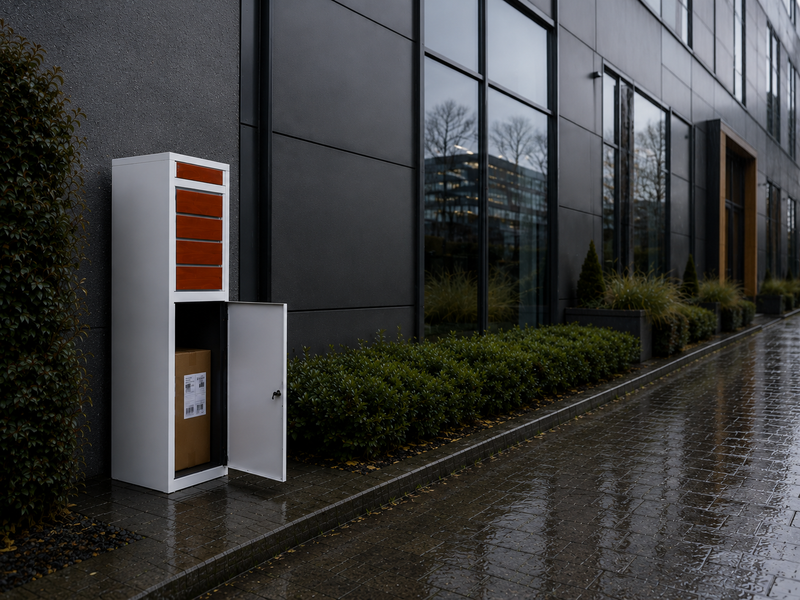
We make four series, and three of them are freestanding models that you place on their own. All series are made of 0.7 mm galvanised sheet steel with Qualicoat Class 2 powder coating with zinc phosphate pretreatment, and have a door with a key lock and two keys, plus a flap on top where the delivery driver puts the parcel in. Colours are RAL 9005 black, RAL 9010 white, RAL 7036 platinum grey and RAL 7016 anthracite, plus combinations with dark teak or light oak.
| Model | Type | External dimensions (w x d x h) | Parcels up to | Post and parcels | Assembly |
|---|---|---|---|---|---|
| BunnyBox Style | Standing post with wood-effect front | 380 x 365 x 1000 mm | 350 x 320 x 200 mm | Separate slot, 1 compartment | Self-assembly kit, 17.0 kg packed |
| BunnyBox Home | Freestanding | 410 x 380 x 1020 mm | 370 x 320 x 210 mm | 1 compartment | Self-assembly kit, 16.0 kg packed |
| BunnyBox Plus | Tall standing post | 500 x 370 x 1120 mm | 450 x 320 x 210 mm | Separate compartments for post and parcels | Self-assembly kit, 20.0 kg packed |
| BunnyBox Compact | Wall-mounted model | 365 x 250 x 450 mm | 300 x 200 x 200 mm | Separate slot, 1 compartment | Supplied pre-assembled, 6.5 kg packed |
Those external heights of 1000, 1020 and 1120 mm are exactly why a standing post works so well with the Postregeling 2009: they put the drop opening within the 0.6 to 1.8 metre range from article 6 paragraph 2, around the 1.1 metre target. You do not need to raise or lower anything.

The range works like this. If you want a post that blends into a garden with timber, decking or a wooden fence, the BunnyBox Style with its wood-effect front and separate letter slot is the logical choice: 380 x 365 x 1000 mm outside, parcels up to 350 x 320 x 200 mm. If you are looking for the largest parcel compartment in an ordinary garden width, the BunnyBox Home is the middle model with parcels up to 370 x 320 x 210 mm. If you often order large boxes or want to keep your post separate from your parcels, the BunnyBox Plus is the answer: parcels up to 450 x 320 x 210 mm and separate compartments for post and parcels. It is the only series where your letters do not end up between the boxes.
The capacity figures make it concrete. The Home and the Style take 14 book packages, the Plus 18. Four shoeboxes fit in every freestanding model. Phone boxes: 40 in the Home and the Style, 42 in the Plus, and 9 in the Compact. Those numbers were measured with tilting, just as a delivery driver does it. The parcel compartment of a freestanding model is almost half a metre tall, so a week of orders fits inside. That is exactly why you do not need to empty a freestanding post every day: you empty the box whenever it suits you.
If the facade is the better spot after all, for example because the front door is already within ten metres of the road and you do not want to dig, the BunnyBox Compact is the model for that. It is the only series delivered to you pre-assembled: unpack, hang, done. No self-assembly kit, no hunting for tiny screws. Still undecided between the four series? Which BunnyBox suits me sets them side by side on every dimension. And if you want to know what carriers do with a parcel letterbox before you choose, read whether PostNL may put a parcel in your parcel letterbox. Always someone home with a BunnyBox, even if your post stands thirty metres from your front door by the garden path.

View the models
How far from the road may my letterbox be?
Your box must be reachable within ten metres of the boundary of a road, according to article 5 paragraph 4 of the Postregeling 2009 (the Dutch postal regulation). Article 5 paragraph 1 also asks that the box be fitted as close as possible to the carriageway. PostNL speaks in its own flyer of a maximum of ten metres walking distance. So measure along the path the delivery driver walks, and you are fine under both readings.
At what height should the letter slot be?
At 1.1 metres, and in any case no lower than 0.6 metres and no higher than 1.8 metres. That is in article 6 paragraph 2 of the Postregeling 2009. PostNL and ACM ConsuWijzer give the same figures in centimetres: 110 cm, with 60 cm as the lower limit and 180 cm as the upper limit. Measure from the level where the delivery driver stands.
Do I need a permit for a letterbox post in my front garden?
Article 2.29 under r of the Besluit bouwwerken leefomgeving (the Dutch Building Decree) makes another structure in the front or back garden area permit-free up to 1 metre high and 2 m2 in surface area. Not a single primary source and no municipal regulation we searched mentions a letterbox by name, and we found no ruling in which a letterbox post was assessed against that provision. If in doubt, call your local council and ask about the environmental plan for your plot.
How deep should I set a letterbox post in the ground?
The only manufacturer's instruction that deals specifically with a letterbox is Knauf's: a hole of 25 by 25 cm and at least 25 cm deep, in firm ground, adjusted to the weight and dimensions of the element. Advisory sources on frost-free foundations use 60 to 80 cm. That is a practical guideline and not a legal requirement; there is no legally prescribed frost-free depth in the Netherlands.
How much rapid-set concrete do I need for a letterbox?
That depends on your hole. Knauf works with 3 to 3.5 litres of water per 25 kg bag. Sakrete states about 3.2 litres of water per 25 kg and 13 litres of wet mix per bag. Weber Beamix gives about 14 litres per 25 kg bag and a consumption of 16 to 68 kg for holes from 20 by 30 cm to 30 by 45 cm. For a hole of 25 by 25 by 25 cm you have about 16 litres of volume to fill.
How long does rapid-set concrete need to cure before the post is firm?
The manufacturers give different times. Sakrete states 15 minutes, Weber Beamix NoMix beton 125 also states 15 minutes, Knauf Turbo-Beton 20 minutes and Turbo-Beton Plus 5 minutes. All four are manufacturer figures. So there is no single curing time for rapid-set concrete; check the bag you buy.
Do I need to file a KLIC notification if I dig a hole myself?
The Wibon links the notification duty to mechanical digging, so with a spade you fall, to the letter, outside the definition of excavation work. But the subdistrict court of the Rechtbank Midden-Nederland ruled on 6 March 2019, case number ECLI:NL:RBMNE:2019:957, that a notification should also be filed for manual digging if cable damage could occur, on the basis of article 6:162 paragraph 2 BW (Dutch Civil Code). That case concerned a professional excavator. Requesting the data takes you five minutes.
May my letterbox stand right on the property boundary?
Book 5 of the Dutch Civil Code has no general minimum distance for an object near the property boundary. Article 5:36 BW does apply, which presumes the middle of a wall, fence, hedge or ditch to be the boundary, as does article 5:37 BW on nuisance. So keep a margin on your own side and make sure your foundation does not extend under your neighbours' ground, because article 5:20 BW counts the layers of earth beneath the land as part of the property.
Does my name have to be on the letterbox?
No. Article 5 paragraph 3 of the Postregeling 2009 only requires a number that makes clear which home or building the box belongs to. We found no obligation to display a name, not in the regulation, not in the PostNL flyer and not at ACM ConsuWijzer. A municipal bylaw on naming and numbering does require the house number, legible from the public space.
Will a freestanding parcel letterbox blow over in a storm?
Do the maths: on a front surface of 1.0 by 0.4 metres, so 0.40 m2, the lowest peak velocity pressure from Table NB.4 of the National Annex to NEN-EN 1991-1-4 gives about 0.192 kN, which comes to roughly 19.6 kilograms of force. A standing post itself weighs around 18 kilograms. That is a worked example and not a structural calculation, but it explains why a post standing only on its foot plate can tip over and a post in concrete cannot.
Note. This page is based on primary sources: the Postregeling 2009 (BWBR0025578, in force since 1 April 2009, articles 5 and 6), the withdrawn Besluit brievenbussen (BWBR0004448, withdrawn on 1 April 2009), the Besluit bouwwerken leefomgeving (BWBR0041297, article 2.29, version of 1 January 2024), the Wibon (BWBR0040728, version applicable from 1 January 2026, article 8), Burgerlijk Wetboek Book 5 (BWBR0005288, title 4 neighbour law), the letterbox flyer from PostNL (no document date stated), ACM ConsuWijzer "Eisen aan mijn brievenbus" (last updated 29 July 2025), the Informatiepunt Leefomgeving on permit-free building (updated 2 April 2025) and on garden and plot boundaries (updated 6 July 2026), politie.nl on reporting vandalism, the municipal Verordening naamgeving en nummering (adressen) 2026 of Vught (in force since 22 May 2026), ruling ECLI:NL:RBMNE:2019:957 of 6 March 2019, the manufacturer documentation from Knauf, Sakrete and Saint-Gobain Weber Beamix, the load table from Krinner Schraubfundamente GmbH, De Meteoor Beton B.V. and the weight table from De Keij, KNMI publication WR-60-05 by P.J. Rijkoort from 1960, Erno Bouma in Groen en Golf of February 2009, "Rekenen aan wind" in VEBIDAK issue 208 of March 2020, funderingskeuze.nl (updated August 2026), Betondingen (10 December 2024), the GAMMA product page for item B610560 and Achmea Rechtsbijstand on obstacles on the verge. Dutch legislation can be found at wetten.overheid.nl and the permit rules at iplo.nl. We update this page at least twice a year and immediately after any change to the Postregeling 2009 or the Besluit bouwwerken leefomgeving. Last checked on 26 August 2026.
You will find more research like this in our Knowledge base, where the articles on assembly, anchoring and carriers are also gathered together.