In short
- There is no official figure for parcel theft in the Netherlands: not from CBS (Statistics Netherlands), not from the police, not from the ACM.
- Amsterdam recorded 94 police reports from January to April 2026, compared with 82 in 2024. That measures willingness to report, not theft.
- In the United Kingdom, only 1 in 353 parcel thefts is reported to the police.
- American estimates range from 37 to 228 million parcels a year, a factor of six.
- Among 309 self-identified parcel thieves, a lockable box scores 4.38 on a 5-point scale as a deterrent.
- If your parcel was left at the door and disappeared, you complain to the seller, not the carrier. Under Dutch law: Article 7:11(1) of the Civil Code (BW).
Nobody knows how many parcels are stolen in the Netherlands, because no organisation counts them: not CBS, not the police as a national category, and not the ACM. What you can control is the physical situation on your own doorstep, and there all the available research points the same way: visibility and accessibility determine whether a parcel disappears.
Below you will first find what is not known and why that matters, then exactly which figures do exist and what each one measures. You get the three American estimates side by side with sample and method, the British reporting figures that explain why Amsterdam's police report numbers say little, the offender research published in Crime Science on 22 July 2026, how anti-fishing mechanisms work, and the legal position with article number, case number and date. We make parcel letterboxes ourselves in our own factory, so we know what a flap and a lock can and cannot do. That is also exactly why we write down here where the data stops, rather than laying an American percentage over it.
- 615 millionparcels in the Netherlands in 2025, according to the ACM Post and Parcel Monitor of 18 June 2026
- 94police reports of parcel theft in Amsterdam, January to April 2026, compared with 82 in the same period of 2024
- 1 in 353parcel thefts in the United Kingdom is reported to the police
- 98%of the stolen parcels in the American study by Stickle and colleagues was visible from the street

How many parcels are stolen in the Netherlands?
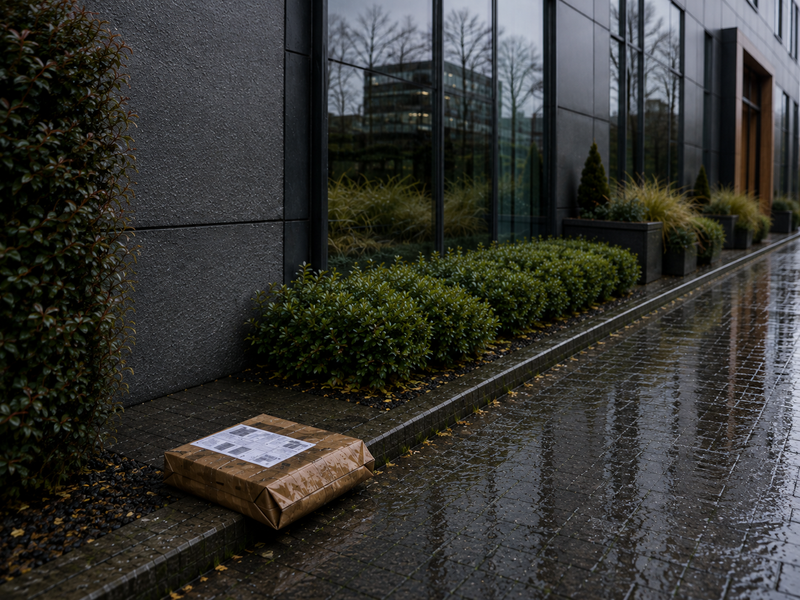
Nobody knows. There is no organisation in the Netherlands that records parcel theft as a separate category. Not CBS, not the police as a national category, not the ACM. That is not sloppiness in our research: it is the state of affairs on 25 August 2026.
The CBS Veiligheidsmonitor (Safety Monitor), published on 2 March 2026 covering 2025, does have categories for bicycle theft, car theft, theft from a car, theft of parts from a car, theft of other vehicles, pickpocketing and robbery, plus a residual category of other theft. In 2025, 2.4 percent of the population fell into that residual category. Property crime as a whole came to 10.7 percent. A parcel theft logically ends up somewhere in that 2.4 percent of other theft, together with everything else that does not fit a box. No parcel figure can be distilled from that number, and anyone who does so anyway is making it up.
The ACM measures the parcel market extensively, but does not record theft. The Post- en pakketmonitor 2025 (Post and Parcel Monitor), published on 18 June 2026, counts 615 million parcels in the Netherlands for 2025, compared with 609 million in 2024. Domestic volume grew by 0.9 percent; internationally it was 447 million parcels, with growth of 7.4 percent. Of all parcels, 82.2 percent were delivered to the home, 12.4 percent went to a service point and 5.3 percent fell under other. The number of parcel lockers rose to 9,309, growth of 90.6 percent, after 4,800 in 2024 and 2,800 in 2023. Letterbox parcels accounted for 73 million items, 11.9 percent of the total, compared with 71 million in 2024. Post arrived on time in 86 percent of cases, against a standard of 95 percent.
Those are hard figures on volume. There is not a single theft figure among them. Every Dutch number you come across on parcel theft therefore comes from one of three sources: a survey of a self-selected panel, local police figures, or a commercial party with an interest. All three have limitations you need to know before you pass the number on.
Which Dutch figures do exist, and exactly what they measure
There are three kinds of Dutch figures in circulation. All three measure something other than parcel theft, and that is exactly where it goes wrong when someone quotes them in isolation.
The EenVandaag Opiniepanel (a Dutch current affairs opinion panel) published a poll of more than 24,000 panel members on 6 August 2026. From it: 1 in 3 participants did not receive a parcel in the past year, with misdelivered, lost and stolen all lumped together. In addition, 4 in 10 experienced a parcel being left without the doorbell being rung, 63 percent received an unjustified "not at home" notification and 96 percent of participants shop online. TTM gives 32 percent as the headline figure. This is a self-selecting panel and the fieldwork period is not stated. People who have just lost a parcel are more likely to fill in a poll like this than people for whom everything went fine. The number is useful as a signal that delivery problems are widespread, not as an estimate of the number of thefts.
The Consumentenbond (Dutch Consumers' Association) surveyed more than 12,000 panel members on 28 October 2025: 35 percent had a problem with a delivery within six months, compared with 30 percent in 2023 and 27 percent in 2021. With UPS it was almost half. Use of parcel lockers rose from 4 to 17 percent. Important: this research does not break down how many of those problems were theft. A parcel that arrives two days late counts in the same 35 percent as a parcel stolen from the doorstep. Anyone presenting that 35 percent as a theft figure is misreading the research.
The third source is police figures, and we only found those for Amsterdam. That is the subject of the next section, because that figure is often the most misused.
| Source | Date | Sample | What it measures | What it does not measure |
|---|---|---|---|---|
| CBS Veiligheidsmonitor | 2 March 2026 | national population survey | other theft 2.4%, property crime 10.7% | no parcel theft category |
| ACM Post and Parcel Monitor | 18 June 2026 | market-wide registration | 615 million parcels, 82.2% delivered to the home | does not record theft |
| EenVandaag Opiniepanel | 6 August 2026 | more than 24,000 panel members, self-selecting | 1 in 3 did not receive a parcel | does not separate theft, loss and misdelivery |
| Consumentenbond | 28 October 2025 | more than 12,000 panel members | 35% had a delivery problem within six months | no breakdown by theft |
| Amsterdam police via AT5 | 11 July 2026 | police reports in one city | 94 reports in four months of 2026 | willingness to report, not national scale |
Why 94 police reports in Amsterdam say nothing about the scale
On 11 July 2026, AT5 (Amsterdam's local broadcaster) published figures from the Amsterdam police. Reports of parcel theft in the months January to April: 82 in 2024, 87 in 2025 and 94 in 2026. Amsterdam-Oost separately went from 25 to 36 reports, a rise of 44 percent in two years. An AT5 city panel indicated that 16 percent of participants had seen one or more parcels disappear.
Put those 94 next to the 615 million parcels that went around the Netherlands in 2025 and you immediately see that something is wrong with the idea that police report numbers measure the scale. They measure something else: how many people take the trouble to report a €40 parcel when they know the police can do little with it.
How big that gap can be is shown by the United Kingdom. On 11 November 2025, Quadient and iParcelBox published an analysis based on Freedom of Information requests to 27 of the 45 British police forces, supplemented by extrapolation. The outcome: £666.5 million worth of stolen parcels, 4.83 million affected households, a rise of 31 percent year on year, and an average value per stolen parcel of £138 compared with £102 a year earlier. December is the peak month there, and November peaks because of Black Friday. And then the figure that matters here: only 1 in 353 thefts is reported to the police.
That British number cannot simply be transferred to the Netherlands: a different reporting culture, a different police organisation, a different method. But the direction is unmistakable. If anything even remotely similar is going on in the Netherlands, then behind every Amsterdam police report there is a large and unknown number of cases nobody ever heard about. That is precisely why you cannot build a national figure from those 94, in any direction.
What the Amsterdam figures do provide is the description the police give with them, and it is concrete. "Thieves just walk into the hallway and take everything." And: "Parcels are quite often left in the publicly accessible hallway. Shortly afterwards, all the parcels have disappeared." And: "The parcels are often put down in the central hallway by delivery drivers, or even outside by the front door." That is not statistics, but it is the sharpest Dutch picture we have of how it happens.
Parcels are quite often left in the publicly accessible hallway. Shortly afterwards, all the parcels have disappeared.
Amsterdam police, via AT5, 11 July 2026
The three American estimates differ by a factor of six
Almost every Dutch page about parcel theft opens with an American figure in the millions. That is problematic for two reasons. First, it is about a different country with different housing types, different distances to the kerb and a different delivery culture. Second, and worse: there is no American figure. There are three, and they differ by a factor of six.
| Source and date | Parcels per year | Total loss | Average per parcel | Sample and method |
|---|---|---|---|---|
| Security.org, 6 November 2025 | 37 million | $8.2 billion | $222 | n=3,307, October 2025, weighted to US Census |
| SafeWise, 6 November 2025 | 104.3 million in 12 months | $14.9 billion | $143 | n=7,500, margin of error 1.4% |
| Omnisend, April 2026 | approx. 228 million | $12.8 billion | $56 | n=1,000, weighted model of 75% survey and 25% FBI data |
Look at the right-hand column and you see why the outcomes are so far apart. Security.org arrives at the lowest number of parcels but the highest value per parcel, $222. Omnisend arrives at six times as many parcels with an average value of $56, so a quarter of that. In practice they are not measuring the same thing. If you set a low threshold for what counts as theft, including the cheap little package that may simply have gone missing, you end up high on numbers and low on value. Count more strictly and you end up exactly the other way round.
SafeWise gives the most detail: 31 percent of Americans are said to have been victims, which comes to around 250,000 parcels a day, 75 percent of victims lost several parcels and only 4 percent got the parcel back. SafeWise also reports a fall of 13 percent compared with 120 million in 2023. That last point is striking, because the other two sources do not point to a decline.
The conclusion is simple: you cannot quote any of the three in isolation as "the" American figure. All three are survey extrapolations, not registrations. What you can take from them is an order of magnitude and a direction, and above all the knowledge that estimating parcel theft is fundamentally difficult, even in a country where far more research is done on it than here.
What the other European figures show
On 19 November 2025, Citizens Advice published a survey of 8,000 Britons, with fieldwork from 29 August to 27 September 2025: 37 percent had a problem with their most recent parcel delivery, for 29 percent the delivery driver left before they got to the door, for 24 percent the parcel was left in an unsafe place and for 24 percent it arrived late. Here too, it is about delivery problems in general, not theft alone.
In Germany, the Bundesnetzagentur (Federal Network Agency) recorded a total of 55,395 postal complaints in 2025, a rise of 25 percent on 2024, 90 percent of them about DHL and Deutsche Post. Those are complaints, not thefts. We have not found a reliable German theft figure. What the various carriers agree on about where your parcel ends up is covered in our article on what each carrier does with a parcel letterbox.
Where exactly does a parcel disappear?
We have to be honest here: not a single Dutch source breaks down how many parcels disappear from the doorstep and how many get lost in the carrier's network. That figure does not exist, and we are not going to fill it in. Anyone who tells you that "such and such percent" of missing parcels is stolen from the front door got that number from somewhere it was not measured.
What we can do is list the routes that come up in the sources. There are six, and each has a different solution.
For the consumer who has lost one parcel, the distinction between route 1 and route 2 is not even that relevant, because the legal route is the same in both cases: you go to the seller. For the question of what to change at your own front door, the distinction is everything. Nothing at your home helps against route 1. Against routes 2, 3 and 5 something does help, and that can be measured in the physical situation.
What offender research says about visibility and accessibility
The best research into the physical situation comes from the United States. Stickle, Hicks, Stickle and Hutchinson published "Porch pirates: examining unattended package theft through crime script analysis" in Criminal Justice Studies in 2019 and 2020, volume 33, issue 2, pages 79 to 95. They analysed recorded thefts and looked at where the parcel was.
The findings are sharp. Of the stolen parcels, 98 percent were visible from the street. 61 percent were within about 7.6 metres of the kerb. There was not a single recorded theft of a parcel more than about 15.5 metres from the kerb. In 46 percent, the box carried clear branding. Medium-sized parcels were stolen most often; large parcels made up only 12 percent of the haul.
This is American research, and Dutch housing looks different: our front doors are on average much closer to the pavement than an American porch. So you cannot transfer the 61 percent within 7.6 metres. What you can transfer is the mechanism: visibility and accessibility are the two variables that determine whether a parcel becomes a target. A parcel you cannot see lying there and cannot pick up in two seconds falls outside the pattern.
What 309 offenders themselves say stops them
On 22 July 2026, Crime Science published the study by Stickle and Jackson, "Porch Pirates' perceptions of opportunity", DOI 10.1186/s40163-026-00289-7. It is a survey of 309 self-identified parcel thieves in the United States, recruited via Prolific. They were asked how strongly various situations would deter them, on a scale of 1 to 5.
DETERRENCE ACCORDING TO 309 OFFENDERS, SCALE 1 TO 5
Stickle and Jackson, Crime Science, 22 July 2026, n=309 self-identified offenders in the US. This is a perception survey, not a measurement of effect.
A lockable box scores 4.38 there, exactly equal to visible neighbours and just below a doorbell camera at 4.54. Only a resident who is actually at home scores higher, at 4.61. That is remarkable, because a box works twenty-four hours a day and a resident does not.
Now the honesty that belongs alongside it. This is a perception survey among offenders, not a measurement of effect. It was not measured whether less is actually stolen in streets with lockable boxes. Offenders were asked what they think would stop them, and people are poor predictors of their own behaviour. The sample was also recruited via Prolific among people who identify themselves as parcel thieves, which is an unusual group. And the study itself shows that the effect is not uniform: frequent offenders were significantly less deterred than occasional offenders, 3.93 versus 4.31, with p=0.013. Characteristics of the parcel itself, such as size, branding and weight, were only weakly linked to offender frequency.
The Dutch counterpart: the Politiekeurmerk is critical
Now set the Dutch view alongside that. On 9 July 2025, the Politiekeurmerk Veilig Wonen (the Dutch police-backed Secure Housing quality mark), together with Thom Snaphaan of Avans University of Applied Sciences, published a critical line on doorbell cameras: there is "insufficient evidence that doorbell cameras actually prevent burglaries". Deterrence is possible but not scientifically proven. According to them, good locks and fittings are more effective, because burglars give up if they spend more than three minutes without result.
Note what is happening here. The American offender research puts the doorbell camera at 4.54 as a deterrent; the Politiekeurmerk says there is insufficient evidence that such a camera works. The two do not literally contradict each other, because the Politiekeurmerk is about domestic burglary and not parcel theft, and it measures effect whereas the American research measures perception. But the tension is there, and you should know about it before you buy a camera against parcel theft.
Where both sources do point in the same direction: physical barriers perform well. The Politiekeurmerk says so explicitly about locks and fittings, and the three minutes a burglar is willing to spend at most is exactly the kind of logic that also applies to a parcel box. Breaking open a locked steel box on a pavement where everyone walks past is not two seconds' work. Picking up a parcel is.

Fishing post out of the letterbox: how it works and what helps
Letterbox fishing is a separate method, and in the Netherlands the best documented. It comes down to someone fishing post or small packages out of a letterbox through the letter opening, using a hook, a wire, a stick or a sticky rod. Often the target is not even the parcel. The target is post containing financial or personal details.
The case at the Oostelijke Handelskade in Amsterdam, described by Quotenet on 29 May 2017, shows the pattern. Criminals collect company details, order credit cards in the victim's name and then fish them out of the letterbox before the resident gets home. In one residential tower there were two reports in two months, including one successful attempt causing thousands of euros in damage. The advice from the residents' committee and the Amsterdam police at the time: collect your post regularly, install an anti-fishing plate or a sturdy brush, and report it to the police.
Eight years later, the same pattern played out in Almere. On 5 March 2025, NOS (the Dutch public broadcaster) reported on the Literatuurwijk district, where the police spoke of large-scale identity fraud. The suspect stole post, posed as the victims towards banks and government, withdrew money and took out subscriptions. Possibly hundreds of residents were affected. Omroep Flevoland (the regional broadcaster) reported on the outcome: four years in prison for the man who fished post out of the letterboxes of vulnerable elderly people.
Four years in prison is a heavy sentence for something that starts with a piece of wire. That puts it in perspective: the loot is not the value of the post, but what you can do with someone's identity.
The problem is not new. As early as 31 October 2007, NH Nieuws reported that Amsterdam police officer Rien Heppener had developed an anti-fishing letterbox with a special flap, nominated for the Hein Roethof Prize.
The four working principles, explained as engineering
Before we describe them, here is the most important caveat of this whole section. There is no independent standard and no quality mark for anti-fishing mechanisms. We have not found a technical description or test in any independent source that classifies a non-return flap, a double flap, brushes or a tilting mechanism. Nor have we found any PKVW (Dutch police-backed security mark) requirements for parcel letterboxes. Manufacturers claim all sorts of things in this area, from anti-fishing flaps to three-point locking with butterfly locks and numbered push locks, but nobody tests those claims against a shared benchmark. So what follows is engineering and logic, not a tested standard. Whoever tells you otherwise is referring to a standard that does not exist.
| Mechanism | Working principle | What it counters | Status |
|---|---|---|---|
| Non-return flap | A flap that only hinges inwards and immediately falls back to the closed position by gravity or spring force | A hook or wire finds no open gap to get past and no edge to catch on | Engineering and logic, not a tested standard |
| Double flap | Two flaps one behind the other with a gap in between, where the second can only move once the first is closed. Airlock principle | There is never a continuous straight line from the outside to the contents | Engineering and logic, not a tested standard |
| Brushes | Rows of dense nylon bristles in the opening that post slides through and that then close again | Blocks the view inside and slows down a wire or stick. The advice from the 2017 Amsterdam case mentions this explicitly | Engineering and logic, not a tested standard |
| Tilting mechanism | A tilting tray or drum that is open in the insertion position and drops the contents into the locked space when tilted | After tilting, the contents lie in a space that can no longer be reached from the opening | Engineering and logic, not a tested standard |
The common thread through all four is the same: make sure there is never a straight, open line from the outside to the contents, and make sure the contents drop under gravity to a place the opening can no longer reach. It is the same logic as the U-bend under your sink, only against people.
What you can do yourself, apart from engineering: collect your post every day, especially if you live in a residential tower or a flat with a shared entrance. The advice from the 2017 Amsterdam case started with that for good reason. And report it to the police, even if it seems pointless, because cases like the one in Almere come to light when separate reports are linked together. The requirements for an ordinary letterbox in the Netherlands are covered in our article on letterbox requirements in the Netherlands.
Who is liable if your parcel is stolen?
Short answer, under Dutch law: in a consumer purchase, the seller, until the moment you or a third party you nominated has actually received the parcel. Not the carrier, and not you.
The basis is Article 7:11(1) of the Burgerlijk Wetboek (BW, Dutch Civil Code), which reads literally: "In a consumer sale where the item is delivered to the buyer, the item is at the buyer's risk from the moment the buyer or a third party designated by the buyer, who is not the carrier, has received the item."
Read the phrase "who is not the carrier" once more. Those few words do most of the work. The carrier cannot shift the risk to you by putting the parcel down somewhere, because the carrier is by definition not a designated third party.
Note. Many articles cite Article 7:19a BW when discussing the transfer of risk. That is wrong. Article 7:19a BW is about default in the event of late delivery: about giving notice of default with a reasonable deadline and about refunds on termination. It does not regulate when risk passes. Article 7:11(1) BW does that.
The ACM (Netherlands Authority for Consumers and Markets) is crystal clear about the practical route. Its ConsuWijzer page "Aankoop niet geleverd" (Purchase not delivered), amended on 22 July 2026, states literally: "You do not need to complain to the delivery service yourself. Contact the seller." And: "Because the seller is responsible for shipping." And, the sentence that reverses the burden of proof: "Does the seller say the product was delivered to you? Then the seller has to prove it."
That last point is more important than it seems. You do not have to prove that you did not receive the parcel. That would be impossible anyway. The seller has to prove that you did receive it. A tracking status of "delivered" is not automatically enough for that, and neither is a photo of a parcel on a doormat, because that photo shows the parcel was there, not that you received it.
What the Geschillencommissie has decided
The Geschillencommissie Thuiswinkel (the Dutch disputes committee for online shopping) has four rulings that together set the line. Here they are with case number and date.
| Case and date | What happened | Amount | Outcome | The rule that follows |
|---|---|---|---|---|
| 227340/233108, 6 December 2023 | Parcel left at the door and disappeared | €425.72 | Upheld, full refund plus €52.50 complaint fee | "Merely leaving a parcel on site does not count as handing it to the consumer in person." |
| 13 November 2023 | Two smartphones delivered to a parcel point | €3,714 | In favour of the consumer | A parcel point does not count as a designated third party, because it is part of the carrier itself |
| 15296/22874, 9 November 2020 | Laptop accepted by a colleague at the business address given | not stated | Rejected, risk with the consumer | A colleague at the address you gave does qualify as a designated third party |
| 21163/37590, 9 November 2020 | Consumer gave permission via the video doorbell to leave the delivery, Philips Hue | €249.95 | Rejected | Consent via a video doorbell counts as acceptance |
Put those four side by side and the dividing line becomes visible. If you nominated someone yourself or gave permission yourself, the risk has passed. If the carrier made a choice on its own initiative, the risk has not passed, not even if the carrier leaves the parcel at one of its own parcel points. So the video doorbell case of 9 November 2020 is not a technology trap: the point is not the doorbell, the point is that the consumer gave active consent.
And if the delivery driver leaves it with the neighbours?
Here we need to mark a boundary. We have not found a ruling specifically about the neighbour. What follows is therefore reasoning based on the four rulings above, not a quoted position and not case law.
The reasoning goes like this. Article 7:11(1) BW turns on whether there is "a third party designated by the buyer". If you set a delivery preference yourself in the carrier's app or at checkout that names that specific neighbour, then you designated that third party and a transfer of risk is the obvious conclusion, along the same line as the colleague at the business address in case 15296/22874. If the delivery driver handed it to a random neighbour on their own initiative without you having designated that person, then exactly that element of designation is missing, and the analogy with case 227340/233108, the parcel that was merely left on site, is stronger.
Again: that is our reasoning, not a ruling. What you do with it in practice is this: set delivery preferences for a place you can designate yourself and that is on your own property. A locked box at your own front door is such a place, and it also does not put a neighbour in the position of having to keep your parcel in their home. How to set delivery preferences and what the options are is covered in receiving a parcel when you are not home.
Does your home contents insurance cover a stolen parcel?
That is probably the wrong question, and we explain why here as reasoning, not as a quoted position.
First the facts that do exist. The Verbond van Verzekeraars (Dutch Association of Insurers) has not published any position or figure on parcel theft that we have been able to find. On 24 June 2026, the Consumentenbond wrote about home contents and burglary that for theft from your home there do not need to be signs of forced entry, whereas for theft from sheds, storerooms and cars there are requirements, such as visible signs of forced entry and locked doors. That page does not deal with parcels stolen from the doorstep or a porch. For cover outside the home, the ANWB (Dutch motoring association) mentions amounts such as €7,500 for valuables, €3,500 for sports equipment and €3,500 for theft from vehicles. Parcels are not mentioned there.
Then the reasoning, which is ours. If the risk under Article 7:11(1) BW has not yet passed, then legally that parcel is not yet yours. It is then an item that is still at the seller's expense, so the party to approach is the seller and not your home contents insurer. An insurer compensates damage to your belongings, and these were not yet your belongings.
There is a second, more practical argument, also as reasoning. A claim with your home contents insurer costs you your excess and goes on your claims history, which can affect your premium. The route via the seller costs you nothing. With a parcel of €60 or €200, there is a good chance that you end up worse off on balance with an insurance claim than with an email to the webshop, especially since, according to the ACM, the burden of proof there lies with the seller.
The practical order is therefore: first the seller, then the Geschillencommissie, and only if the parcel demonstrably did reach you and was then stolen from your home or storeroom does it become an insurance question. At that point the normal home contents rules apply, including the requirements for signs of forced entry at a shed or storeroom.
Your parcel is gone: what to do today
Do this on the day itself. The longer you wait, the weaker your case becomes and the smaller the chance that camera footage still exists. The full route with the template letter is in the step-by-step plan for a stolen parcel.
- Check the tracking and save it. Take a screenshot of the status, the time, and the delivery photo if there is one. That photo later becomes the piece of evidence the conversation is about.
- Search physically first. Look round the back, in the bin store, in the porch, behind the planter, and ask the immediate neighbours. A significant share of "missing" parcels are somewhere you do not look straight away.
- Report it in writing to the seller, not the carrier. That is the ACM's line: "You do not need to complain to the delivery service yourself. Contact the seller." Include your order number, the date and the tracking status. Email, not a phone call, so you have a record.
- Ask for proof of delivery to you. According to the ACM, the seller has to prove the product was delivered to you. Ask for that explicitly and do not accept any reference to "the carrier says it was delivered" as an answer.
- Set a reasonable deadline and give notice of default. If the seller does not deliver after all and does not refund you, set a reasonable deadline in writing and state that you will terminate the contract if it is exceeded. This is the process Article 7:19a BW is about.
- Report it to the police. Especially for theft from a porch or shared hallway, and always for fishing from the letterbox, because there is almost always identity fraud behind it. Separate reports get linked together: that is how the Almere case came to light.
- Still no solution? Go to the Geschillencommissie. If the webshop is affiliated, you can submit the dispute there. The ruling of 6 December 2023 in case 227340/233108 shows that a parcel merely left at the door does not count as handed over.
- Change the physical situation. The same thing will happen a second time if the delivery driver faces the same choice again. Make sure there is a locked place the parcel can go into.
Is December really riskier?
In the Netherlands that is an assumption, not a figure. We have not found a single Dutch source that quantifies a theft peak around Black Friday, Sinterklaas or Christmas. What is solid is the volume peak.
Via NL Times on 27 November 2025, PostNL reported that in the peak period it handles more than 3 million parcels a day, compared with 1.2 million on a normal day. 1,000 extra delivery drivers and 1,250 extra lorries are added, and the Nieuwegein sorting centre goes from 40,000 to at least 60,000 parcels a day. The busiest day ever was in November 2024, with more than 2.8 million parcels.
There is a Dutch figure on loss, although it is older. Sendcloud surveyed more than 1,000 Dutch consumers about 2022 and found that the chance of a lost parcel in the fourth quarter was 15 percent higher than in an average quarter, and 35 percent higher in December. Note two things: that is about lost, not stolen, and it is data from 2022.
In the United States, the seasonal peak is visible in the theft figures. In April 2026, Omnisend reported that 27.2 percent of all theft incidents fell in December and 21.1 percent in November, together almost half the year. In the United Kingdom, Quadient and iParcelBox name December as the peak month and November as a peak because of Black Friday.
The reasoning you may draw from this, which we present here explicitly as reasoning: if the supply of parcels on doorsteps more than doubles in December, and opportunity determines whether theft happens, then a theft peak in the same month is the obvious expectation. But that is an expectation based on foreign data and Dutch volume figures, not a Dutch measurement. Anyone serving you a Dutch Christmas peak percentage is making it up.
What a BunnyBox actually does about this
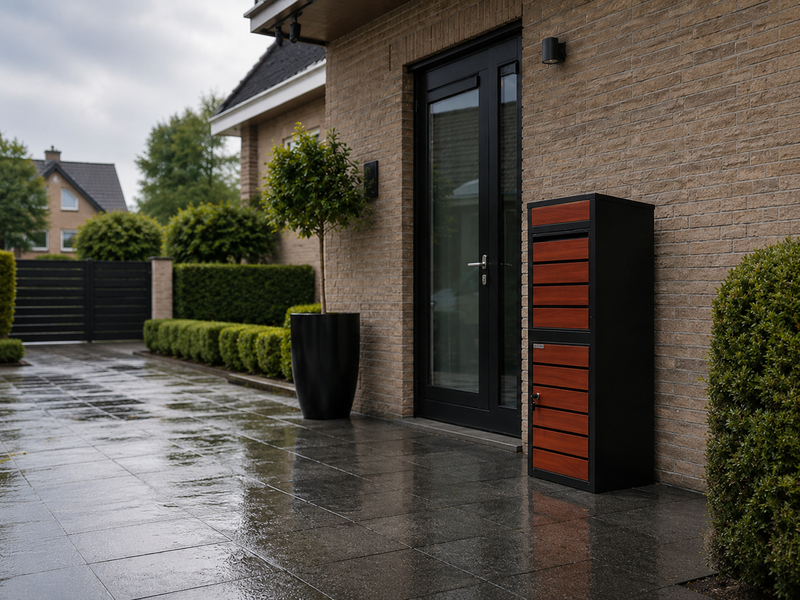
All the research above points to two variables you control yourself: visibility and accessibility. A locked box removes both. This is what a BunnyBox demonstrably does about it, and nothing more than that.
Lockable, with a key lock and two keys. Every series has a door with a key lock, and two keys are supplied. That is exactly the category that scores 4.38 in the Crime Science study of 22 July 2026: a lockable box on the doorstep, equal to visible neighbours and just below a doorbell camera. The contents are not visible and cannot be grabbed in two seconds, and those are the two things that matter according to the research by Stickle and colleagues. Which lock works best outdoors is compared in combination lock, key lock or smart lock.
0.7 mm galvanised sheet steel with Qualicoat Class 2 powder coating with zinc phosphate pretreatment. All series are made of 0.7 mm galvanised sheet steel with Qualicoat Class 2 powder coating with zinc phosphate pretreatment. Galvanised steel is the foundation against rust, and the powder coating goes on top. That is material that stands outside and stays outside.
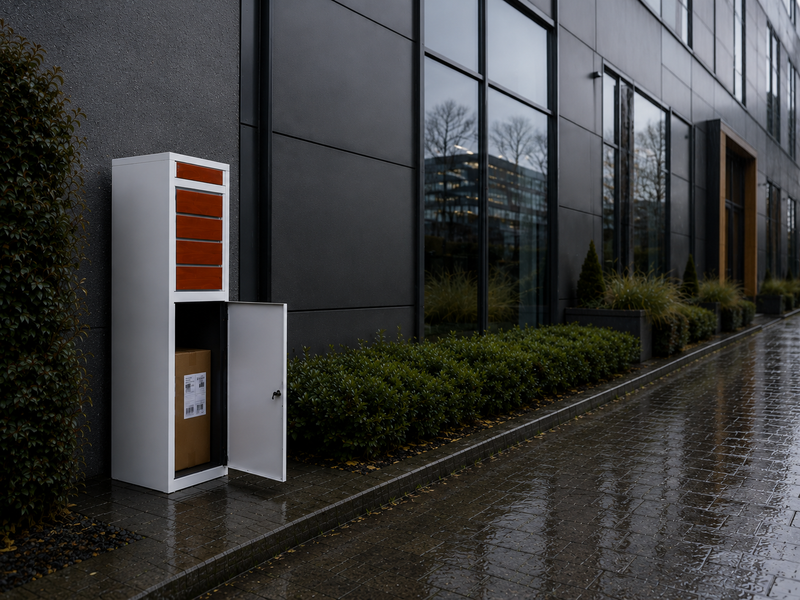
A parcel compartment that cannot be fished empty from the flap. This is the point that links directly to the fishing section above. The delivery driver puts the parcel through the drop flap on top. The parcel then falls into the locked space below that flap. So from the flap there is no straight line to the contents and no way to get the parcel out again: it lies in a space that can only be reached behind the door with the key lock. That is the same logic as the tilting mechanism in the table above, and here too: this is engineering, and there is no independent standard that tests such mechanisms.
The parcel compartment of a freestanding model is almost half a metre tall. A week's worth of orders fits in it. That is not just convenience: it means you do not have to be home every day to empty your box, and that a full box is no reason for a delivery driver to leave the parcel on the doorstep after all. In numbers: a Home or Style holds 14 book packages in the maximum arrangement with tilting as a delivery driver would do it, a Plus 18. Four shoeboxes fit in every freestanding model. Phone boxes: 9 in the Compact, 40 in the Home and the Style, 42 in the Plus.
What you need to know in general: ideally, fix a freestanding box on paving slabs or in concrete. That is general advice for any freestanding outdoor unit and belongs to this topic, whichever brand you choose. The anchoring details and what a policy covers are in anchoring a parcel letterbox.


Which BunnyBox suits your situation
The choice depends on what you order and where the box will stand. Here are the dimensions, in millimetres, width by depth by height.
| Model | Type | Parcels up to | Outer dimensions | Post and parcels | Assembly |
|---|---|---|---|---|---|
| Compact | wall-mounted model | 300 x 200 x 200 mm | 365 x 250 x 450 mm | separate slot, 1 compartment | supplied pre-assembled |
| Style | freestanding column with wood-effect front | 350 x 320 x 200 mm | 380 x 365 x 1000 mm | separate slot, 1 compartment | self-assembly kit |
| Home | freestanding | 370 x 320 x 210 mm | 410 x 380 x 1020 mm | 1 compartment | self-assembly kit |
| Plus | tall freestanding column | 450 x 320 x 210 mm | 500 x 370 x 1120 mm | separate compartments | self-assembly kit |
If you live in an apartment or a flat with a shared entrance and the shared hallway is the problem, as in the Amsterdam police quotes, the BunnyBox Compact is the model that fits. It is a wall-mounted model of 365 x 250 x 450 mm that goes on the facade and accepts parcels up to 300 x 200 x 200 mm. The Compact is also the only series supplied pre-assembled, so all you have to do is hang it.
If you regularly order larger boxes, the BunnyBox Plus is the answer: parcels up to 450 x 320 x 210 mm and, unique in the range, truly separate compartments for post and parcels. That last point ties in directly with the fishing section: your post and your parcels are not in the same space.
If you want a freestanding model by the front door with plenty of capacity for a normal mix of orders, the BunnyBox Home is the standard choice, with parcels up to 370 x 320 x 210 mm. If you want the same but with a wood-effect front and a separate letter slot, you end up with the Style. All series are available in RAL 9005 black, RAL 9010 white, RAL 7036 platinum grey and RAL 7016 anthracite, and in combinations with dark teak or light oak. Still unsure about the size? Read what size parcel letterbox you need or go through which BunnyBox suits me. All models are together in the parcel boxes collection. Always someone home with a BunnyBox.

View the models
Frequently asked questions about parcel theft
How many parcels are stolen in the Netherlands?
That is not known. There is no official Dutch registration of parcel theft: not at CBS, not with the police as a national category, and not at the ACM. Every number you come across comes from a panel survey, from local police figures or from a commercial party. The ACM did count 615 million parcels in the Netherlands in 2025, but does not record theft.
My parcel was stolen from the doorstep. Who has to pay?
The seller. Under Article 7:11(1) of the Dutch Civil Code (BW), risk only passes once you or a third party you designated, who is not the carrier, has received the parcel. On 6 December 2023, in case 227340/233108, the Geschillencommissie Thuiswinkel ruled that merely leaving a parcel on site does not count as handing it to the consumer in person. The consumer got €425.72 back plus €52.50 complaint fee.
Should I complain to PostNL or to the webshop?
To the webshop. On its ConsuWijzer page "Aankoop niet geleverd", amended on 22 July 2026, the ACM writes: "You do not need to complain to the delivery service yourself. Contact the seller." The seller is responsible for shipping.
The seller says the parcel was delivered. What now?
Then the seller has to prove it, as the ACM states literally. You do not have to prove that you received nothing. A tracking status or a photo of a box on a doormat shows that the parcel was there, not that you received it.
The parcel was left at a parcel point and lost there. Am I out of luck?
No. In the ruling of 13 November 2023 about two smartphones worth €3,714 together, the Geschillencommissie ruled that a parcel point does not count as a designated third party, because it is part of the carrier itself. So the risk had not passed.
My neighbour accepted the parcel and it is gone. Who is liable?
We have not found a ruling on that. As reasoning: if you designated that neighbour yourself via a delivery preference, a transfer of risk is the obvious conclusion, just like the colleague at the business address given in case 15296/22874 of 9 November 2020. If the delivery driver handed it to a random neighbour on their own initiative, there was no designation by you and it looks more like the parcel that was merely left at the door.
Does my home contents insurance cover a stolen parcel?
Often that is the wrong question. If the risk under Article 7:11(1) BW has not yet passed, the parcel is legally not yet yours and the seller is the party to approach. Claiming with your home contents insurer costs your excess and counts in your claims history, while the route via the seller is free. This is our reasoning, not a position of the Verbond van Verzekeraars (Dutch Association of Insurers), which has published nothing on this that we could find.
What is letterbox fishing?
Fishing post or small packages out of a letterbox through the letter opening, with a hook, wire, stick or sticky rod. The target is usually not the parcel but post with financial or personal details. In Almere in 2025 this led to a case of large-scale identity fraud with possibly hundreds of victims and four years in prison for the offender.
Does a doorbell camera help against parcel theft?
The sources disagree. In the offender research in Crime Science of 22 July 2026, among 309 self-identified parcel thieves, a doorbell camera scores 4.54 out of 5 as a deterrent. On 9 July 2025, by contrast, the Politiekeurmerk Veilig Wonen stated that there is insufficient evidence that doorbell cameras prevent burglaries. The latter is about domestic burglary and is a question of effect; the former is about parcel theft and is a question of perception.
Is more stolen in December?
In the Netherlands that is an assumption. There is no Dutch figure that quantifies a theft peak around Black Friday, Sinterklaas or Christmas. What is solid is that PostNL handles more than 3 million parcels a day at the peak, compared with 1.2 million normally. In the United States, according to Omnisend in April 2026, 27.2 percent of theft incidents did fall in December and 21.1 percent in November.
Read more in the knowledge base
If your parcel does not disappear but your box gets skipped, read why your delivery driver skips your parcel letterbox. If you want to know what has been agreed about PostNL and parcel letterboxes, see whether PostNL may put a parcel in your parcel letterbox. Not sure whether your box fits through an ordinary letterbox? Read which parcels do not fit through a standard letterbox. If you want to build the box into a wall, gate or fence, see building in a parcel letterbox. If you want to know what a good box costs, see what a good parcel letterbox costs. All topics are together in the Knowledge base.
Note. Last checked on 25 August 2026. Main sources: ACM Post- en pakketmonitor 2025, published 18 June 2026. CBS Veiligheidsmonitor 2025, published 2 March 2026. Amsterdam police via AT5, 11 July 2026. EenVandaag Opiniepanel, 6 August 2026, more than 24,000 panel members. Consumentenbond, 28 October 2025, more than 12,000 panel members, and Consumentenbond on home contents and burglary, updated 24 June 2026. Security.org, 6 November 2025, n=3,307. SafeWise, 6 November 2025, n=7,500. Omnisend, April 2026, n=1,000. Quadient and iParcelBox, 11 November 2025. Citizens Advice, 19 November 2025, n=8,000. Stickle, Hicks, Stickle and Hutchinson, Criminal Justice Studies 33(2), 79 to 95, 2019 and 2020. Stickle and Jackson, Crime Science, 22 July 2026, DOI 10.1186/s40163-026-00289-7, n=309. Politiekeurmerk Veilig Wonen with Thom Snaphaan, Avans University of Applied Sciences, 9 July 2025. ACM ConsuWijzer "Aankoop niet geleverd", amended 22 July 2026. Geschillencommissie Thuiswinkel, cases 227340/233108 of 6 December 2023, the ruling of 13 November 2023, 15296/22874 and 21163/37590 of 9 November 2020. Articles 7:11(1) and 7:19a of the Dutch Civil Code via wetten.overheid.nl, and also acm.nl, degeschillencommissie.nl and cbs.nl. Quotenet, 29 May 2017, NOS, 5 March 2025, Omroep Flevoland, NH Nieuws, 31 October 2007, PostNL via NL Times, 27 November 2025, Sendcloud on 2022, Bundesnetzagentur on 2025. We check this page twice a year and immediately after any of the sources mentioned publishes a new measurement.