In short
- The legal slot in the Netherlands is at least 265 x 32 mm (Postregeling 2009, Article 6(3)): a minimum for the opening, not a maximum for your parcel.
- The letterbox parcel of 380 x 265 x 32 mm comes straight from that, with the 380 mm from Article 6(5).
- Around 88 percent of the 615 million parcels are not letterbox parcels (ACM, 24 June 2026).
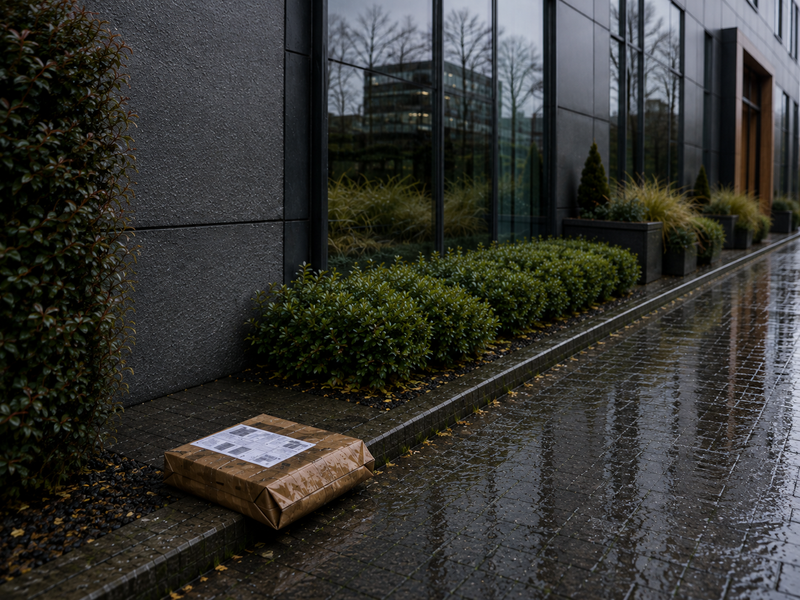
- Anything thicker than 32 mm is out: shoeboxes, electronics, toys, groceries.
- None of the five parcel boxes PostNL itself sells fits through; the smallest height is 56 mm.
- If it does not fit, you have 5 to 7 days to collect it, after which it goes back to the sender.
Only items flatter than 32 mm and smaller than 380 x 265 mm fit through a standard Dutch letterbox, and that is about 12 percent of everything that gets delivered. The other 88 percent or so, from a sneaker box of 330 x 200 x 110 mm to a folding crate of groceries of 600 x 400 mm, does not fit by definition.
Below you will find where that 32 mm comes from, with article and paragraph number, exactly how big a letterbox parcel may be with PostNL, DHL and DPD, which box sizes the packaging industry actually uses per product category, and what happens when a parcel does not go in. You are hearing this from us and not from a webshop, because we make these boxes ourselves in our own factory and so deal with real box sizes and real delivery drivers every day. And because we also add what we have not been able to establish: of the six largest Dutch webshops, not a single one publishes its box sizes.
- 265 x 32 mmlegal minimum for the letter opening, Postregeling 2009 Article 6(3)
- 88%of all parcels delivered are not letterbox parcels, ACM Post and Parcel Monitor 2025
- 28 mmthe height packaging suppliers use for letterbox boxes, deliberately below 32
- 56 mmthe smallest height in the range of parcel boxes PostNL itself sells, almost twice the slot

What size is a standard letterbox in the Netherlands?
The size is not in the Postwet (Dutch Postal Act) itself, but in the Postregeling 2009 (Postal Regulations 2009), which is based on Article 20(1) of the Postwet 2009. Article 6(3) of those regulations requires the clear letter opening to be "at least 265 mm in length and 32 mm in width". Those are the two numbers everything revolves around in the Netherlands: 265 mm wide and 32 mm high. That same slot is also the opening people fish through: anti-fishing protection for your letterbox.
Article 6(5) is about the space behind the slot. There, the usable internal width must be at least 270 mm, and the two other usable internal dimensions at least 150 and 380 mm. A letterbox that complies with the law therefore has a receiving space of at least 270 x 150 x 380 mm. On ConsuWijzer, the ACM phrases this as a receiving space of at least 27 x 15 x 38 cm, which are the same numbers in centimetres.
The rest of Article 6 is about placement and safety. Paragraph 2 says the slot should be 1.1 metres above operating level, in any case no lower than 0.6 metres and no higher than 1.8 metres, and that the opening is horizontal in a vertical surface or in the top surface. Paragraph 1 requires the shape and colour to be such that confusion with public postboxes is not possible. Paragraph 4 requires that you can operate the box without risk of injury, so no flap that traps a delivery driver's hand.
Article 5 governs where the box stands. Paragraph 1: as close as possible to the carriageway of a public road accessible to vehicles. Paragraph 3: the house number clearly shown. Paragraph 4: reachable within ten metres of the boundary of a road. Paragraph 7: a maximum height difference of 2.5 metres with the road surface. If you want to see the full set of requirements side by side, you will find them in our article on letterbox requirements in the Netherlands.
In its own flyer, PostNL translates the same rules into practical language: an opening of at least 26.5 cm wide and 3.2 cm high, placed at 110 cm and no lower than 60 or higher than 180, an internal depth of at least 15 cm with an explicit recommendation of at least 25 cm, a maximum walking distance of 10 metres, no steps with more than 2.5 metres of height difference, and a visible house number. That 25 cm depth recommendation is interesting: PostNL itself asks for more space than the legal minimum, precisely because the legal minimum is tight.
Why 265 x 32 mm is a minimum and not a maximum
This is the mistake almost everyone makes, including many webshops and even some letterbox sellers. They read 265 x 32 mm as a rule saying how big a parcel may be at most. That is not what it says. The law regulates the box, not the parcel. Article 6(3) says how small a slot may be at most before it no longer meets the requirements. A larger opening is allowed: a slot of 300 x 50 mm meets Article 6(3) just as well, because it is larger than the minimum in both directions.
What happened next is logical and has only added to the confusion. The carriers wanted a product that is guaranteed to fit through every legally compliant letterbox in the Netherlands. So they took the legal minimum and turned it into their maximum. The letterbox parcel of 380 x 265 x 32 mm is literally cut out of the regulations: the 265 mm and the 32 mm come from Article 6(3), and the 380 mm comes from Article 6(5), the smallest of the two other internal dimensions mentioned there.
The result is circular reasoning you come across everywhere. The law sets a minimum for the box, the carrier turns that into a maximum for the parcel, and the consumer reads the parcel size back as "the legal maximum size for the letterbox". That is simply not right. There is no legal maximum for how big your opening may be. A parcel letterbox with a 370 x 320 mm flap is perfectly legal, and that is exactly why parcel letterboxes exist. What does matter is whether the carrier is willing to put something in it, and that is a matter of delivery preferences, not legislation. We explain that in whether PostNL may put a parcel in a parcel letterbox.
Note. If a webshop or delivery site writes that "the maximum letterbox size is 265 x 32 mm", it is mixing two things up. The correct phrase is: the legal minimum opening is 265 x 32 mm, and carriers have based their letterbox parcel on it. Your own box may have a much larger opening.
How many parcels do not fit through a letterbox?
Here is the number this article revolves around. On 24 June 2026, the ACM (Netherlands Authority for Consumers and Markets) published the Post- en pakketmonitor (Post and Parcel Monitor) for 2025. It states that 615 million parcels were delivered in the Netherlands, compared with 609 million in 2024. Of those 615 million, 73 million were letterbox parcels, almost 12 percent. In 2024 there were 71 million, or 11.7 percent. In 2021 there were 58 million, or 9 percent.
Do the maths yourself: 615 million minus 73 million is 542 million shipments that are not letterbox parcels. That is 88.1 percent. For an average household, that means: of every eight parcels you order, about one goes in through the slot and seven do not.
Why that 88 percent is a lower limit and not an exact figure
This is the methodological caveat you will not read in most articles on this subject, but it belongs here. The ACM counts letterbox parcels as a product category booked by the carrier, not as physically measured cases of "this package actually went through the box". A shipment booked as a letterbox parcel that does not go in on arrival, because the box is too shallow, because there is already post in it or because the flap sticks, still counts as a letterbox parcel in the statistics.
So the real share of shipments that physically go through a letterbox is lower than that almost 12 percent, and the share that does not fit is higher than 88 percent. The 88 percent is a lower limit, not an upper limit. How much higher cannot be established from public sources: there are no figures on how many booked letterbox parcels still end up with the neighbours or at a service point. We would rather write that down than invent an estimate. Why a delivery driver sometimes does not put a package in your box even when it would fit size-wise is covered in why your delivery driver skips your parcel letterbox.
What is clear is the direction. The share of letterbox parcels is growing by about one percentage point a year: 9 percent in 2021, 11.7 percent in 2024, almost 12 percent in 2025. On the 2024 monitor, ecommerceNews reported that total parcel volume grew by 2.4 percent and that three quarters of that volume growth was attributable to letterbox parcels. So the category is growing faster than the rest, but even at that pace it will take decades before the share that does not fit through the box falls below half. For the next ten years, the rule of thumb stands: most of your orders will not fit through the slot.
How big may a letterbox parcel be per carrier?
All three major carriers that offer a letterbox product arrive at almost the same size, but not exactly the same. And on weight, two of them contradict themselves. That is not a detail, because weight determines whether your shipment may be sent as a letterbox parcel or falls into a more expensive class.
| Product and carrier | Maximum dimensions | Minimum | Maximum weight | Price |
|---|---|---|---|---|
| PostNL letterbox parcel, private, NL | 38 x 26.5 x 3.2 cm | 14 x 9 cm | 2 kg | from €4.55 online |
| PostNL letterbox parcel, business, NL (rate booklet) | 38 x 26 x 3.2 cm | not stated | 2 kg | contract rate |
| PostNL letterbox parcel, EU and outside EU | 38 x 26.5 x 3.2 cm | not stated | 1 kg | not stated |
| DHL eCommerce letterbox parcel, consumer | 38 x 26.5 x 3.2 cm (l x w x h) | not stated | 2 kg | from €3.95; €3.85 to a ServicePoint, €4.35 to a home address |
| DHL eCommerce letterbox parcel, business | 38 x 26.5 x 3.2 cm | not stated | 1 kg | contract rate |
| DHL Envelope | 38 x 26.5 x 3.2 cm | 15 x 11 x 1 cm | 500 g (minimum 50 g) | not stated |
| DPD NL ParcelLetter | 38 x 26 x 3 cm | 15 x 10 x 1 cm | 1 kg | €4.15 including VAT |
The contradiction at DHL
On its consumer page, DHL gives 2 kg as the maximum for the letterbox parcel. On the business page and in the 2026 MyParcel carrier specification, it says 1 kg for the same product with the same dimensions. Both numbers come from DHL itself. We include both and choose neither: if you are sending as a consumer, assume 2 kg, but if you are sending under a business contract or via a shipping platform, allow for 1 kg. If in doubt, stick to 1 kg and you will not run into trouble with either page.
The contradiction at PostNL
At PostNL, the contradiction is not in the letterbox parcel but one class up, in the small parcel. PostNL's shipping page gives 34 x 28 x 15 cm for a small parcel, while the customer service page gives 38 x 28 x 15 cm. Four centimetres' difference on the longest side, and that is exactly the dimension that determines whether your box still falls in the cheapest parcel class. The pages also differ on the large parcel: 178 x 78 x 58 cm on the shipping page versus 176 x 78 x 58 cm at customer service. We do not publish that as a single number, because that would suggest we know which of the two is correct. If in doubt, work with the smaller size.
There is another difference that goes wrong more often. PostNL uses 26 cm wide for the business letterbox parcel and 26.5 cm for the private one. An A4 letterbox box 250 mm wide falls within both limits, but a box 265 mm wide only meets the private standard. For the differences between carriers on every other point, from permission to leave parcels to claim deadlines, see what each carrier does with a parcel letterbox.
Brievenbuspakje, brievenbuspakket, klein pakket
Those three Dutch terms are used interchangeably and do not mean the same thing. Brievenbuspakje (letterbox parcel) is the official product name at PostNL, DHL and DPD. It fits through the legal slot, is a maximum of 3.2 cm thick, has tracking, needs no signature and you do not have to stay home for it. Brievenbuspakket is not an official PostNL name; DHL does use it in a business context, with the same limit. Klein pakket (small parcel) is something completely different: it is a PostNL rate class, not a letterbox product. Maximum 3 kg, height up to 15 cm. A small parcel does not fit through a letterbox by definition, because 15 cm is almost five times the 3.2 cm slot. Small parcel international is yet another class: maximum 2 kg, longest side 60 cm, girth maximum 90 cm.
Why letterbox boxes are 28 mm high and not 32
If you order a letterbox box from a Dutch packaging supplier, it is almost always 28 mm high. Not 32, even though 32 is the legal space. Two independent suppliers give exactly the same range, and that is no coincidence.
| Format | Size in mm (l x w x h) | Variants at other suppliers | Fits through the 265 x 32 mm slot |
|---|---|---|---|
| A6 | 180 x 115 x 28 | no different size found | Yes |
| A5 and A5+ | 255 x 160 x 28 | no different size found | Yes |
| A4 | 310 x 220 x 28 | Superdoos 310 x 215 x 30 | Yes |
| A4+ | 350 x 250 x 28 | G&F 345 x 255 x 28; Superdoos 345 x 255 x 27, FEFCO 0427, E-flute | Yes |
The suppliers themselves say why they stay below the legal limit. Verpakgigant writes literally that "all formats keep to a height of around 28 mm, so that they fit through the letterbox effortlessly". G&F explains it technically: the 28 mm is the usable product space inside, and the remaining millimetres up to 32 are taken up by the corrugated cardboard walls themselves. A box with an outer height of 32 mm only has 28 mm left inside. Make a box with 32 mm of usable internal space and the outside comes to over 35 mm, so it no longer fits through a legal slot.
That detail explains why a package sometimes gets stuck even though it "should" fit by size. The carrier's 3.2 cm is an outer dimension, and there is no clearance between outer dimension and slot. A flap with a brush or a rubber strip, a box that bends slightly, or an envelope already in the box: suddenly 32 mm becomes 30 mm and a box 30 mm high no longer goes in. The packaging industry's 28 mm is exactly that safety margin of four millimetres.
Interestingly, the A4 letterbox box on the market varies between 310 x 215 x 30 and 350 x 250 x 28 mm. For comparison: A4 paper itself is 297 x 210 mm. So the box is by definition larger than the format it is named after, and that difference of 13 to 53 mm in length can make the difference between fitting and not fitting through a slot 265 mm wide. Because note the direction: a box 310 mm long goes in with the short 220 mm side first, not the long side.
32 MM VERSUS THE HEIGHT OF REAL BOXES
Heights from Postregeling 2009 Article 6(3), the PostNL box range, the DPD Parcel Locker specification and standard formats from Dutch packaging suppliers.
Which parcels do and do not fit through the slot?
This is where it gets concrete. The table below puts the common box size per product category next to the 265 x 32 mm slot. An important caveat first: most large Dutch webshops do not publish their packaging specifications. After a targeted search, no public box sizes were found for Coolblue, Zalando, Amazon.nl, Douglas, Bax Music and HelloFresh. The sizes below are therefore standard formats from Dutch packaging suppliers, not confirmed by those webshops. This is shown per row in the source status column.
| Category | Typical box size | Fits through the 265 x 32 mm slot | Source status |
|---|---|---|---|
| A5 book or paperback | 217 x 155 x 10 mm and 230 x 165 x 15 mm | Fits | Standard packaging supplier format |
| A4 book, thin | 302 x 215 x 20 mm | Fits | Standard packaging supplier format |
| A4 book, thick, or several books | 302 x 215 x 75 mm and 330 x 230 x 100 mm | Does not fit | Standard packaging supplier format |
| Clothing, small and flat, letterbox box | 310 x 220 x 28 mm | Fits | Standard packaging supplier format |
| Clothing, small, T-shirt box | 200 x 150 x 80 mm | Does not fit | Standard packaging supplier format |
| Clothing, large, coat | 613 x 502 x 80 mm | Does not fit | Standard packaging supplier format |
| Shoes, sneakers | 33 x 20 x 11 cm | Does not fit | Standard packaging supplier format |
| Women's shoes | 30 x 18 x 10 cm | Does not fit | Standard packaging supplier format |
| Children's shoes | 25 x 17 x 9 cm | Does not fit | Standard packaging supplier format |
| Boots | lying flat 35 x 22 x 12 cm, upright 48 x 30 x 12 cm | Does not fit | Standard packaging supplier format |
| Toiletries, small, A6 letterbox box | 180 x 115 x 28 mm | Fits | Standard packaging supplier format |
| Toiletries, several bottles | 240 x 170 x 80 mm | Does not fit | Standard packaging supplier format |
| Small electronics | 200 x 140 x 80 to 305 x 215 x 110 mm | Does not fit | Standard packaging supplier format |
| Toys | 305 x 220 x 150 mm | Does not fit | Standard packaging supplier format |
| Groceries, folding crate | 600 x 400 mm, Euro standard format | Does not fit | Albert Heijn, crate size confirmed |
| Pet food | not known | cannot be determined | No reliable public source found |
- Paperback and A5 book, 217 x 155 x 10 mm
- Thin A4 book, 302 x 215 x 20 mm
- Flat clothing box, 310 x 220 x 28 mm
- A6 toiletries box, 180 x 115 x 28 mm
- Anything booked as a letterbox parcel: 380 x 265 x 32 mm
- Every shoebox, from 25 x 17 x 9 cm
- T-shirt box, 200 x 150 x 80 mm
- Small electronics, from 200 x 140 x 80 mm
- Toys, 305 x 220 x 150 mm
- Several bottles, 240 x 170 x 80 mm
- Folding crate of groceries, 600 x 400 mm
The pattern is simple: the third dimension decides. Length and width are rarely the problem, because 380 x 265 mm is plenty for a book or a clothing box. Height is the problem. As soon as a product cannot be packed flat, the box goes over 32 mm and that is the end of it. A pair of sneakers is 110 mm high, three times the slot. A toy box is 150 mm, almost five times.

What webshops do and do not reveal
We searched specifically for packaging specifications from the largest Dutch webshops, and there are hardly any. What we did find: bol.com sells own-brand shipping boxes in the sizes 20 x 14 x 6, 20 x 12 x 8, 24 x 20 x 12, 28 x 20 x 8, 31 x 23 x 14 and 28 x 24 x 20 cm. That is a range bol.com supplies to sellers and not proof that bol.com itself ships in those boxes. In fact, in its own fulfilment centre bol.com packs with machines that scan the product's dimensions, cut the cardboard to size and fold the box around it. So there is no fixed set of boxes you can count on. Incidentally, none of those six bol.com box sizes is under 6 cm high.
In 2020, Wehkamp reported that 70 percent of orders go out in plastic bags rather than boxes. That figure is out of date and we only use it with the year attached. A bag is no guarantee that something will go through the box, by the way: a folded winter coat in a bag is still ten centimetres thick. Albert Heijn delivers in folding crates of the Euro standard format 600 x 400 mm, and the crate goes back in the delivery driver's van.
Not a single standard PostNL parcel box fits through a letterbox
This is the sharpest evidence in this whole article, and it comes from the carrier itself. PostNL sells five standard parcel boxes. None of the five fits through a letterbox slot that meets Article 6(3).
| PostNL parcel box | Size in mm | Smallest side | Fits through the 265 x 32 mm slot | Price |
|---|---|---|---|---|
| Type 1 | 146 x 56 x 131 | 56 mm | Does not fit | €1.96 |
| Type 2 | 200 x 140 x 80 | 80 mm | Does not fit | €2.09 |
| Type 3 | 240 x 170 x 80 | 80 mm | Does not fit | €2.29 |
| Type 4 | 305 x 215 x 110 | 110 mm | Does not fit | €2.59 |
| Type 5 | 430 x 300 x 90 | 90 mm | Does not fit | not stated |
Look at the smallest side of type 1: 56 mm. That is the lowest dimension in the whole range, and it is almost twice the 32 mm of the slot. Even if you turn that box on its side and try it narrowest side first, you are 24 mm short. Type 4, at 110 mm, is more than three times the slot.
The conclusion is harsh, and it is not ours: if you buy a standard parcel box at a PostNL point to send something in, you are guaranteed to buy a box that will not go through a letterbox. PostNL does also sell letterbox boxes, but those fall outside the parcel box range and come in the 380 x 265 x 32 mm format. So the two product lines are mutually exclusive: parcel box means not through the letterbox, letterbox box means through the letterbox. There is no overlap.
For sending, that makes little difference, because you simply drop it off at a point. For receiving, it makes all the difference. What arrives at your home comes in one of those boxes or something similar, and that means you have to be home, or you need something larger than a slot. What receiving size you need in practice is worked out in what size parcel letterbox you need.
Size classes are upper limits, not average parcel sizes
Note. The sizes in the table below are the upper limits of a rate class. They tell you where the price jump is, not how big a parcel is on average. A shipment in the PostNL "medium parcel" class, with an upper limit of 100 x 50 x 50 cm, is in practice almost always much smaller than that limit. Choose your box based on class limits and you buy something far too big. Choose it based on real box sizes and you choose well.
| Carrier and class | Upper limit of the class | Maximum weight | Details |
|---|---|---|---|
| PostNL letterbox parcel, private | 38 x 26.5 x 3.2 cm | 2 kg | from €4.55 |
| PostNL small parcel | 38 x 28 x 15 cm (shipping page: 34 x 28 x 15 cm) | 3 kg | from €5.85; sources contradict each other |
| PostNL medium parcel | 100 x 50 x 50 cm | 10 kg | from €6.95 |
| PostNL large parcel | 176 x 78 x 58 cm (shipping page: 178 x 78 x 58 cm) | 23 kg | sources contradict each other |
| PostNL parcel NL, business contract | 175 x 78 x 58 cm | 31.5 kg | minimum 10 x 10 x 1 cm |
| PostNL parcel outside EU | 150 x 50 x 70 cm | 20 kg | business |
| DHL For You S, M, L, XL and XXL | 120 x 60 x 60 cm for all five | 5, 10, 15, 20 and 31.5 kg | weight classes, not size classes; MyParcel spec 2026 |
| DHL eCommerce standard parcel, consumer | 80 x 50 x 35 cm (l x w x h) | 20 kg | minimum 11 x 15 x 3.5 cm |
| DHL eCommerce, business | longest side 120 cm, other sides 60 cm | not stated | maximum 240 litres |
| DPD NL contract | length 175 cm, girth 300 cm | 31.5 kg | minimum 15 x 10 x 1 cm |
| DPD online and Parcel Point | length 100 cm, girth 250 cm | 20 kg | minimum 15 x 10 x 1 cm |
| GLS NL | length 2.00 m, girth 300 cm | 32 kg | surcharge of €4.50 above 120 cm length, 60 cm width or 60 cm height; volume surcharge of €4.50 above 128 litres; insured value maximum €500 |
| UPS NL | length 274 cm, length plus girth 400 cm | 70 kg | heavy parcel label above 25 kg; additional handling above 100 cm longest side or 76 cm second side; large package surcharge above 300 cm length plus girth, minimum billable weight 40 kg |
The DHL For You range deserves a separate comment, because it is almost always quoted wrongly. S, M, L, XL and XXL sound like size classes, but they are weight classes: 5, 10, 15, 20 and 31.5 kg. The maximum size is identical for all five, namely 120 x 60 x 60 cm. So a DHL parcel in class S can be just as big as an XXL, only lighter. Anyone who wants to match their letterbox or parcel box to "size S" is in reality matching it to 120 x 60 x 60 cm.
Also note the minimum sizes. DPD accepts nothing smaller than 15 x 10 x 1 cm, DHL eCommerce nothing smaller than 11 x 15 x 3.5 cm and PostNL business nothing smaller than 10 x 10 x 1 cm. A very small box is therefore upgraded to larger packaging, and that is one of the reasons a simple accessory sometimes arrives in a 200 x 140 x 80 mm box that you will never get through a slot.
The DPD parcel locker: even the smallest compartment is 7 cm high
There is another way to show how exceptional the 32 mm of a letterbox slot is: look at how the industry builds its own receiving compartments when it is free to choose. The DPD Parcel Locker has five compartment sizes, and it turns out that the smallest compartment DPD still considers worth building is more than twice as high as the legal letterbox slot.
| DPD Parcel Locker compartment size | Dimensions in cm (h x w x l) | Height in mm | Ratio to the 32 mm slot |
|---|---|---|---|
| XS | 7 x 39 x 55 | 70 mm | more than 2 times |
| S | 17 x 39 x 55 | 170 mm | more than 5 times |
| M | 33 x 39 x 55 | 330 mm | more than 10 times |
| L | 52 x 39 x 55 | 520 mm | more than 16 times |
| XL | 70 x 39 x 55 | 700 mm | more than 21 times |
DPD does not build a 3.2 cm compartment. That says enough about what is actually delivered. If the smallest usable compartment is 70 mm high, that is the practical minimum for a receiving space that has to accept anything other than post. The width of 39 cm and the depth of 55 cm are also telling: that is more than the 380 mm the law gives as the minimum internal dimension for a letterbox.
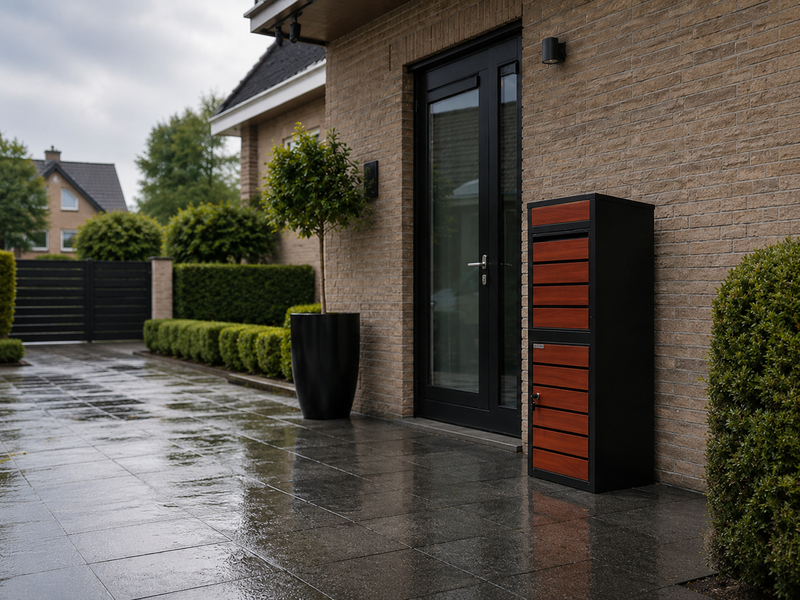
According to the ACM, the Netherlands had 9,309 parcel lockers in 2025. That number is growing fast, but a locker is not at your front door and works with the same collection deadlines as a service point. A parcel letterbox on your own facade effectively does the same as a compartment in such a locker, only at the place the parcel was going anyway. Our freestanding models accept parcels up to 370 x 320 x 210 mm, so in terms of height that sits between the S and the M of the DPD range.
What happens if your parcel does not fit through the letterbox?
Then a chain begins that you have only limited control over, and it ends with a hard deadline. The order differs per carrier, but the pattern is the same everywhere: first an attempt at your door, then the neighbours, then a collection point, and then back to the sender.
| Carrier | First alternative | Collection location | Holding period |
|---|---|---|---|
| PostNL | delivery preferences, then the neighbours | PostNL point | maximum 1 week, then return to sender |
| DHL | the neighbours | DHL ServicePoint, only the next day | maximum 5 days |
| DPD | the neighbours if possible | nearest parcel point, more than 1,500 in the Netherlands | 7 calendar days at a parcel point, 5 days in a parcel locker |
With PostNL: delivery preferences are followed, and if you have not set any, the parcel goes to the neighbours or to a PostNL point. The holding period is a maximum of one week, after which it goes back to the sender. PostNL is also phasing out paper "not at home" cards, so you depend on the app or email to see where your parcel is.
DHL tries the neighbours first. If that does not work, the parcel only goes to a DHL ServicePoint the next day, with a card showing a code and QR code as notification. The holding period is a maximum of 5 days, the shortest of the three.
DPD delivers to the neighbours if possible and otherwise takes the parcel to the nearest parcel point, with a "not at home" notice showing the location. You have 7 calendar days at a parcel point and 5 days in a parcel locker.
Why that deadline hurts during holidays or illness
Five days sounds generous until you are away for two weeks. If you order something just before you leave, or a webshop sends a follow-up delivery while you are abroad, the parcel has already gone back before you get home. The same applies with illness, shift work, or simply a week in which you leave the house at eight every day and get home at seven while the service point closes at six.
The consequences are always the same four: you have to be home at a time you do not choose, your parcel is handed to a neighbour without your consent, you have to collect it yourself, and a hard deadline of 5 to 7 days is running, after which the parcel goes back. How often that last one happens cannot be established from public sources: there are no figures on the number of uncollected parcels in the Netherlands. We are not going to fill that in with an estimate.
What you can control is the first step in the chain. If there is a receiving space that is large enough, steps two to four do not need to happen. That is exactly why people call us. More on the alternatives and their conditions is in receiving a parcel when you are not home, and on the risk of parcels that are delivered but left unattended in parcel theft in the Netherlands.

Which BunnyBox takes which parcels?
Now the sum the other way round. Above you will find the real box size per category. Below is which model that box fits in. Our dimensions are width x depth x height in millimetres, and the "parcels up to" column is the largest box that actually goes in.
| Model | Parcels up to | Outer dimensions | Post and parcels | Assembly |
|---|---|---|---|---|
| BunnyBox Compact, wall-mounted model | 300 x 200 x 200 mm | 365 x 250 x 450 mm | separate slot, 1 compartment | supplied pre-assembled |
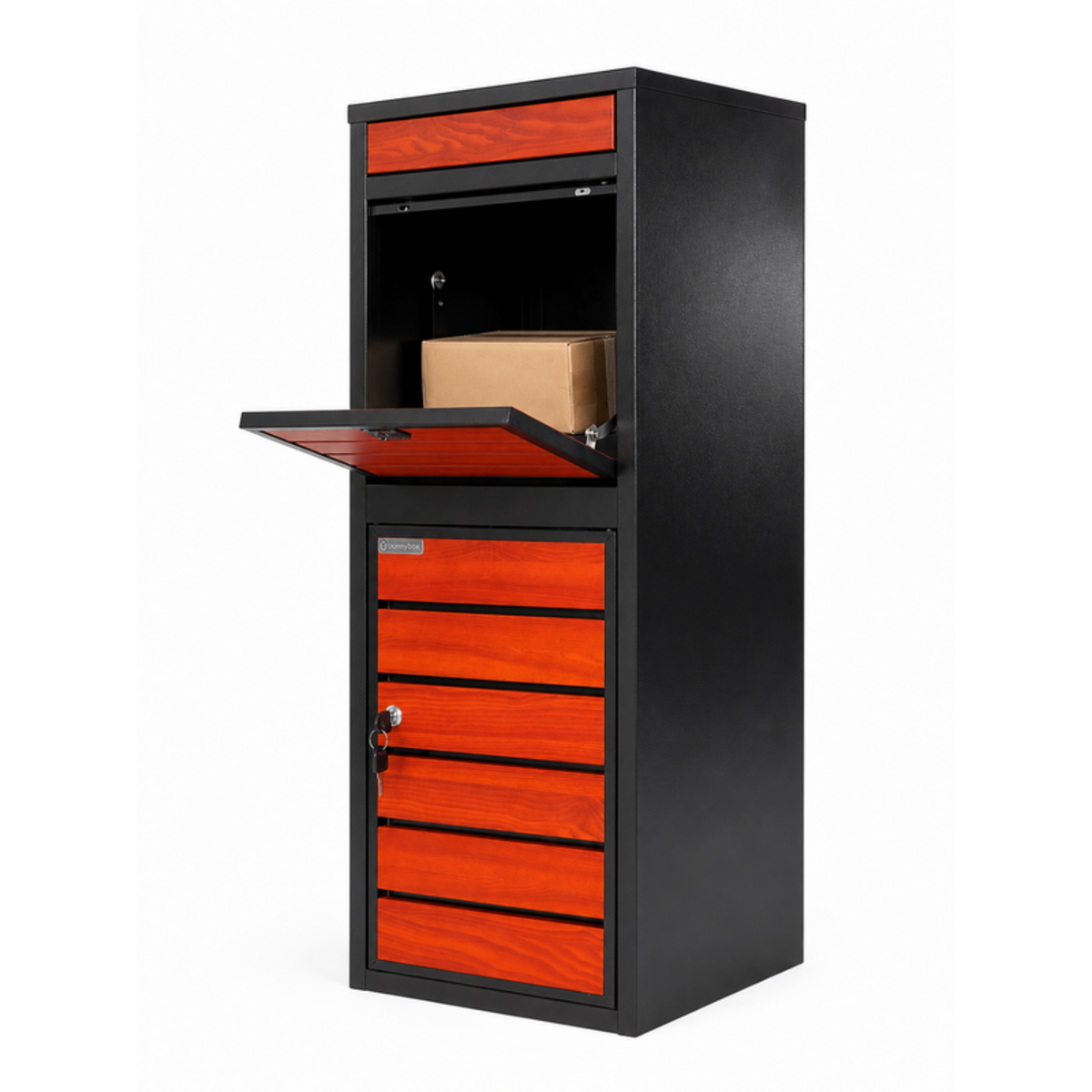
| BunnyBox Style, freestanding column with wood-effect front | 350 x 320 x 200 mm | 380 x 365 x 1000 mm | separate slot, 1 compartment | self-assembly kit |
| BunnyBox Home, freestanding | 370 x 320 x 210 mm | 410 x 380 x 1020 mm | 1 compartment | self-assembly kit |
| BunnyBox Plus, tall freestanding column | 450 x 320 x 210 mm | 500 x 370 x 1120 mm | separate compartments | self-assembly kit |
Per category: where it goes
Books. An A5 book package of 217 x 155 x 10 mm goes through any letterbox and therefore into any model. The interesting case is the thick A4 package of 302 x 215 x 75 mm and the multi-book package of 330 x 230 x 100 mm. Those do not fit through a slot. The 302 mm is just too long for the Compact, so you go for a freestanding model: the BunnyBox Style at 350 x 320 x 200 mm or the BunnyBox Home at 370 x 320 x 210 mm both take both sizes. In the Maximum column, so with tilting as a delivery driver would do, the Home and the Style take 14 book packages. In the Plus that is 18. That is six months of a book club in one go.
Shoes. Not a single shoebox fits through a letterbox, from children's shoes at 250 x 170 x 90 mm to sneakers at 330 x 200 x 110 mm. A 330 mm sneaker box is too long for the Compact, so here too the answer is a freestanding model. Four shoeboxes go into every freestanding model. A boot box lying flat, 350 x 220 x 120 mm, fits in the Style, the Home and the BunnyBox Plus.
Small electronics and phones. A phone box or a small accessory in a 200 x 140 x 80 mm box goes fine in the BunnyBox Compact, which takes up to 300 x 200 x 200 mm and is the only series supplied pre-assembled. Nine phone boxes go in. If your category is bigger, for example the 305 x 215 x 110 mm electronics box, the Style or the Home is the model that fits. 40 phone boxes go in those, 42 in the Plus.
Toiletries and personal care. An A6 box of 180 x 115 x 28 mm goes through the slot. As soon as it is several bottles, 240 x 170 x 80 mm, it is a parcel. That size fits in all four models, including the Compact.
Clothing. A flat letterbox box of 310 x 220 x 28 mm goes through the letterbox. A T-shirt box of 200 x 150 x 80 mm does not, but it fits in every model. For the larger clothing boxes, the freestanding models take over, and for the largest sizes you choose the Plus at 450 x 320 x 210 mm.
Toys. A toy box of 305 x 220 x 150 mm, at 150 mm high, is far beyond the reach of a letterbox. For the Compact it is 5 mm too long and 20 mm too wide, so this is a category for the Style or the Home. If you order toys more often than average, think December, the Plus at 450 x 320 x 210 mm with a capacity of 18 book packages is the safest choice.
Why a freestanding model is the answer to 88 percent
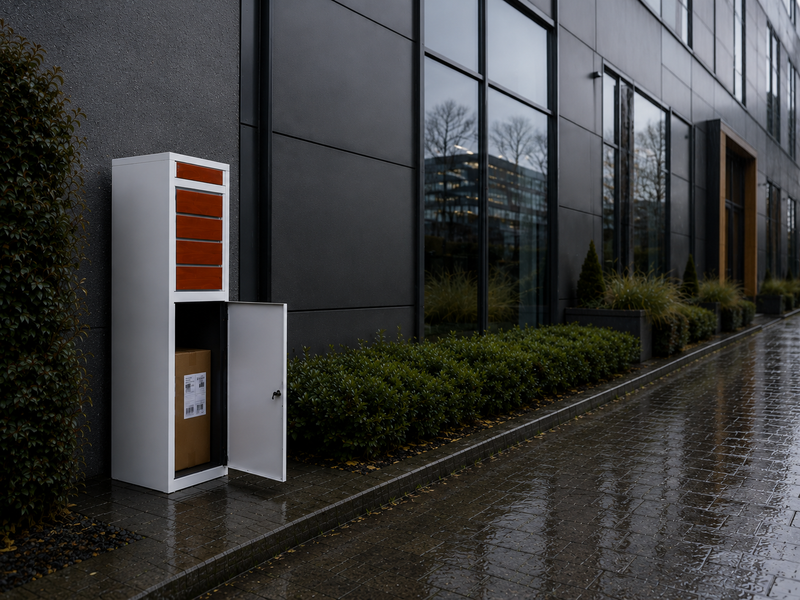
The sum above shows where it gets stuck: not on length and width, but on height. A 32 mm slot is the narrowest container in the entire delivery chain, narrower than the smallest compartment of a DPD locker and narrower than any parcel box PostNL itself sells. A freestanding model turns that around. The parcel compartment of a freestanding BunnyBox is almost half a metre tall, so a week's worth of orders fits in without you having to empty it. You then take the post and parcels out in one go on Saturday. Always someone home with a BunnyBox.
The Plus goes one step further: post and parcels have separate compartments, so your envelopes are not under a shoebox. And because the Plus takes up to 450 x 320 x 210 mm, it is the model for anyone who regularly gets bigger boxes: the multi-book package, the larger clothing box, the boot box lying flat. If you mainly receive small electronics and toiletries and have no room for a column, the Compact on the facade will do the job. All series are made of 0.7 mm galvanised sheet steel with Qualicoat Class 2 powder coating with zinc phosphate pretreatment, with a door with a key lock and two keys, and a drop flap on top for the delivery driver. We make them ourselves in our own factory, and that is why we can give the internal dimensions to the millimetre instead of "spacious".
Torn between the four? Go through which BunnyBox suits me, or see what a good parcel letterbox costs for what you pay for which material. If you want to build it into a wall, gate or fence, that is covered in building in a parcel letterbox. Fix a freestanding model on paving slabs or in concrete; that is standard advice for any freestanding column. All knowledge base articles are together in the Knowledge base. With a built-in box you also choose the retrieval side, see rear or front retrieval.

View the models

Frequently asked questions about letterbox sizes and parcels
How big may a letterbox parcel be?
With PostNL (private), a maximum of 38 x 26.5 x 3.2 cm and 2 kg, with a minimum of 14 x 9 cm. With DHL eCommerce, the same dimensions, with 2 kg on the consumer page and 1 kg on the business page. At DPD it is called ParcelLetter and is 38 x 26 x 3 cm with a maximum of 1 kg. PostNL business uses 38 x 26 x 3.2 cm.
Will my parcel fit through the letterbox?
Measure the smallest side of the box. If it is more than 32 mm, it will not fit, however small the other two dimensions are. If the smallest side is 32 mm or less, check whether the box also stays within 380 x 265 mm. In practice: flat books and clothing boxes do, anything with a third dimension does not.
What is the legal size of a letterbox in the Netherlands?
According to Article 6(3) of the Postregeling 2009, the letter opening must be at least 265 mm long and 32 mm wide. According to Article 6(5), the receiving space behind it must be at least 270 mm wide with two other internal dimensions of at least 150 and 380 mm. The legal basis is Article 20(1) of the Postwet 2009.
Is 265 x 32 mm a maximum or a minimum?
A minimum for the opening. The law says how small a slot may be at most, not how big your box may be. A larger opening complies with the law just as well. Carriers turned that minimum into their maximum size for letterbox parcels, and that is why many people read it the wrong way round.
What percentage of parcels does not fit through the letterbox?
Around 88 percent. According to the ACM Post and Parcel Monitor 2025, published on 24 June 2026, 615 million parcels were delivered, of which 73 million were letterbox parcels. That is a lower limit, because the ACM counts booked product categories and not physical fits.
Why are letterbox boxes 28 mm high and not 32 mm?
Because the corrugated cardboard walls take up the remaining millimetres. G&F explains that the 28 mm is the usable product space inside; Verpakgigant writes that all formats keep to around 28 mm so that they fit through the letterbox effortlessly. That four-millimetre margin absorbs brushes, sticking flaps and post already in the box.
Does a shoebox fit through the letterbox?
No, not a single one. Children's shoes come in 25 x 17 x 9 cm, women's shoes in 30 x 18 x 10 cm and sneakers in 33 x 20 x 11 cm. The lowest of those three is 90 mm, almost three times the 32 mm slot. A boot box lying flat is 35 x 22 x 12 cm.
Does a PostNL small parcel fit through the letterbox?
No. Small parcel is a rate class and not a letterbox product: maximum 3 kg with a height of up to 15 cm. That 15 cm is almost five times the letterbox slot. The name suggests something other than the size.
How long does the carrier keep my parcel if it does not fit?
PostNL a maximum of 1 week, DHL a maximum of 5 days, DPD 7 calendar days at a parcel point and 5 days in a parcel locker. After that, the parcel goes back to the sender. So during a holiday or illness, that almost always means your order goes back.
Which BunnyBox do I need for shoeboxes and toys?
A freestanding model. A sneaker box of 330 x 200 x 110 mm and a toy box of 305 x 220 x 150 mm fit in the Style, up to 350 x 320 x 200 mm, and in the Home, up to 370 x 320 x 210 mm. Four shoeboxes go into every freestanding model. If you often get large boxes, choose the Plus, up to 450 x 320 x 210 mm.
Note. Last checked on 25 August 2026. Main sources: Postregeling 2009, Article 5 and Article 6, based on Article 20(1) of the Postwet 2009; the ACM Post- en pakketmonitor 2025, published on 24 June 2026 (615 million parcels, 73 million letterbox parcels, delivery location home 82.2 percent, service point 12.4 percent, other 5.3 percent, 9,309 parcel lockers); ACM ConsuWijzer on the receiving space of 27 x 15 x 38 cm; PostNL's own letterbox flyer, rates and parcel box pages; the consumer and business pages of DHL eCommerce and the MyParcel carrier specification 2026; the DPD pages on ParcelLetter, shipping limits and Parcel Locker compartment sizes; GLS figures via a fulfilment partner because gls-group.com blocks scraping; UPS shipping limits; standard formats from Dutch packaging suppliers including G&F, Verpakgigant, Superdoos and Dozen.nl; ecommerceNews on the 2024 parcel monitor; Wehkamp on packaging in bags (2020, out of date). Where sources contradict each other, on the DHL weight and on the PostNL sizes for small and large parcels, we give both numbers and do not publish a choice. No public box sizes were found for Coolblue, Zalando, Amazon.nl, Douglas, Bax Music and HelloFresh; no reliable public source was found on pet food packaging. We update this page twice a year and immediately after every new ACM monitor or rate change.