In brief
- Anchoring stands or falls on the base. For its smallest certified anchor, an M8, TOX requires 100 mm of concrete thickness.
- An ordinary Dutch concrete paving slab is 45 mm thick. Anchoring into a loose slab therefore falls outside every approval.
- Where depth is lacking, mass does the work: a Stelcon slab of 200 x 200 x 14 cm weighs 1340 kg.
- Use fixings that do not accept a counter tool: Torx with pin (DIN 7991, ISO 7380) or a shear bolt.
- There is not a single Dutch figure on stolen letterboxes. CBS (Statistics Netherlands) does not have the category.
- Theft outside the home appears on a closed list in policy conditions. A letterbox does not.
You fix a parcel letterbox in concrete, not in paving: the smallest certified through-bolt anchor in this file requires 100 mm of concrete thickness, and a loose concrete paving slab only reaches 45 mm. On top of that, fix it so it cannot be undone, with fixings that no ordinary bit fits.
Below you will find what you will not find complete anywhere else in Dutch: the real anchor data from fixing manufacturers with ETA number and tightening torque, the calculation that shows why a paving slab does not count, the four tamper-proof fixing principles with their standard designations, and what policy conditions literally say about belongings in the garden. And it starts with what is missing, because not a single Dutch figure exists on theft of the box itself. We make parcel letterboxes ourselves in our own factory, so we read technical data sheets and approvals as part of our work. A webshop that only resells does not. You will find more research like this in our Knowledge base.
- 100 mmMinimum concrete thickness TOX specifies for an M8 through-bolt anchor, the smallest size in the table
- 45 mmThickness of a standard Dutch 30 x 30 cm concrete paving slab
- 1340 kgWeight of a Stelcon slab of 200 x 200 cm at 14 cm thick
- 2.4%Share of the population in the Netherlands that was a victim of other theft in 2025, the CBS residual category into which a stolen letterbox disappears

Are parcel letterboxes really stolen in the Netherlands, and how often?
The answer to the second part of that question is uncomfortable but clear: nobody knows, because nobody measures it. We went through the sources that should have it and the figure does not exist. In the Veiligheidsmonitor 2025 (Safety Monitor), chapter 5 on traditional crime, published in 2026, CBS (Statistics Netherlands) distinguishes the following property crimes: attempted burglary and burglary, bicycle theft, car theft, theft from a car, theft of parts from a car, theft of other vehicles, pickpocketing and robbery, and other theft. Theft of objects from the garden, from the property or from the front of the house is not a separate category. A stolen letterbox therefore falls into the residual category of other theft and cannot be isolated in the figures.
That is not a detail. It means that any website presenting you with a percentage or number of stolen letterboxes cannot have that figure from a statistic. The closest figure that does exist is the residual category itself: 2.4% of the population in the Netherlands was a victim of other theft in 2025. That covers everything from a stolen wheelie bin to a stolen planter, and there is no way to pick a letterbox out of it.
| Offence | 2025 | 2023 | 2021 |
|---|---|---|---|
| Bicycle theft | 4.9% | 5.0% | 3.8% |
| Other theft | 2.4% | 2.4% | 2.1% |
| Burglary or attempted burglary | 2.0% | 2.0% | 1.8% |
| Pickpocketing and robbery | 1.4% | 1.4% | 0.9% |
| Theft of parts from a car | 0.9% | 0.9% | 0.9% |
| Theft from a car | 0.6% | 0.6% | 0.6% |
| Theft of other vehicles | 0.2% | 0.2% | 0.2% |
| Car theft | 0.1% | 0.1% | 0.1% |
Percentage of the population in the Netherlands that was a victim in that year. Source: CBS, Veiligheidsmonitor 2025, chapter 5, published in 2026.
The insurers get no further. On 23 January 2025 the Verbond van Verzekeraars (the Dutch Association of Insurers) published a report that there had been 22,305 domestic burglaries in the previous year, 2% fewer than the year before, over 60 a day. Around Christmas, from 24 to 26 December, there were 267 reports against 378 the year before, and around New Year 125 burglaries against 153 in 2023. The same report also describes what a burglary does to people, based on CBS research: 67% of victims feel less safe at home, 40% have less trust in people and more than a quarter have trouble sleeping. Theft of objects outside the home does not appear anywhere in the report.
What there is: individual documented cases
That it happens is certain. It just happens without anyone counting. In Meijel in Limburg, in the night of Monday 29 to Tuesday 30 April 2024 at 1:48am, a man with a scarf over his face walks up to a letterbox on the Molenhaagweg, lifts it up and walks off with it. A security camera recorded it, the residents shared the footage and referred to 0900-8844 (the Dutch police non-emergency number). Meijel24 published it on 30 April 2024. In Santpoort a letterbox was stolen from a 90-year-old man; TPO reported on it on 7 February 2023. Politie Doetinchem (the local police) published camera footage of someone suspected of stealing a letterbox; we could not establish the date of that post, and Facebook is not a reliable archive.
The fourth case works differently. In the Belgian police zone AMOW, covering Asse, Merchtem, Opwijk and Wemmel, more reports came in during May 2025 of letterboxes and parcel boxes being broken open but not taken away. Fred Scrayen of that police zone described the method on VRT NWS on 16 May 2025.
With a crowbar, a screwdriver or some other lever, the letterbox is brutally forced.
Fred Scrayen, police zone AMOW, on VRT NWS, 16 May 2025
Put those two cases side by side and you have the two attack scenarios this whole article revolves around. In Meijel the box was lifted away. In AMOW the box was broken open. That calls for two different measures: against lifting away, anchoring and tamper-proof fixing help; against breaking open, the strength of the cabinet, the design of the flap and the lock help. That second track is covered in our article on anti-fishing protection, which explains how someone tries to reach the contents through the drop opening with a tool.
The only hard theft figures are American, and they are about parcels
If you do want numbers, you end up in the United States, and then about parcel theft from doorsteps rather than about the box. The Wikipedia overview on package theft mentions about 90,000 parcels a day disappearing in New York City in 2019, 20% more than four years earlier, more than 1.7 million parcels a day nationwide, about 19% of households a year, an average value per stolen item of about 140 dollars, and only 10% of cases leading to an arrest. The sources behind that are the New York Times of December 2019, a Ring study from November 2017, SafeAtLast from 2020 and CBS News from March 2019. Treat those figures for what they are: American, about parcels, and not about the letterbox. What can and cannot be said about parcel theft in the Netherlands is covered in parcel theft in the Netherlands, the figures.
Note. There is also a manufacturer's page titled Wordt een brievenbus wel eens gestolen (are letterboxes ever stolen). We were unable to read the content of that page, so we quote nothing from it. What you read above is everything that could be established with a source and date.
Which anchor do you need to fix a parcel letterbox in concrete?
Start with the name, because almost everyone gets it wrong. In Dutch, keilbout (wedge bolt) is colloquial. Manufacturers call this product a through-bolt anchor (doorsteekanker), at fischer a bolt anchor (snelbouwanker), at Hilti a stud anchor (segmentanker), and in English a throughbolt or in German a Bolzenanker. The principle is the same for every brand: when you tighten the bolt to the specified torque, a cone is drawn into an expansion sleeve that clamps against the wall of the drill hole. From that follows something that appears in almost no DIY guide: the torque wrench is a functional part of the anchoring, not a luxury. Too loose, and there is no preload and the sleeve does not clamp. Too tight, and the concrete cracks or the anchor stretches. The specified tightening torque is therefore not a recommendation, it is the operating condition under which the stated values apply.
The strongest table we found is the one for the TOX S-Fix Pro through-bolt anchor, declaration of performance 1219-CPR-0181, approved under ETA-17/0829 of 6 February 2018. That table is the only one in this whole file that gives both the minimum concrete thickness and the tensile resistance for each anchor size. That is exactly the combination you need if you want to know whether your base counts.
| Anchor size | Drill diameter | Anchorage depth hef | Tightening torque | Minimum concrete thickness | Tensile resistance NRk,s | Approval |
|---|---|---|---|---|---|---|
| M8 | 8 mm | 48 mm | 20 Nm | 100 mm | 18.1 kN | ETA-17/0829, 6 February 2018 |
| M10 | 10 mm | 60 mm | 40 Nm | 120 mm | 31.4 kN | ETA-17/0829, 6 February 2018 |
| M12 | 12 mm | 70 mm | 60 Nm | 140 mm | 40.4 kN | ETA-17/0829, 6 February 2018 |
| M16 | 16 mm | 85 mm | 100 Nm | 170 mm | 72.7 kN | ETA-17/0829, 6 February 2018 |
Read the minimum concrete thickness column once more. It does not tell you how deep to drill, it tells you how thick the concrete under your feet must be before the anchor can do what the table promises. For the smallest size, an M8, that is 100 mm. The anchorage depth of that same M8 is 48 mm, so the tip of the anchor is already well into the material and there must still be concrete left below it to carry the stress cone.
The same product from another brand, different figures
For comparison, the Hilti HST3 stud anchor, with ETA-98/0001 of 9 February 2018, issued by DIBt in Berlin. For an M8 it gives a tightening torque of 20 Nm and a characteristic resistance of 12.0 kN in uncracked concrete and 8.0 kN in cracked concrete, with a recommended load of 5.7 and 3.8 kN. For the M10 it is 45 Nm with 12.8 and 9.1 kN, for the M12 60 Nm with 22.0 and 15.0 kN. The M16 row in that table gives 17.9 kN, so lower than the M12, and that cannot be physically right. The most likely explanation is that the table has several anchorage depths per size and that those rows do not refer to the same depth. We would rather mention it than paper over it: do not use that M16 value without checking it in the approval itself. The M8, M10 and M12 rows and all tightening torques are consistent with each other.
Now compare the two brands on one point. Hilti gives 110 Nm for M16, TOX gives 100 Nm. Hilti gives 45 Nm for M10, TOX gives 40 Nm. Both are correct, because a tightening torque belongs to a specific product and not to a size. That is the most important thing to take away from this section: you look up the torque in the data sheet of the anchor in your hand, not in a table you found somewhere else.
Concrete screw, chemical anchor and the gaps in the published data
A concrete screw is the quick route. The fischer FBS II US cuts its own thread in the concrete, with a drill diameter equal to the nominal size, so 8 mm for the 8 series and 10 mm for the 10 series. The minimum drilling depth is specified per length and is always 10 mm deeper than the screw length: 8x55 needs 65 mm, 8x80 needs 90 mm, 8x130 needs 140 mm, 10x60 needs 70 mm, 10x100 needs 110 mm and 10x140 needs 150 mm. There are several anchorage depths per screw, for the 8x80 for example 50 at 30 mm and 65 at 15 mm. Permitted base materials are concrete C20/25 to C50/60, both cracked and uncracked, plus brick according to EN 771-1 and calcium silicate brick, solid and perforated, according to EN 771-2. Approvals: ETA-15/0352, ETA-20/0321 and ETA-20/0134. fischer itself notes that the attached part can be unscrewed up to twice within the certification, with shims up to 10 mm. That is an installation advantage and at the same time a security weak spot: what you can unscrew twice, someone else can unscrew once.
The chemical anchor is the only category in this file for which the manufacturer explicitly approves difficult base materials. For the fischer injection mortar FIS V Plus, its own documentation lists concrete C20/25 to C50/60 in cracked and uncracked condition, hollow and lightweight concrete blocks, perforated brick and calcium silicate brick, solid calcium silicate brick and brick, aerated concrete, and even water-filled drill holes. Approvals: ETA-20/0603 for anchoring in concrete, ETA-20/0729 for masonry and ETA-20/0728 for rebar connections. Packs are 300 ml, 150 ml and 360 S, with an FIS VW Plus version for faster curing at low temperatures. Mechanical expansion anchors mention those base materials nowhere; at both Hilti and TOX it simply says concrete C20/25 to C50/60.
And then the accounting of what has not been published, because that belongs in this subject. For the fischer FBN II 12/30 K, item 45274, with ETA-07/0211 and declaration of performance 0192, the product page does give the drill diameter of 12 mm, the minimum drill hole depth for push-through installation of 100 mm, the anchor length of 109 mm, the thread M12 x 64 mm, spanner size 19 mm, a maximum clamping thickness of 30 mm and concrete C20/25 to C50/60 uncracked. The tightening torque and the kN values are not there; fischer refers to the approval documents for those. For the FBS II concrete screw and the FIS V Plus, the tightening torques, curing times per temperature and kN values are not on the product pages either. The Rawlplug R-XPT throughbolt is known to exist, with ETA-17/0183 from 2021 and sales sizes M6 to M24 in galvanised and stainless steel A4, but the figures themselves cannot be freely retrieved from the manufacturer's own document server. For SPIT we found not a single product with a specification. So anyone who needs a kN value will not get there with product pages alone: the approval is needed too.
How thick does the concrete need to be, and can it go into a concrete paving slab?
This is the calculation that carries the whole article, and the answer is no. An ordinary Dutch concrete paving slab measures 30 x 30 x 4.5 cm and is therefore 45 mm thick. That size is in the product name at four independent paving suppliers: Betondingen, Jonk Sierbestrating, Tebi and Wassink Bestratingen all sell the grey 30x30x4.5 concrete paving slab. The smallest certified through-bolt anchor in the TOX table, the M8, requires 100 mm of concrete. The anchorage depth alone is 48 mm, and that is more than the entire thickness of the slab.
SLAB THICKNESS VERSUS REQUIRED CONCRETE THICKNESS
Slab thickness according to Betondingen, Jonk, Tebi and Wassink. Minimum concrete thickness according to TOX S-Fix Pro, ETA-17/0829, 6 February 2018.
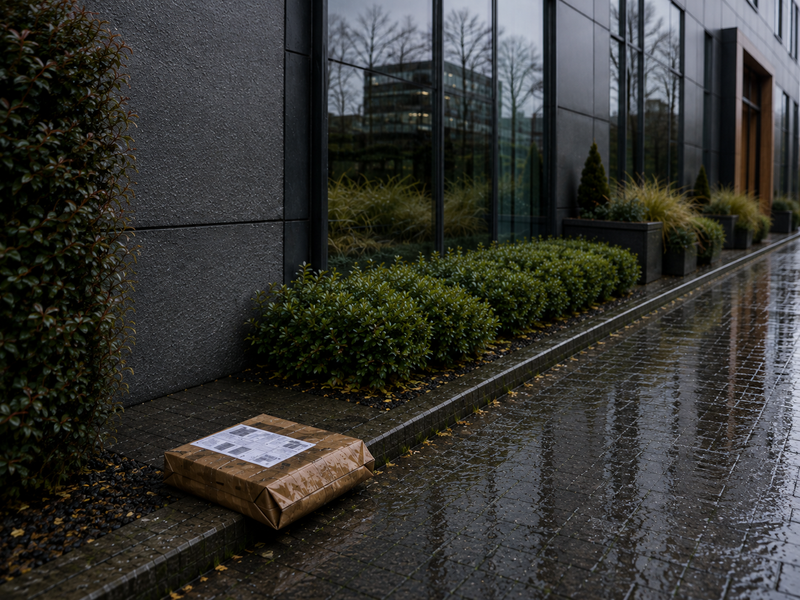
What does that mean in practice? If you anchor into a loose paving slab, you are not anchoring outside your own judgement, you are anchoring outside the approval. The stated tensile resistance of 18.1 kN then does not apply, because it was established in concrete of the specified thickness. What you are left with is not the strength of the anchor but the weight and cohesion of the slab. And you can lift a single loose slab of 30 x 30 x 4.5 by hand. Someone who wants to take the box then lifts box plus slab and walks off, exactly as happened in Meijel.
Note. We deliberately do not give kilos per concrete paving slab. Two weight overviews from paving suppliers could not be read by us, and a weight you cannot take from a source does not belong in a table. What is certain is the thickness of 45 mm, and that thickness is the point here.
The other extreme: the Stelcon slab
Look at the heaviest end of the spectrum and the logic shifts completely. De Keij publishes the weights of Stelcon slabs, and those figures are of a different order from anything you handle by hand.
| Size | Thickness | Weight | With steel angle edge |
|---|---|---|---|
| 200 x 100 cm | 14 cm | 670 kg | 680 kg |
| 200 x 100 cm | 16 cm | 770 kg | 780 kg |
| 200 x 100 cm | 20 cm | 950 kg | not stated |
| 200 x 100 cm | 25 cm | 1200 kg | 1210 kg |
| 200 x 200 cm | 14 cm | 1340 kg | 1360 kg |
| 200 x 200 cm | 16 cm | 1540 kg | 1560 kg |
| 200 x 200 cm | 20 cm | 1900 kg | not stated |
| 200 x 200 cm | 25 cm | 2400 kg | 2420 kg |
De Keij states literally that slabs with a steel edge are 20 kg heavier than slabs with a bevelled edge without a steel angle edge. For a slab of 200 x 200 cm the same supplier gives a price indication from €120; Van Kalsbeek Beton sells the 200 x 200 x 25 cm version with a weight in the order of 4.2 tonnes in the product name.
Here two things are true at once, and that is the insight of this section. A Stelcon slab of 14 cm is 140 mm, exactly the minimum concrete thickness TOX specifies for an M12, so you are right on the limit, and for an M16 at 170 mm that slab is too thin. At the same time, 1340 kg makes lifting it out practically impossible. With a paving slab the security is therefore next to nothing, with a Stelcon slab the security comes from the weight of the slab, and only with sufficient thickness does it also come from the anchor. Once you understand that difference, you will never again be unsure about DIY advice.
Is a ground anchor or a concrete footing better than anchoring into paving?
For a freestanding box this is the key question, and the market gives a surprisingly concrete answer: ready-made ground anchors exist as a separate item. Bravios sells a ground anchor for a freestanding letterbox measuring 10 x 24.2 x 42.6 cm, made of galvanised sheet steel with powder coating, weighing 15 kg and priced at €59.90 including 21% VAT. The manufacturer adds that it ensures a theft-proof and stable installation and that the letterbox therefore cannot fall over. The installation method is not on the product page itself; there is a separate installation manual as a download for that, which we have not seen.
Allux sells an anchoring and mounting set with number 8002: a cube-shaped anchor 400 mm high, 380 mm wide and 225 mm deep, in galvanised steel, which is dug into the ground and onto which the parcel letterbox is mounted. The price at a dealer is €85.95, reduced from €106.00. The weight is not stated. And this is striking: on that product page, theft prevention is not mentioned as an argument at all, even though it is the heavier steel anchor of the two.
The third route comes from the installation manual of a letterbox supplier. It states that a galvanised ground anchor must be dug fully into the ground and cast into a concrete footing. As an alternative, the same manual mentions a galvanised steel base plate that must be buried at a depth of 25 cm, with a frame height of 1300 mm. The volume of concrete and the number of anchor points are not stated. In its own FAQ, Bravios mentions a hole about 40 to 60 cm deep that you fill with concrete and leave to cure.
Put those side by side and you get three ways to achieve the same thing, with very different levels of evidence behind them.
Which route you choose depends on what is already there. If there is already a thick concrete slab, drilling and anchoring is quickest and you have a certified system with specified values. If there is only soil, the footing is the way to go, because you make the concrete the anchor will sit in yourself, and then you decide the thickness instead of the contractor from thirty years ago. What else is involved in a freestanding installation, from height to distance from the road, is covered in detail in freestanding installation: foundation, height and the ten-metre rule.

Which bases can and cannot be used for anchoring?
The base determines everything: the anchor type, the size, the depth and whether a certified solution exists at all. Below, for each base, is what is and is not possible according to the manufacturers' documentation, with the source. Where no manufacturer source exists, we say so.
| Base | What works | What does not work | Source or justification |
|---|---|---|---|
| Concrete C20/25 to C50/60, thick enough | Through-bolt anchor, concrete screw or chemical anchor, all three certified | Nothing excluded, provided the minimum concrete thickness per size is met | TOX ETA-17/0829; fischer FBS II ETA-15/0352; fischer FIS V Plus ETA-20/0603 |
| Stelcon slab 14 cm or thicker | M8, M10 and M12 if the thickness is right; 14 cm is exactly the 140 mm TOX requires for M12 | M16, because it requires 170 mm of concrete thickness | TOX ETA-17/0829; weights and thicknesses via De Keij |
| Loose concrete paving slab 30 x 30 x 4.5 cm | Nothing within an approval; the slab is 45 mm thick | Not even the smallest size M8, which requires 100 mm of concrete and has 48 mm anchorage depth | Slab size via Betondingen, Jonk, Tebi and Wassink; anchor requirement via TOX ETA-17/0829 |
| Brick paving | Lift the pavers, pour a footing, then anchor into the new concrete | Anchoring into a paver itself; you then only anchor that one paver | No manufacturer source found for anchoring in brick paving; pavers are loose elements without cohesion between them |
| Masonry and facade | Concrete screw in brick according to EN 771-1 or calcium silicate brick according to EN 771-2; chemical anchor in perforated material | Drilling into the top or side of a low wall, and drilling with less than 5 cm of brick around the hole | fischer FBS II US; fischer FIS V Plus ETA-20/0729; the 5 cm rule via the Logixbox installation instructions |
| Aerated concrete, hollow blocks, wet drill hole | Chemical anchor with injection mortar; this is the only category the manufacturer approves for this | Mechanical expansion anchor; Hilti and TOX only approve concrete C20/25 to C50/60 for these | fischer FIS V Plus, ETA-20/0603, ETA-20/0728 and ETA-20/0729 |
| Timber and wooden post | There is a separate product line of stud anchors for timber; for a post in the ground, suppliers mention setting in concrete, driving in or a post holder | Working with kN values, because we could not read the specifications of that timber line | Hilti HST3 product line for timber; supplier overviews of post holders and ground anchors |
Two things stand out when you read that table from top to bottom. First: the chemical anchor is the only solution the manufacturer itself approves for the messy bases you actually run into in an old Dutch front garden. Second: for brick paving and a loose paving slab there is no certified solution, and that is not because nobody has tried, but because the material cannot carry the stress cone of an anchor. The solution there is not a thicker anchor but a different base.
The gap between two industries, in two figures
Now the contrast this article started with. One letterbox supplier specifies a drill diameter D of 6 mm for wall mounting, about 60 mm deep, with supplied wall plugs and screws, and does not specify the number of anchor points. For a wall-mounted parcel box, another supplier mentions four supplied bolts or wedge bolts, with the instruction to use the wall plugs only where you have at least 5 cm of brick around the hole. An anchor manufacturer requires 8 mm diameter and 100 mm of concrete thickness for its smallest certified through-bolt anchor. Those are two completely different orders of magnitude for the same problem, and that gap is exactly why this page exists. If you are installing a wall-mounted model, it is also worth reading hanging a wall-mounted model without leaks or a cold bridge, because for an insulated facade one manufacturer advises insulation plugs or spacers to achieve a sturdy installation and avoid cold bridges.
How do you fix a parcel letterbox so it cannot be undone?
Anchoring and tamper-proof fixing are two different things. You can set a box with four M10 anchors in 200 mm of concrete and still lose it within two minutes if those four nuts come off with an ordinary spanner. The principle behind all anti-theft fixings is the same: the head must no longer accept a counter tool. There are three ways to achieve that. With a pin in the profile, so an ordinary bit no longer fits. With a head that snaps off at a set torque, so no gripping surface is left after installation. Or with an asymmetric profile that only grips in the tightening direction.
What is available in the Dutch trade, with standard designation, is listed below. One supplier of fixings sells four types of Torx pin security screws, all in stainless steel A2, so rust-resistant and suitable for outdoor use. The same supplier explains how it works literally: a normal Torx has a six-pointed star, but a Torx pin screw has a pin in the middle of that recess, so only a matching Torx pin bit or key fits, and without that bit the screw will not come undone. The matching bits and L-keys are available separately.
| Fixing | How it works | Can you still undo it yourself | Source |
|---|---|---|---|
| DIN 7981 pan head tapping screw, Torx PIN, stainless steel A2 | Pin in the middle of the Torx recess, so an ordinary Torx bit does not fit | Yes, with the matching Torx pin bit or L-key | JRV, bevestigingsmateriaal.nl, TX pin security screws category |
| DIN 7982 countersunk tapping screw, Torx PIN, stainless steel A2 | Same pin principle, countersunk head so nothing sticks out to grip | Yes, with the matching bit | JRV, bevestigingsmateriaal.nl; version DIN 7982CTP with TX30 pin head via Techniekwebshop |
| DIN 7991 metric countersunk head, Torx PIN, stainless steel A2 | Metric thread with pin profile, so it can be combined with a through nut or tapped hole | Yes, with the matching bit | JRV, bevestigingsmateriaal.nl |
| ISO 7380 metric low button head, Torx PIN, stainless steel A2 | Low button head with pin profile, little raised surface for pliers or a lever | Yes, with the matching bit | JRV, bevestigingsmateriaal.nl |
| Shear bolt | The head breaks off as soon as the tightening torque is reached, after which no gripping surface remains | No, not without damaging or drilling out the bolt | Separate product section for shear bolts within security bolts at a Dutch supplier; we could not read the sizes and prices |
| Concrete screw | Cuts its own thread in concrete, with a normal screw drive in the head | Yes, and that is the point here: within the certification it can be unscrewed up to twice | fischer FBS II US, ETA-15/0352, ETA-20/0321 and ETA-20/0134 |
| Chemical anchor with threaded rod | Threaded rod fixed in mortar; the nut remains accessible and therefore needs a pin nut or shear nut on top | The rod no, the nut yes, unless you secure it separately | fischer FIS V Plus, ETA-20/0603 |
The category is broader than one supplier. Fabory has its own security screws section, and Esmax, Borenco and RW Products all sell security screws as a separate category. Even bol.com has a category page for anti-burglary screws with Torx and pin. So the products are available in the Netherlands, and it is not a specialism you need to source from abroad.
Note. For Tri-Groove, one-way screws, shear nuts or break-off nuts and blind rivets as anti-theft fixings, we found no type, size or price data at Dutch suppliers. Those techniques exist as concepts, but we do not give specifications we cannot take from a source. We also could not see the sizes of shear bolts, because the webshop concerned put a browser check in front of the page.
- Concrete of the specified minimum thickness, checked per size
- Anchor tightened to the torque from that product's data sheet
- Fixings whose head does not accept a counter tool
- Four points instead of two, so it cannot be levered off
- An anchor in a loose 45 mm concrete paving slab
- An anchor in a single paver from the paving
- Standard hex nuts on the outside, reachable with a spanner
- A tightening torque copied from another brand
What steps do you follow to anchor a parcel letterbox yourself?
The order matters more than the tools. Anyone who drills first and only then checks how thick the concrete is has already made the most important decision without actually making it.
- Decide on the spot. If you want to be able to take in a week of parcels, choose a spot where the delivery driver can reach the flap from the pavement in one movement.
- Establish the base and measure the thickness. Concrete, Stelcon slab, paving slab, brick pavers, soil or facade lead to five different next steps, as in the table above.
- Choose the anchor and size from the table of the product you are buying, and write down the three figures that go with it: drill diameter, anchorage depth and minimum concrete thickness.
- Drill at right angles to the slab, to the specified depth, and clean out the hole. With a chemical anchor that is not extra tidiness but a condition of the approval.
- Tighten to the specified torque with a torque wrench. Never copy a torque from another brand, because it belongs to the product and not to the size.
- Replace the visible nuts or bolts with Torx pin or shear bolts, so there is no longer anything on the outside for a counter tool to grip.
- Check after a few weeks whether the connection is still under tension, and once more after the first frost period.
The full assembly story, including the five mistakes made most often, is in assembling a parcel letterbox: tools, steps and the 5 most common mistakes. If you would rather tuck it into a wall, gate or fence than put it on the paving, building in a parcel letterbox is the better route.
Is a stolen parcel letterbox insured?
This is where it gets interesting, because this is the part where almost every page on the subject misses the mark. We read the policy conditions ourselves. The outcome in one line: under a Dutch home contents insurance policy, theft of belongings outside the home is not general cover but a closed list, and a letterbox is not on any of those lists.
The clearest example is at ZLM, in the Voorwaarden Inboedelverzekering (home contents insurance conditions) valid from 1 May 2026 up to and including 30 April 2027, article 3, headed in which places the contents are insured. It states literally that the contents are insured on the outside of the house, under canopies, in the garden and on the property, and immediately afterwards that the insurance does not apply in these places for damage caused by storm, precipitation, theft and vandalism. Then comes the exception, and it is a short list: garden furniture, garden tools with the exception of ride-on mowers, a flagpole and laundry. Four items. A letterbox is not among them.
| Source | What it literally says about outdoors and theft | Limit | Version and date |
|---|---|---|---|
| ZLM, Voorwaarden Inboedelverzekering, article 3 | In the garden and on the property, the insurance does not apply for damage caused by storm, precipitation, theft and vandalism; exceptions are garden furniture, garden tools except ride-on mowers, a flagpole and laundry | No maximum amount stated for these outdoor items | Valid 1 May 2026 up to and including 30 April 2027 |
| Univé, Verzekeringskaart Inboedelverzekering basis (insurance summary card) | Damage to contents on or near the home is insured; this covers laundry, garden furniture, garden tools and flagpoles. Damage caused by fire, storm, leaks, water or theft is insured | Maximum €2,500 | Version 12, 14 March 2023, issued via the Verbond van Verzekeraars (the Dutch Association of Insurers) |
| ANWB, Verzekeringskaart Inboedel (insurance summary card) | Belongings are not insured outside the home or your own property; theft from a cellar, lock-up garage or communal area is reimbursed | Maximum €4,000 for a cellar, lock-up garage or communal area | Version 3, 18 June 2025 |
| Centraal Beheer, explanation of contents and buildings | Rule of thumb: what falls out is usually contents, what stays put is usually buildings. Contents are the things in your house, buildings are your house and everything attached to it | Not applicable, this is an explanatory page | Public article, consulted 26 August 2026 |
| Interpolis, difference between contents and buildings | Everything fixed in or to the home falls under the buildings insurance; a pergola, fixed outdoor kitchen and charging point are mentioned, a hot tub is classified according to whether it is movable or not | Not stated | Page dated 13 July 2020 |
| Nationale-Nederlanden, garden and contents insurance | Contents are garden furniture such as a lounge set, garden table, garden chairs and parasol, and garden tools such as a lawnmower, leaf blower, wheelbarrow and pruning tools; buildings are a fence and other fixed boundary partitions, shed, summer house and veranda | Not stated | Last updated 8 July 2026 |
Three primary sources, one pattern. And note the difference between two of them, because that is exactly the kind of detail that gets lost on comparison sites: ZLM and Univé use almost the same list of outdoor items, but Univé puts a cap of €2,500 on it and ZLM states no maximum amount for those items. The same four categories, two different financial outcomes.
Then the question that surfaced above: is the box itself contents or buildings? All three insurers that explain it use the same criterion: being attached to the home or the plot. Centraal Beheer makes it clear with an example that has nothing to do with letterboxes, and is all the more useful for it: click laminate is contents because it lies loose, glued parquet or a poured floor is buildings because they are attached to the home. Follow that line and you get a logical, not a literal, classification: a wall-mounted model screwed to the facade falls on the buildings side, a freestanding box you take with you when you move falls on the contents side, and an anchored freestanding box sits exactly on the boundary.
Not a single insurer gives a statement on exactly that boundary. We looked it up in ZLM's policy conditions, on the Univé and ANWB insurance summary cards via the Verbond van Verzekeraars, and on the explanatory pages of Centraal Beheer, Interpolis and Nationale-Nederlanden. The word letterbox does not appear in any of those documents. Nor did we come across the term nagelvast (fixed by nails), which was used in older policies. That is not carelessness by one insurer, it is a gap in the whole market. So if you want certainty, ask your own insurer in writing beforehand and keep the answer.
And the parcels that were in the box?
That is a different question with a different answer, and the answer does not start with the insurance but with the webshop. The Consumentenbond (the Dutch consumers' association) puts it like this: the webshop is the first point of contact and must provide a solution. For private sales via a marketplace, if the agreement says the seller ships or delivers, that seller bears the risk. What no source we read addresses is the key question underneath: does delivery into an anchored parcel letterbox count as legally valid delivery that transfers the risk to the consumer? No ruling on that was found. The full process, from report to template letter, is in your parcel has been stolen: step-by-step plan and template letter. What carriers themselves do with a parcel letterbox in their terms and working instructions is covered in may PostNL put a parcel in your parcel letterbox.
Reporting to the police: what the police themselves publish about it
Politie.nl (the Dutch police) writes under other theft that you can report online or at a police station, and refers to 0900-8844 to make an appointment for help at the station. The page gives no mandatory list of details and no separate procedure for theft at the home. On follow-up, the police are remarkably open in their own explanation of the procedure: only a limited number of offences can be reported online, mainly thefts and vandalism, and many online reports often offer too few leads for further police investigation. If there are no leads, you receive an email with a copy of the report attached and the case is closed.
Still, reporting is not pointless, for two reasons the police themselves give. Cases can be picked up again later if links with other cases emerge, and all reports count towards the crime figures and local decisions on patrols. There is a third reason that follows from the insurance section: that copy of the report is exactly the document an insurer requires for a theft claim. The Consumentenbond explicitly names the police report as a condition for away-from-home cover, and also notes that a claim can be rejected if you did not take proper care of your belongings.
One more nuance about that away-from-home cover (buitenshuisdekking), because the name is misleading. It is an extension to home contents insurance for valuable items you take out with you, so not for items that stand outside. The Consumentenbond mentions limits that vary enormously between insurers: up to €200,000 at Lemonade, up to €2,500 for Univé all-risk away from home, a maximum of €1,000 for jewellery at OHRA and a combined maximum of €1,000 at De Internationale. So for a box in your front garden, that is not the cover you are looking for. Figures and context on how often parcels go missing in the Netherlands are in parcel theft in the Netherlands.


May you dig in your front garden or anchor on council land?
Two questions, two different regimes, and on one point no conclusive answer. Start with digging, because that comes first if you want to pour a footing. For excavation work there is the Wet informatie-uitwisseling bovengrondse en ondergrondse netten en netwerken, WIBON for short (the Dutch act on information exchange about underground cables and pipes), also known as the Grondroerdersregeling (excavators' regulation). The Dutch government's Ondernemersplein (business portal) writes that anyone who carries out or commissions excavation work must report it to the Kadaster (the Dutch Land Registry) and the Omgevingsloket (environment portal), and that a notification is made no earlier than 20 working days and no later than 3 working days before the work. For agricultural businesses there is relief for digging up to half a metre deep. The page gives no fee for a notification and no minimum depth threshold for private individuals; for that, the government refers to the Kadaster's customer service.
Whether a private individual digging a hole of 40 to 60 cm in their own front garden formally has to file a notification, we could not establish with any primary source. The Ondernemersplein is aimed at businesses, and the private side is only covered on commercial and industry platforms: the Kabel en Leiding Overleg (the Dutch cables and pipes consultation body) states that a notification must also be made for excavation work on private land, and the same line is taken by Klic App, Grondverzet.nu and the Gemeentelijk Platform Kabels en Leidingen. So what we write down is the fact and not the verdict: the regulation exists, it is about digging, and the foundation depth of 40 to 60 cm that a letterbox manufacturer advises is exactly in the range where cables and pipes lie. If in doubt, a notification is five minutes' work and considerably cheaper than a damaged service connection.
Council land: this is regulated entirely locally
There is no national rule for objects in public places. It is in the local bylaw, and that differs per municipality. Take Weert as an example, because that municipality publishes it in full. Article 2:10 of the local bylaw prohibits placing objects in public places. A notification is only sufficient if all conditions are met: notified at least 14 days in advance, located in a 30 km per hour zone, present for no more than 14 days, no larger than 16 square metres, not in the town centre ring, the station area or a paid parking area, and directly adjoining your own plot. For a permit, Weert charges €80.50 in fees for up to a month and €158.00 for longer, plus a public land use charge (precario) of €0.45 per day or €2.00 per week with a minimum of €33.35. In a paid parking area that is €1.15 per day or €5.55 per week. For an application within seven days, a 35% surcharge is added.
Note the word temporary in that regulation. The notification route in Weert applies to objects that stay in place for no more than 14 days. A permanently anchored letterbox by definition does not fit that, and that makes it a permit matter in that municipality. Other municipalities use other conditions: Katwijk, Uitgeest, Best, Smallingerland and Helmond each have their own page with their own requirements, and Smallingerland even calls it explicitly permission to place an object on council land. Nationally, those bylaws can be found via lokaleregelgeving.overheid.nl.
There is also a second layer, and it concerns ownership. The distinction between movable and immovable property is in article 3:3 of the Burgerlijk Wetboek (the Dutch Civil Code): immovable property includes what is permanently attached to the land. In this research we only found that article on secondary sites and not at the official source, so we do not quote the text literally. The gist is enough for this page: if you permanently attach something to land that is not yours, it affects the landowner's ownership. That is a reason not to treat anchoring on council land as a casual DIY tip.
And then the permit question for your own property, because people almost always ask it straight afterwards. In article 2.29, the Besluit bouwwerken leefomgeving (the Dutch Building Decree) has a permit-free category for another structure in the garden area up to 1 metre high and 2 square metres. What we have to write down here, because almost nobody does: not a single primary source and not a single municipal page we saw mentions a letterbox or parcel letterbox by name in that context, while in practice letterboxes stand in front gardens all over the Netherlands. If you want to be sure for your street, call your local council. It takes five minutes. For the placement side, including the distance from the road, we refer you once more to freestanding installation.
What do letterbox manufacturers themselves publish about anchoring?
This is an observation about the market and not a verdict on any brand, and it is the second part of this page you will not find anywhere else. We systematically went through what letterbox and parcel letterbox suppliers write about anchoring in their own documentation. The outcome is that there are dimensions, weights and prices, and not once a force.
Bravios publishes the most: a ground anchor as a separate item with dimensions, material, weight and price, plus an FAQ page with a foundation depth of 40 to 60 cm and the instruction to fill the hole with concrete and let it cure. For insulated facades, Bravios advises insulation plugs or spacers to achieve a sturdy installation and avoid cold bridges. On security, the same manufacturer writes that parcels can be dropped off but cannot be removed without a key, and that boxes can be firmly anchored to the ground or wall. Allux supplies an anchoring and mounting set with dimensions and price via a dealer, without mentioning theft as an argument. For a wall-mounted parcel box, Logixbox gives four supplied bolts or wedge bolts and the requirement of at least 5 cm of brick around the hole, with a warning against the top or side of low walls, and also has a blog post on an anti-fishing system. Post-Point publishes an installation manual with 6 mm drilling, about 60 mm deep, a 1300 mm frame, a ground anchor cast into a concrete footing, and as an alternative a galvanised steel base plate at 25 cm depth. Even an adhesive manufacturer has a guide to mounting a letterbox with construction adhesive.
Five conclusions from that overview, and all five can be checked.
- Not a single letterbox supplier we consulted publishes a figure for the tensile force or pull-out resistance of its anchoring. Dimensions, weight and price, yes; never a kN, never a tightening torque, never a minimum concrete thickness.
- All kN and Nm values in this file come from fixing manufacturers, namely Hilti, TOX and fischer, and not from the letterbox industry.
- Not a single letterbox manual we consulted prescribes anti-theft fixings. Security screws and shear bolts come from fixing specialists such as Fabory, Esmax, Borenco, JRV and RW Products.
- Where theft is used as an argument, it is without a standard, test or figure. Terms such as theft-proof and designed to prevent theft appear without justification, and the party that sells the heaviest steel ground anchor does not mention theft at all.
- There is no standard and no quality mark for anchoring a parcel letterbox. The Politiekeurmerk Veilig Wonen (the Dutch Police Secure Housing Label) and the Verbeterde Risicoklassenindeling (improved risk classification) of the Verbond van Verzekeraars are about the home, not about objects in the garden.
That last point deserves one more sentence, because it is the reason this page exists. The Verbond van Verzekeraars (the Dutch Association of Insurers) is a partner of the Centrum voor Criminaliteitspreventie en Veiligheid (the Dutch Centre for Crime Prevention and Safety), the organisation behind the Politiekeurmerk Veilig Wonen, and developed the Verbeterde Risicoklassenindeling with the security industry, a tool for determining the burglary risk of homes and establishing which prevention measures are needed. That tool stops at the front door. For what stands in your front garden, no equivalent exists, so you have to fall back on data from the anchor industry. That is exactly what we did above.
Which BunnyBox suits the spot you have in mind?
The choice starts with the spot and with the size of what needs to go inside, not with the colour. We make four series, all of 0.7 mm galvanised sheet steel with Qualicoat Class 2 powder coating with zinc phosphate pretreatment, all with a door with a key lock and two keys, and all with a flap on top where the delivery driver puts the parcel in. That last point is why a delivery driver does not have to wait and you do not have to be home: always someone home with a BunnyBox.
The range runs from small to large. The Compact is the wall-mounted model, with external dimensions of 365 x 250 x 450 mm and parcels up to 300 x 200 x 200 mm, and it is the only series that arrives pre-assembled. So you do not need to put anything together before you get to the spot. It takes nine phone boxes. For anyone whose spot is on the facade or under a canopy, that is the logical start.
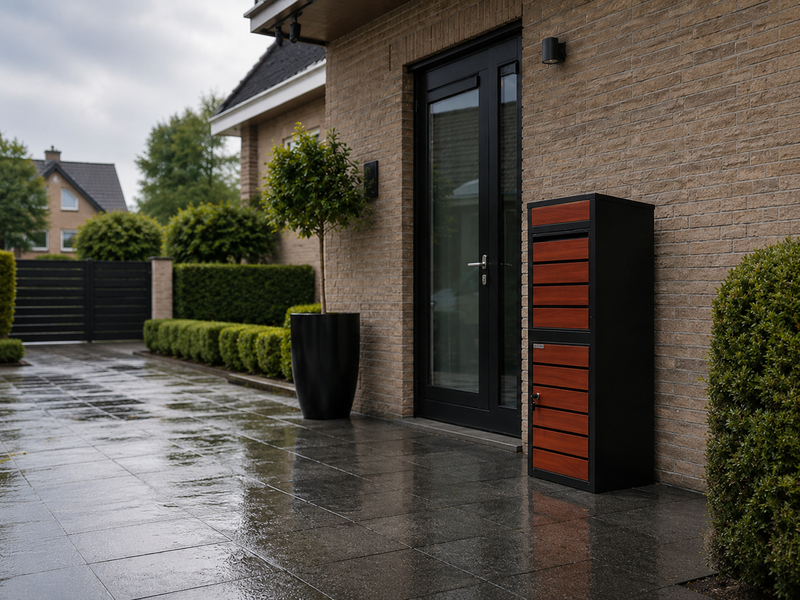
If you want a freestanding model, the Style is the post with a wood-effect front, external dimensions 380 x 365 x 1000 mm, parcels up to 350 x 320 x 200 mm, and with a separate slot for post next to the parcel compartment. The Home is the freestanding standing model with external dimensions of 410 x 380 x 1020 mm and parcels up to 370 x 320 x 210 mm. And if your boxes are just a bit longer than that, the Plus is the answer: external dimensions 500 x 370 x 1120 mm, parcels up to 450 x 320 x 210 mm, and post and parcels in truly separate compartments. Style, Home and Plus come as a self-assembly kit.
What matters on this subject is capacity, because a full box is a box the next delivery driver walks past. The parcel compartment of a freestanding model is almost half a metre tall, so a week of orders fits inside. In figures: the Home and Style take 14 book packages, the Plus 18. Every freestanding model takes four shoeboxes. As for phone boxes, 40 fit in the Home and the Style and 42 in the Plus. Those figures were measured with tilting, just as a delivery driver does it.
Colours are available in RAL 9005 black, RAL 9010 white, RAL 7036 platinum grey and RAL 7016 anthracite, plus combinations with dark teak or light oak for the wood-effect front. Still undecided between the four series? Which BunnyBox suits me sets them side by side, and which size parcel letterbox do I need starts with the boxes you receive rather than with the model.

View the models
Frequently asked questions about anchoring a parcel letterbox
How do I fix my parcel letterbox so it does not get stolen?
In three steps: make sure you have a base that meets the anchor's minimum concrete thickness, use a certified through-bolt anchor or chemical anchor tightened to the specified torque, and replace the visible fixings with Torx pin or shear bolts. At TOX, the smallest size M8 requires a concrete thickness of 100 mm and a tightening torque of 20 Nm.
Can I fix a parcel letterbox into a concrete paving slab?
Not within an approval. A standard 30 x 30 cm concrete paving slab is 45 mm thick, while the smallest certified through-bolt anchor requires 100 mm of concrete and itself needs 48 mm of anchorage depth. What you are left with is the weight of the slab, and you can lift a single slab by hand. Lift the slabs and pour a footing, or use a thicker slab.
Which wedge bolt do I need for a parcel letterbox?
Wedge bolt (keilbout) is colloquial; manufacturers call it a through-bolt anchor, bolt anchor or stud anchor. The size you need follows from the thickness of your concrete and not from the weight of the box. TOX gives M8 at 100 mm of concrete, M10 at 120 mm, M12 at 140 mm and M16 at 170 mm, with tensile resistances from 18.1 to 72.7 kN.
How deep should I drill for a through-bolt anchor?
As deep as the data sheet for that specific anchor prescribes. For the TOX S-Fix Pro, the anchorage depth is 48 mm for M8, 60 mm for M10, 70 mm for M12 and 85 mm for M16. For the fischer FBN II 12/30 K, push-through installation requires a minimum drill hole depth of 100 mm. Then blow or vacuum the hole clean, because drilling dust costs clamping force.
What tightening torque should I use for an anchor?
The value for that product, because tightening torques are not interchangeable between brands. TOX gives 40 Nm for M10, Hilti gives 45 Nm for the same size; for M16 it is 100 versus 110 Nm. Too loose means no preload and therefore no clamping, too tight means cracking concrete or a stretching anchor.
Are Torx pin security screws really impossible to undo?
They cannot be undone with ordinary tools. In the middle of the six-pointed recess there is a pin, so only a matching Torx pin bit or L-key fits. Those bits are sold separately, so anyone who wants to remove it needs the right tool. In the Dutch trade there are four standard versions in stainless steel A2: DIN 7981, DIN 7982, DIN 7991 and ISO 7380.
How many letterboxes are stolen in the Netherlands?
That figure does not exist. In the Veiligheidsmonitor 2025, CBS (Statistics Netherlands) has no category for theft of objects from the garden or property; it falls into the residual category of other theft, of which 2.4% of the population was a victim in 2025. The Verbond van Verzekeraars publishes burglary figures but nothing about objects outside the home. What is documented are individual cases, such as Meijel on 30 April 2024.
Is a stolen letterbox insured?
Under a home contents insurance policy, theft outside the home is limited to a listed set of items. In article 3 of its 2026 and 2027 conditions, ZLM lists garden furniture, garden tools except ride-on mowers, a flagpole and laundry. Univé lists the same kind of items with a cap of €2,500. A letterbox is not on any list we read. So ask your own insurer in writing beforehand.
Is an anchored letterbox buildings or contents?
The insurers' criterion is whether something is attached to the home or the plot. That puts a model screwed to the facade on the buildings side, and a freestanding box you take with you when you move on the contents side. For an anchored freestanding box, not a single insurer we read gives an explicit statement, so have the answer put in writing.
Do I need to file a notification if I dig in my front garden for a footing?
The WIBON and the notification route via the Kadaster and the Omgevingsloket exist, with a period of no earlier than 20 and no later than 3 working days in advance. Whether that is formally required for a private individual with a hole of 40 to 60 cm, we could not establish with a primary source; the government page is aimed at businesses. That depth is, however, in the range where cables and pipes lie.
Sources and last check. Last checked on 26 August 2026. We update this page at least twice a year, and immediately when a source appears in a new version or with a new year.
- TOX S-Fix Pro through-bolt anchor, declaration of performance 1219-CPR-0181, ETA-17/0829 of 6 February 2018: drill diameter, anchorage depth, tightening torque, minimum concrete thickness and tensile resistance per size.
- Hilti HST3 stud anchor, product information with ETA-98/0001 of 9 February 2018, issued by DIBt in Berlin: tightening torques and characteristic resistances.
- fischer FBN II 12/30 K (item 45274, ETA-07/0211, declaration of performance 0192), fischer FBS II US concrete screw (ETA-15/0352, ETA-20/0321, ETA-20/0134) and fischer FIS V Plus injection mortar (ETA-20/0603, ETA-20/0728, ETA-20/0729), product documentation consulted on 26 August 2026.
- CBS, Veiligheidsmonitor 2025, chapter 5 Traditional crime, published in 2026: victim percentages per offence.
- Verbond van Verzekeraars, Minder woninginbraak maar impact blijft groot, 23 January 2025, and the topic page on safety with the Politiekeurmerk Veilig Wonen and the Verbeterde Risicoklassenindeling.
- ZLM, Voorwaarden Inboedelverzekering valid from 1 May 2026 up to and including 30 April 2027, article 3.
- Insurance summary cards from the Verbond van Verzekeraars: Univé Inboedelverzekering basis, version 12 of 14 March 2023, and ANWB Inboedel, version 3 of 18 June 2025.
- Centraal Beheer, explanation of the difference between contents and buildings; Interpolis, page dated 13 July 2020; Nationale-Nederlanden, garden and contents, last updated 8 July 2026.
- Politie.nl, reporting other theft and the explanation of the online reporting procedure, consulted on 26 August 2026.
- The Dutch government's Ondernemersplein, Graafwerkzaamheden melden (Grondroerdersregeling), on the WIBON; municipality of Weert, article 2:10 of the local bylaw with fees and public land use charges; lokaleregelgeving.overheid.nl for the bylaws themselves.
- De Keij, weight overview of Stelcon slabs, and Van Kalsbeek Beton for the thicknesses; Betondingen, Jonk Sierbestrating, Tebi and Wassink Bestratingen for the size of the 30 x 30 x 4.5 cm concrete paving slab.
- JRV and bevestigingsmateriaal.nl for the four standard Torx pin versions in stainless steel A2, with Techniekwebshop for DIN 7982CTP; Fabory, Esmax, Borenco and RW Products for the security screws category.
- Bravios (ground anchor and FAQ), Allux 8002 via a dealer, Logixbox (installation instructions for a wall-mounted parcel box) and Post-Point (installation manual) for what the letterbox industry itself publishes.
- VRT NWS, 16 May 2025, with the quote from Fred Scrayen of police zone AMOW; Meijel24, 30 April 2024; TPO, 7 February 2023; Politie Doetinchem, date not established.
- Consumentenbond (consumentenbond.nl) on away-from-home cover and on a lost parcel. Comparison sites with a name resembling the Consumentenbond were not used.